New South, New Country

  Many musical influences have flowed through the rural South over many generations, like rivers that intersect, merge and diverge again. Country folks went to town and came back with strange tales and new tunes. While in town they might go to a jook joint, or stop for a while to listen to a street singer. Staged theatrical and musical shows also traveled through rural areas, including minstrels, medicine shows, and vaudeville and tent shows. These productions featured a wide variety of genres, and were training grounds as well as stylistic expanders for country performers. Eventually there were radio stations and recordings: first cylinders, then big breakable discs. Electrical recording, which replaced singing into a lo-fi horn, came in 1925—as did Nashville’s WSM Grand Ole Opry, on the heels of Chicago’s WLS National Barn Dance.

Clarence Ashley, “The Cuckoo”

The centuries-old cultural interplay continued. Consider again the banjo: the most celebrated White banjo players of the early twentieth century all had contact with Black players. Back in the first half of the nineteenth century, near the intersection of Virginia, North Carolina, and Tennessee, lived minstrel man Joel Sweeney, the Black Knoxville banjoists, and the families that would later produce 20th century players Hobart Smith and Clarence Ashley. Smith recalled several Black banjoists living in the area during his childhood around 1910; he picked up some style from black fiddler Jim Spenser. Ashley’s family had come from Ireland to eastern Virginia and later to the mountains. Frank Proffitt, who both made and played banjoes, was influenced by his neighbor Dave Thompson, a Black player near Sugar Grove, NC. Thompson and Ashley both transferred an a cappella British ballad to the banjo; they also shared tunings. Thompson’s family hosted music sessions attended often by Frank Proffitt, as well as Doc Watson.[i] We don’t think of Blacks and Whites hangin’ in the hood in the early twentieth century, but there it is. 

Ed Young & Hobart Smith, “Joe Turner,” 1959

  Ralph Peer launched the era of recorded folk music: he recorded blues singer Mamie Smith in 1921 and Virginia’s Fiddlin’ John Carson in 1923, and lots, lots more. All this southern wisdom was released by the Okeh company on two separate product lines: “Race” and “Hillbilly”—these in addition to its “popular” series. These segregated categories were designed to be marketed back to the communities whence they allegedly had come; they had the effect of strengthening musical apartheid, drowning out the communication that had existed in the South for generations, and confusing the whole nation about the roots of American culture. But then, Okeh probably wouldn’t sell many Mamie Smith records at the 1925 Ku Klux Klan-sponsored fiddler’s convention.[ii]

  For an example of music that was neglected and buried by commerce, we can look at the African-American string band led by John Lusk in south-central Tennessee, which was among the most popular square-dance bands around in the twenties and thirties. They played for White dances as well as Black, but were never recorded commercially. An ear-witness to a folkloric 1946 recording session tells us,

Suddenly, at the second part of the tune, the fiddle would leap into an upper octave, with a wild cry…The banjo would then play a loose and free polyphonic obligato around a rudimentary suggestion of the melody, ranging far away melodically, omitting strong downbeats, dancing a different step rhythmically—and this was most radical of all for banjo—not hitting all the upbeats and downbeats, with sudden startling gaps and hesitations…it produced a rolling syncopation like a jazz beat…It was far and away the most sophisticated square dance music we had ever heard… [iii]

Murphy Gribble, John Lusk and Albert York play Pateroller’ll Catch You (the man in the picture has no relation to the performers.)

John Lusk played a fiddle he got from his grandfather, a captive worker who was sent to New Orleans in the 1840s to learn his fiddling. Adult education increased his value to his master and all around him, value that was handed down to the next century.

  In the early twentieth century South, White artists like Jimmie Rodgers soaked up the blues and incorporated their version of its feel into their musical style. A railroad brakeman, Rodgers learned the guitar, the banjo and the blues from Black musicians in Meridian, Mississippi, where he worked even as a boy. He later toured with a medicine show, where he learned a style in which condescension contended with imitation-as-sincere-flattery of African-American styles (kind of like what happened in rock and roll). He was a pivotal player in the merging of styles, moving away from plain singing toward ornamentation, interaction between voice and guitar, three-line blues form and bluesy melodies.[iv] He didn’t sound like Led Zeppelin, but each in their time spread a lot of White blues around to a lot of White folks. 

Jimmie Rodgers, 1930

  The “blue yodel” for which Rodgers was famous, and which was so influential on other country musicians, is generally seen as a combination of Swiss yodeling and Hawaiian falsetto—both popular at the time—and the Mississippi delta blues falsetto leap, which owed a lot to earlier field hollers. [v] African-Americans were already yodeling the blues—singers like Monroe Tabor, the “Yodeling Bell Boy;” Beulah Henderson, “America’s Only Colored Lady Yodeler,” and the celebrated Charles Anderson, a “Yodler of Note.” [vi] These and many other Black blues yodelers were active from around 1905, with yodeling becoming more and more prominent in their styles after 1910. 

  Another influence on Rodgers was Emmett Miller, a country and jazz singer who worked for decades in blackface minstrelsy. Miller came from Macon, Georgia, and set his falsetto-break style to wax in 1924.[1] He recorded as part of the Okeh Medicine Show, and went on to work with a studio band called the Georgia Crackers that were anything but: they intermittently included jazzmen Gene Krupa, Eddie Lang, Jack Teagarden, and Tommy and Jimmy Dorsey. Hank Williams copied his version of “Lovesick Blues” from Rex Griffin, who copied his from Miller.[vii]

[1] Riley Puckett yodeled on record the same year. (Daniel 1990, 103)

  To my mind, Miller is the missing link, binding together city jazz and country twang. Listening to Miller makes you feel like there is one American culture, albeit woven of diverse strands. His tunes were religiously duplicated by Bob Wills and others, making a mark on western swing, which had only a few years left in the incubator. To the extent that Miller recorded two distinct kinds of music, it was largely due to the needs or demands of recording companies. He was widely accepted by both Black and White audiences.  In fact, according to Merle Haggard, he was married to a Black woman and was buried in the Black section of a Macon, Georgia cemetery, with no marker until Haggard paid for one.[viii]

Emmett Miller, “Take Your Tomorrow”   

  When Jimmie Rodgers’ blue yodel records were released in 1928, the Black influence was unmistakable: a popular music critic of the time reviewed Rodgers’ second blue yodel record under the headline “White man singing black songs.”[ix] He was soon referring to Rodgers as a “White man gone black,”[x] and recommended that White listeners seek out African-American recordings as well because “Listening to race records is nearly the only way for White people to share the Negroes’ pleasures without bothering the Negroes.”[xi]

  Rodgers did some recording with small jazz groups, even with Louis Armstrong and his wife Lillian in 1930 (Blue Yodel No. 9)—check out their enthusiastic interaction, which reveals their mutual admiration. And Howlin’ Wolf said later that Rodgers gave him his nickname when they met in the twenties.[2] His blue yodel was taken up by other Country singers including Gene Autry, Hank Snow, Ernest Tubb, Jimmie Davis, the Carter Family and the brothers Monroe, and persisted until the forties. [xii]

[2] Wolf may have been trying to imitate Rodgers’ yodel
and thus blundered into his trademark. (Lipsitz 1994, 313)

♬substitution: Listen to a traditional-style Country tune by Roy Acuff or Buck Owens; dub in a trumpet or sax for the guitar or pedal steel. Or just listen to Emmett Miller with his Cracker-Jazz band.

  Jimmie Rodgers was a key influence on Gene Autry and Roy Rogers (Leonard Slye), who were taken up by Hollywood. Through the alchemy of film and TV, hillbillies were turned into cowboys, mystifying the masses for fun and profit. Coal miners and mountain villagers sprouted chaps and cowboy hats. But the music persevered, and many decades later, New Orleans R&B hero Aaron Neville would credit his yodeling style to, among others, Gene Autry and Roy Rogers.[xiii]

  The influence of the blues on White country singers in the twenties was as pervasive as the influence of jazz on popular music. Take the Allen Brothers, Lee and Austin, two White blues boys from rural Tennessee, whose second record, “Chattanooga Blues” backed with “Laughin’ and Cryin’ Blues” (1927), was mistakenly issued by Columbia on its (Black) Race Record series—the New York office couldn’t tell one southern accent from another and the recording engineers in Atlanta hadn’t bothered to alert them to racial details. It is one of many such anecdotes, like that of Peggy Lee and her army fan, and Elvis, yet to come. 

Allen Brothers, “Chattanooga Blues”  

  The Allens went on to release 34 more records, mostly in the genre then known as white blues.[xiv] White blues artists proliferated throughout the twenties and thirties: Dick Justice recorded “Cocaine” and “Brown Skin Blues;” Grand Ole Opry star Kirk McGee fiddled on “Salt Lake City Blues” and “Salty Dog Blues;” his brother Sam played “Railroad Blues” with all the “pulls, bent notes, choked chords, and even a high falsetto vocal done in unison with the guitar, in the manner of delta bluesmen.”[xv] Sam and Kirk learned their style from Black railroad workers out front of their father’s store near Nashville, and would later say they had kept to the same style the Black workers had taught them sixty years before. [xvi]

  Which means what? Perhaps that what we think is White is maybe all that and more. The “white blues” are a good example of syncretism, the coalescence of a new style based on pre-existing affinities. Like the common pentatonic leanings of Celts and West Africans, the blues attitude straddled the gulf between southern Blacks and Whites. Poor rural Whites had plenty to groan about and had long sung all kinds of sad old Anglo songs. Of course, the blues aren’t all sad: they have at their core a way of dealing with adversity through humor and invention. That too had a universal appeal. The overall effect was to permanently infuse transplanted European folks with African-American sensibility, leaving behind the old-time British ballads. Gone was the a cappella solo, replaced by a new American music.

  Although there are numerous instances in American music history of confusion over the race of a performer heard on radio, there is also a limit to the absorption of the blues and its related genres by White performers. William Lightfoot described White blues as “a deep appreciation of the blues, attempts at replicating the form that use certain key elements, the omission of equally important elements, and an amorphous notion about the fundamental nature of blues music.”[xvii]

  The White blues was a Southern phenomenon, and with increased migration of Southerners to the North, White and Black communities separated and their musics drifted apart. Rock and roll would bring them together and there would be continuous evolutions of Country, blues, rock and soul styles in relation to each other. But the separation of Country—so much a product of mutual Black and White influence—from blues was a landmark negative development in race relations. 

  In the wake of the Hawaiian craze, the metal-bodied, self-amplifying National Guitar became popular with blues players who had already fretted with knives to create a slide effect; in the twenties Country musicians took up the National’s competitor, the Dobro, which later led to the electrified pedal steel guitar. [3] Clell Summey was among the early players of the Dobro, recording “Steel Guitar Blues” and others with Roy Acuff’s first band.

[3] Developed by the Dopyera Brothers. Dobro means “good” in Slavic languages;
their motto was “Dobro means good in any language.” (Clarke, 153)

Uncle Dave Macon, “Take Me Back To My Old Carolina Home”    

  Another Tennessean influenced by the blues was Uncle Dave Macon. His 1924 record “Hill Billie Blues” was an adaptation of W.C. Handy’s version of “Hesitation Blues.” He had been schooled on a wide variety of songs from mines, roads and rivers, created by Black and White alike, all of which he brought into the Grand Ole Opry.[xviii][4]

[4] A detailed exposition on Macon’s repertoire resides at 
http://www.mustrad.org.uk/articles/udm.htm

Frank Hutchison, “Cannonball Blues”

  And up the road in West Virginia an Irish-American miner named Frank Hutchison picked up the blues from Black miners and railroad workers, beginning with Henry Vaughan, who taught the eight-year old Frank to play slide guitar with a knife in 1905. After further tutoring from Bill Hunt, an old Black hill-dweller who knew the old “common stock” tunes, Hutchison went on to record “Worried Blues,” “Stackalee,” “John Henry” and many others. He complained to friends that Okeh Records—where he recorded in a series with Emmett Miller and others—tried to move him away from the blues.[xix]

  South Carolina’s Jimmy Tarlton and Tom Darby were a popular White duo; Tarlton reportedly learned slide guitar at the age of ten from a Black musician.[xx] Just as likely, he hung with Hawaiian musicians in L.A. during his travels.

Roscoe Holcomb, “Pretty Polly”

  Roscoe Holcomb (1911-1981), a Kentucky musician, is among many who credited Blind Lemon Jefferson with bringing the blues to the hills in the twenties, when he sang for Black railroad workers. Writer John Cohen concurs, saying Holcomb’s singing style comes from Jefferson. Hobart Smith heard him too. Many White musicians picked up finger-picking from Jefferson in Dallas in the late twenties.[xxi] Another Black player often cited is Blind Blake, who recorded blues and rags together with White musicians in Kentucky in the twenties.

  The influential Virginia musician Dock Boggs (1898-1971), also a miner, used to visit nearby Black communities and follow blues and string band musicians around. He repeatedly inveigled guitarist “Go Lightning” to play “John Henry” for him. “I had seen two colored men who picked the banjo with one finger and thumb, or with two fingers,” he wrote. “I said to myself, never telling anyone, that was the way I was going to learn.”[xxii] The band he heard featured guitar, mandolin, fiddle, and banjo. Boggs combined the fingerpicking he picked up there with the old frailing or clawhammer style.

Dock Boggs, “Country Blues” 1966

  He also learned from records, a big advantage of the 1920s over some competing decades. He absorbed both religious and secular genres this way. Boggs developed a moaning, “mountain blues” singing style and a banjo approach that was widely copied and deeply embedded in the bluegrass lexicon. In one performance, Boggs introduced “Down South Blues” as “one of the songs that I heard a colored girl sing.” The colored girl was Sara Martin, who recorded it in 1923.[xxiii]

  In Georgia we find Gid Tanner and the Skillet Lickers, a classic/comic group who parodied their own mountain home ways, minstrel-style. Tanner was a hit doing imitations of “Decatur Street types”—Black folks, one would guess—at a fiddlers’ convention.[xxiv] In addition to Tanner, the key players were fiddler Clayton McMichen and guitarist Riley Puckett. They performed a mix of Tin Pan tunes, traditional hill tunes, and blues, with lots of crossover and crossback: trad tunes were rewritten by songsmiths, blues crept into Anglo-based tunes and vice versa. Their record company did its best to restrict them to hillbilly tunes, since their whole existence was based on the separation of the White market from the “race” market.[xxv]

Frailing

  Puckett was a blind guitarist who played bluesy bass runs with flatted sevenths and twisted syncopations.[xxvi] He was partial to African-American tunes: “Puckett’s Blues” was really W.C. Handy’s “St. Louis Blues,” and he performed “Cow Cow” Davenport’s “Mama Don’t Allow No Low Down Hanging Around,” versions of which have enlivened country repertoires both Black and White down the years. He played a slide version of “John Henry” that he called “Darkey’s Wail,” saying he learned it from a Black guitarist.[xxvii]

Clayton McMichen & the Georgia Wildcats, “Wild Cat Rag”  

  McMichen was the jazziest fiddler in those particular mountains, said to have been joyously jazzed when he first heard recordings from across the holler and down the pike a ways. Like his father, he was musically forward and outward-looking, listening widely and incorporating whatever he liked. It was his idea to play popular tunes on stringed instruments, rather than horns—something that would really catch on further down the line in Texas. He recorded with Jimmie Rodgers and also organized his own bands, including the Melody Men and the Georgia Wildcats, who later turned their hands to New Orleans-style jazz and played over Louisville radio until 1955.[xxviii]

  Even solid old-time Roy Acuff had his McMichen in Red Jones, a band member who favored popular tunes and jazzy styles.[xxix] Because of these musical differences, however, McMichen left Tanner and Jones moved on from the Acuff sound.

  Vernon Dalhart mixed “plantation” tunes and old blackface shtick with railroad songs and pop tunes.[xxx] Charlie Poole, with his North Carolina Ramblers, played an old three-finger banjo style that has been traced to minstrels—imitation plantation.[xxxi] The Ramblers played everything from “Hesitatin’ Blues” to “White House Blues,” with Tin Pan Alley and coon songs as well. 

  All this talk of White folks playin’ the blues, picking up the styles, loving the attitude, etc., begs the question of why—at least to us moderns—it mostly doesn’t sound the same when Whites do it. That’s a question of culture that you have to gradually wrap your mind around. Whenever people adopt their neighbors’ music, there’s some adapting going on too—sometimes more apt than others. Abbe Niles went so far as to say that with Black blues singers “it is the gaiety that is feigned, while in the white, it is the grief.”[xxxii] Maybe so—it certainly fits in with the “everything but the burden” thesis. Simply put, if one is not part of a given community, one is not likely to become so simply by copying a style. It might in fact be offensive to try, as it seems to indicate an effort to appear as something one is not, and has little chance of becoming. Later on, people who tried this act would be called wannabees, or posers. The alternative, that of absorbing new styles and combining them with one’s own background influences, is equally common and arguably more fruitful. 

___________________________________

RIDDLES OF THE CARTER FAMILY
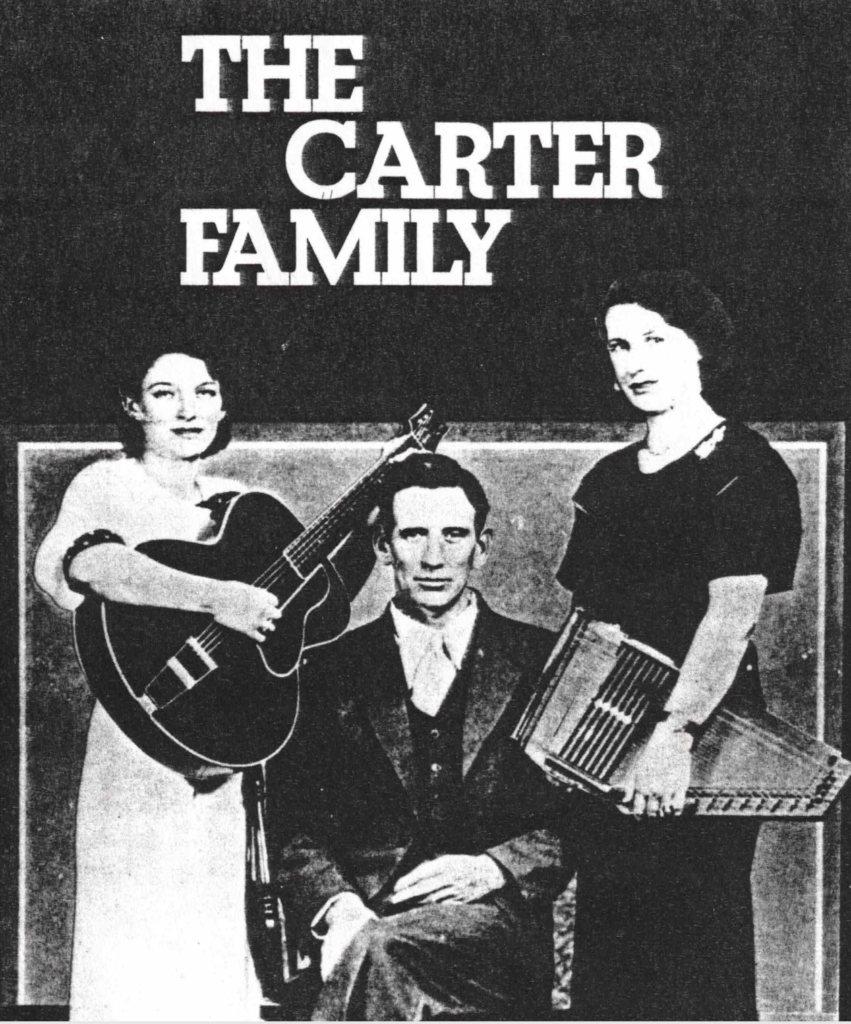
A.P. Carter came from an all-White part of Virginia; Black guitarist Leslie Riddle(s)[5] came from a part of North Carolina where the races fraternized extensively. 

[5] Often spelled “Riddles,” as folks from that region often add an s here and there.

A.P. would drive from Virginia to Tennessee to pick up his musician friend. Together they scoured the Appalachians, collecting songs from Black and White alike, Carter writing down the words and Riddle memorizing the tunes.[6] Carter’s easy friendship with Riddle and non-discrimination in his traveling habits was credited by his daughter Gladys to his being “partial to poor people.”

[6] One of Carter’s song sources was Riddles’ friend Brownie McGee,
the Black guitarist who played with harmonica player Sonny Terry.
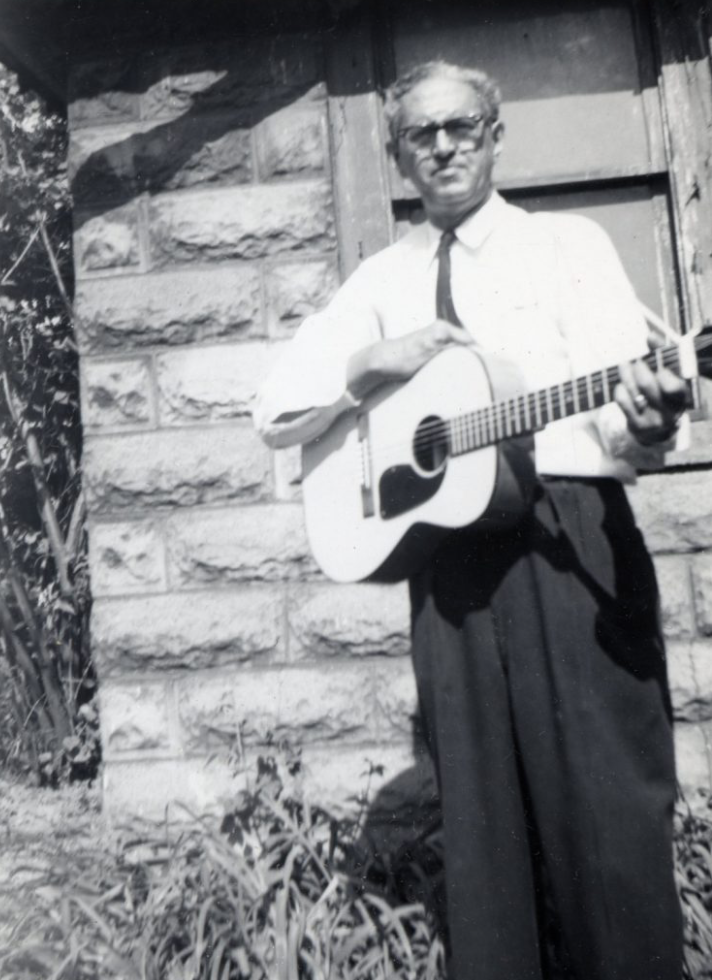
Leslie Riddles

Leslie Riddle’s music spanned the gamut of styles common to musicians in the Piedmont: ragtime, blues, ballads, religious tunes, pop tunes. He played at White and Black dances, mostly Black, throughout the twenties. Many of his tunes were transmitted to the Carters.

Riddle had lost half a leg on the job at a cement plant and received nothing in return, which conjures up the specter of numerous maimed and blind Black musicians who were disabled due to lack of health care or any societal caring for their sort. This drove many to music.[xxxiii] The Carters bought him a wooden replacement. Riddle later lost the two middle fingers of his picking hand in a mysterious gun incident, and had to retrain himself on guitar. 
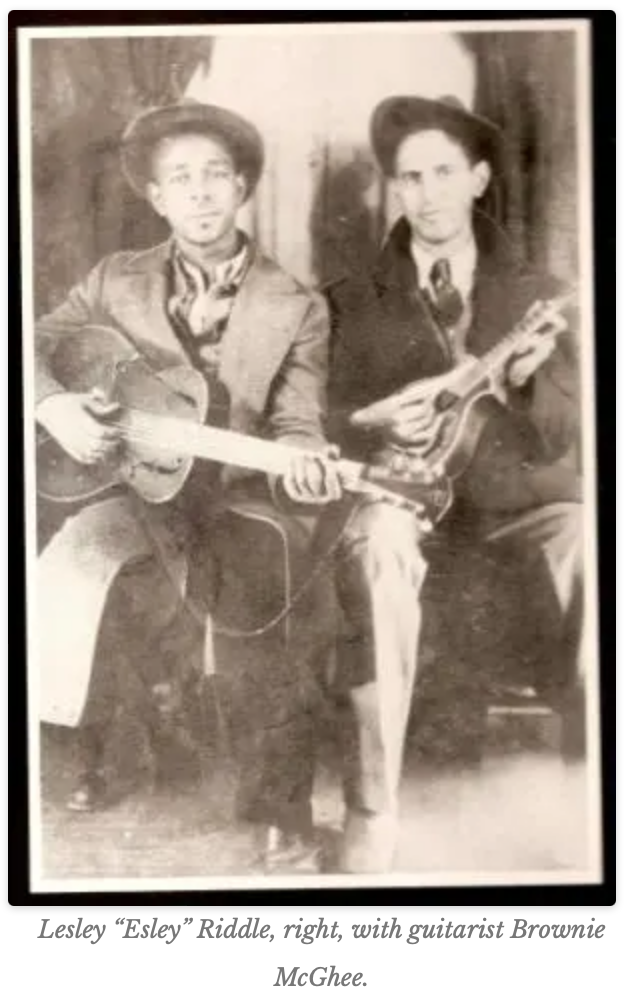
Riddle taught Maybelle Carter the melody guitar style associated with the blues, which complemented her more traditional White folk-based style. Prior to this, White folk guitarists rarely played melody, confining themselves to strumming. The playing of melody on the bass and middle strings and rhythm fills on the high ones was a banjo style, used also by Dock Boggs, who got it from Black players. Contrarily, playing melody on the high strings while picking out alternating bass patterns with the thumb was a ragtime approach she learned directly from Riddle.[xxxiv]

Maybelle on guitar, in front

Maybelle’s rhythm, influenced by old-time banjo style,

included, after the bass or melody note played on the down beat, a sharp downward brush stroke played with the back of the fingernail of the index or first finger, on the upbeat. Consequently, most Carter Family songs moved against a steady upbeat or “backbeat.”[xxxv]

The economic relationship between the partners was murky if not shady. Riddle seems never to have been directly paid for his part, and in those pre-commercial days it didn’t particularly occur to him to ask. But thinking back, he accused the Carters of duplicity: 

  He [A.P.] was learning, but I didn’t know it. They was learning. They’d have me play a song you know, and they’d listen to it. And then when I wasn’t around they’d practice on it, then when everybody’d turn their head, they’d go and make a record…They had more sense than I did, cause along then I didn’t have enough sense to get me nothing out of it…I didn’t get nary a penny out of it.[xxxvi]

He also didn’t get much respect from history; Riddle himself recorded only once. The important points, to my mind, are the enduring ignorance among Carter and Country fans of Riddle’s role or even his existence, and the overarching ignorance about the Black sources of Country music, including the Carters’. This in spite of repeated Blacknowledgements by such as Carter and Rodgers and many more. 

Riddle was, in fact, entirely forgotten until Maybelle told Mike Seeger about him in 1963. He had not owned a guitar for 18 years, but he now recorded and performed at festivals. He died of cigarettes in 1980, after final visits from the surviving Carters.

___________________________________
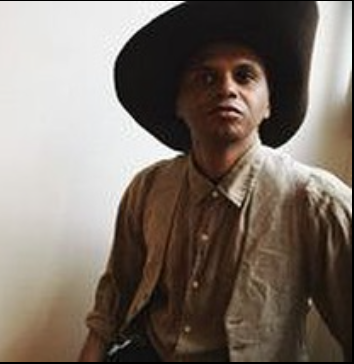
Rufus “Tee Tot” Payne

  The major figure in Country music’s next era was King Hiram “Hank” Williams of Alabama. The Baptist church provided his first musical enthusiasm, and he found his music teacher while shining shoes and selling peanuts at age twelve: an old Black street singer-guitarist named Rufus Payne, aka Tee-Tot, in Greenville, Alabama. Hank frequented the Black part of town, soaking up the blues. Fifteen years later in Montgomery he would recruit Black men to take him to the local Black singers, and his audience included a significant segment of American Americans.[xxxvii]

Hank Williams, “Hey Good Lookin'”

♬SUBSTITUTION: Bill Malone suggests we give a listen to John Dudley, a Black prisoner in the Mississippi Penitentiary (Parchman), to hear a yodeling style similar to Hank’s.[xxxvii]

JOHN DUDLEY, “COOL DRINK OF WATER” 1959

  Hank played the honky-tonks,[7] a southern and southwestern bar scene that produced western swing and all manner of polycultural southern music. His live honky-tonk music had more blues and swing in it than what he recorded or played at the Opry.[xxxix],[8] His career was at a peak in 1953 when he died, 29 years old, of alcohol and pills taken for the pain from a congenital spinal defect that wasn’t treated at birth because his family was dirt poor. At his funeral, African-Americans filled the balcony, and a Black gospel quartet sang.[xl]

[7] Named after the turn of the century Black bars in New Orleans called tonks.

[8] As you proceed through this list of White musicians naming their Black inspirations,
recall that in 1828 Daddy Rice met a Black man dancing for his own entertainment,
and that man’s style became the main attraction in Rice’s and later minstrels’ acts. 

___________________________________

THE HAWAIIAN CONNECTION

In 1916, more Hawaiian records were sold in the U.S. than of any other kind of music. Jimmie Rodgers at one point played ukulele in a Hawaiian band. Rodgers’ back-up guitarist, Cliff Carlisle, played a steel-bodied guitar flat on his lap in a bluesy style that can be heard today from the bluegrass Dobro.[xli] Military and missionary music, along with sailors’ tunes from Portugal,[9] had been imported into Hawaii, and the islanders developed their own styles based on the influx of influences. Their penchant for slide guitar was then incorporated into Country music with the development of the Dobro, and later the pedal steel guitar. (Black southerners had already played homemade slide instruments, even slide banjo.[xlii] In fact, they used to slide a bottle on a wire strung on the side of a barn.[10] This “diddly-bow” was an African retention.)[xliii]

[9] There is even a Hawaiian-Brazilian connection, by way of the Portuguese.
Imagine a samba rhythm and some percussion laying over the top
of a mellow Hawaiian slide guitar tune.

[10] Watch Lonnie Pitchford play the side of a house
on “Johnny Stole an Apple” in the film Deep Blues.

Sol Hoopi, 1943

Joseph Kekuku fretted the guitar with a comb, and first recorded the style in 1909; steel guitar star Sol Hoopii worked in Los Angeles through the twenties and thirties, playing a mix of Country, jazz and Hawaiian traditional music and evolving several tunings; his favorite one became the standard for pedal steel guitars in Nashville. In the forties, many Country players—including Jimmy Helms, who played with Hank Williams—lifted their solos note for note from Hoopii’s records.[xliv]

___________________________________

  We now arrive at the question of guitar picking style, and an important innovator whose name is well known among scholars and selected guitar geeks, but not elsewhere.

___________________________________

ARNOLD SHULTZ

In the Green River region of western Kentucky, centered around Muhlenberg and Ohio counties, veterans of the revolutionary war were given free land; they brought with them “free” labor, a few enslaved folks per family. Matthias Shultz was one of the veterans, and his captives received his name. A hundred years later, a child was born to the last “Shultz” to live in slavery; he would make his mark on, if not in, music. 
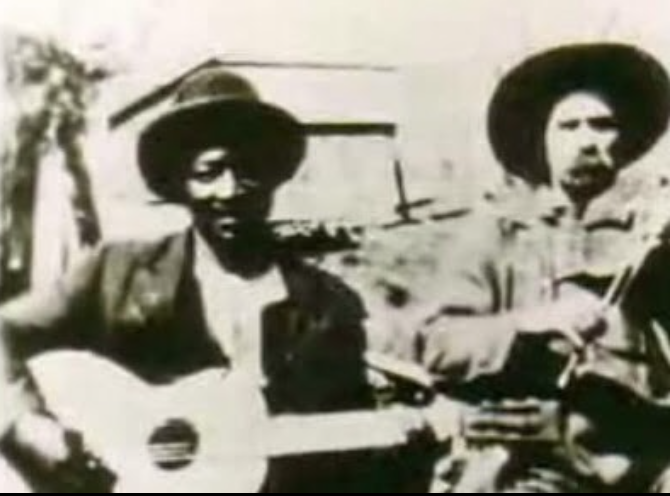
Arnold Shultz grew up playing music with his family, mostly for square dances. He began playing guitar in 1900, at age 14, and developed a thumb-style approach described by Robert Cantwell as syncopated melody, a steady, damped bass heavily accented, walking bass runs, melodic ornaments, a swinging or bouncing tempo, and, in contrast to other Country styles, sophisticated chording up the neck of the guitar, with all the strings stopped.[xlv]

After the Civil War, formerly enslaved laborers had become farmers and stevedores, and later, miners. In isolated roadless mountain areas, Blacks and Whites got along, relatively, and made music together. Arnold Shultz walked the railroad tracks of this area from around 1918 to 1931, jamming with Black and White string band players. They played hillbilly music for sure, but also blues and rags and gospel and just American music generally. Shultz also played on riverboats, and picked up a lot of styles traveling to the cities outside the immediate region; the Green River connects to the Mississippi via the Ohio, carrying outside influences including musical ones. Shultz brought them and taught them.[xlvi]
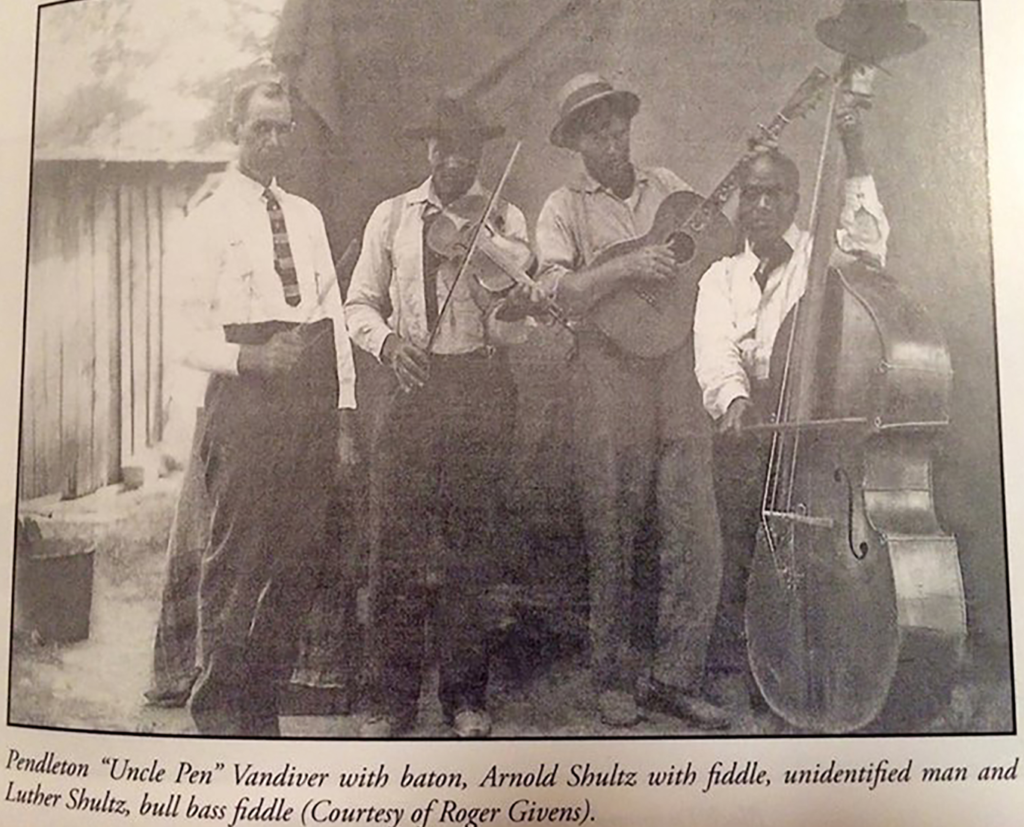
Racial interaction took many forms. One of Shultz’ playing partners was Clarence Wilson, a respected clawhammer banjo player. They had a group with a fiddler named Pendleton Vandiver—Bill Monroe’s uncle. Wilson’s daughter Flossie remembered a picnic thrown by the Black community for the Whites, at which Shultz played. It seems that Arnold broke down many racial barriers in Kentucky through the strength of his musicianship—but not all of them. Flossie says he always waited to eat till the Whites were finished.[xlvii]

One of the folks impressed by Arnold was Ike Everly, father of the Brothers. Ike’s father paid Arnold to teach Ike’s sister a guitar piece, and Ike was fascinated by Arnold’s ragtime style. Another student was Tex Atchison, who heard Shultz in a swing band in which he was the sole Black member. Atchison later replaced him in that outfit, before moving on to the Prairie Ramblers. He defined one of Shultz’s innovations:

He was the first…to play the lead and his own rhythm at the same time.[xlviii]

The bandleader, Forrest “Boots” Faught, concurred:

Yessir! Arnold was the only man I ever saw do it back in them days [1918]…And people were amazed: “Looky there—that man’s leadin’ that music on that guitar and playin’ his own accompaniment!'”[xlix]

Shultz also broke the gang out of their back-country three-chord prison, teaching them about passing chords: 

Arnold Shultz says, “Throw that A in there!” And we’d start puttin that A in, and he’d say, “See how much better it sounded?”[l]

In 1920 a White guitar picker named Kennedy Jones was so impressed with Shultz’ thumb-picked style that he bought a box of thumb picks and gave them away to every guitar picker he met. This remarkable new technology spread the style through the Green River valley in a New York minute. But most directly, Shultz taught Jones, who taught 14 year-old Mose Rager on a porch in 1925.[li] Rager played with Ike Everly in the thirties. He glued together the styles of Kennedy Jones, Arnold Shultz and others, and taught it all to Merle Travis; Chet Atkins heard Travis on the radio at age 16, and it made his day. This is a piece of the story that helps explain why modern Country music is possessed of a distinctively jazzy, bluesy demeanor. 

Arnold Shultz died at 45 in 1931, maybe poisoned, maybe not. Like Buddy Bolden, he was never recorded. The brilliant Merle Travis took his legacy to the outside world in 1936. 

___________________________________

Merle Travis, “Midnight Special” 1968

  Guitar Stuff: Travis picking, as it is generally known, has a strong ragtime component, and features an alternating thumb-picked bass on the first and third beat. In between these beats come lighter beats, played by the thumb across the chord, tempering the traditional stiffness with a danceable bounce. All this on the bass, which is made more percussive by damping it with the heel of the hand, lightening the chokehold on the off-beats for greater bounce. Meanwhile, a melody is fingered on the high strings. As noted above, the player finds complex chords all over the neck, and applies the style to any type of music that gets in the way. As Eubie Blake said, “That’s your ragtime.” 

  Travis picking came to be the dominant guitar style in Country music. It came from the coal-mines of Kentucky, via coal-loads of players influenced by our man Arnold, and was perfected by Rager and Travis. But it had deeper roots: the thumb is imitating the bass notes in stride or ragtime piano, while the melody is fingered in a duplication of the piano’s right hand. 

♬substitution: Listen to Travis or Atkins, followed by Jelly Roll Morton on piano or stride players like James P. Johnson or Fats Waller.

  I played my primitive version of this style for years without even knowing it—I simply absorbed the feeling and found my own way of making the rhythms. It expressed my own multicultural (Country, jazz, blues, rock) heritage. I was a Shultz-Travis baby picker without even trying—and for the same reason: when you play alone, you have to play all the parts for the whole band. A middle class White boy from Seattle has roots in Muhlenberg County, Kentucky, and I’m grateful to Kennedy Jones for buying that box of thumb-picks.

  Fancy picker Chet Atkins, the Country Gentleman himself, said he was raised on “a stack of records, half white and half black.” The traveling musicians of earlier times had been replaced by radio and records as the methods of cultural interpenetration. Atkins’ demigods included Belgian “Gypsy jazz” guitarist Django Reinhardt, who was also favored by Chet’s backup artists, Homer and Jethro.[lii]

♬substitution: In 1946 Atkins recorded “Guitar Blues,” with a fancy arrangement including clarinet. He did the substitution for us.

Doc Watson, “Deep River Blues”

  Another superb Country and folk picker, Arthel “Doc” Watson from Deep Gap, North Carolina, played with tremendous swing, and professed a great love for the blues. He played swing, rockabilly, and honky-tonk guitar before becoming a folk idol. Referring to Furry Lewis and Mississippi John Hurt, he said that “Somehow, I never could get the soul in my guitar picking that they do.”[liii]

  Then there was the curious case of Jimmie Davis, who wrote and sang “You Are My Sunshine,” which helped him become Governor of Louisiana in the forties and again in the sixties. He was White, need we note. But he recorded with Blacks, including the all-Black Louisville Jug Band, and in his campaigns he was often charged with race-mixing.[11] Davis’ notable recordings in 1932 included “Red Nightgown Blues” and “Yo Yo Mama.”

[11] Back in 1924, former Governor Taylor of Tennessee had recorded
a “negro spiritual” with his quartet. (Archie Green 1965, 217)

  The interaction between Black and White music in the South had been going on for many generations before recording technology appeared, and the individual modern-day stories recounted here have their counterparts, more sparsely documented, in earlier times. The style of White players hasn’t been “pure European” for over two hundred years. And the developments among Black musicians of the last century have long since spread to White musicians; the blues and rags that Country musicians play are the best examples. 

  With the big migrations to the northern and western cities, Blacks moved on to urban music, nursing little of the nostalgia for a simpler rural life that many Whites tended to indulge in. Rock and roll was, indirectly, a result of White folk music’s failure to move with the times: Country music, although it evolved and interacted with other musics, came to idealize the old country ways, both in word and in sound. But for next-gen White youth, country and pop were superseded by a grittier, more urban, more Afro-American music. Rock and roll was a result of Black urbanization; its White variants were able to evolve in tandem with Black urban music, intersecting and cross-pollinating frequently over the years and through all the crises of modern urban race relations.

  Over time, stylistic cross-influences continue to proliferate, through recorded media and live interaction of players from various traditions, and Country music continues to be pulled over towards the Black lane. There are a multitude of crossover tunes that start in one chart and rebound into another.[liv] On “New Country” stations, a more Country-rock sort of beat is heard. Nashville session players are forever spilling over if not jumping ship into jazz. Alt-Country folks aren’t too fond of the slick Nashville style, and combine their roots in swing, blues, soul and gospel. The beat goes on.
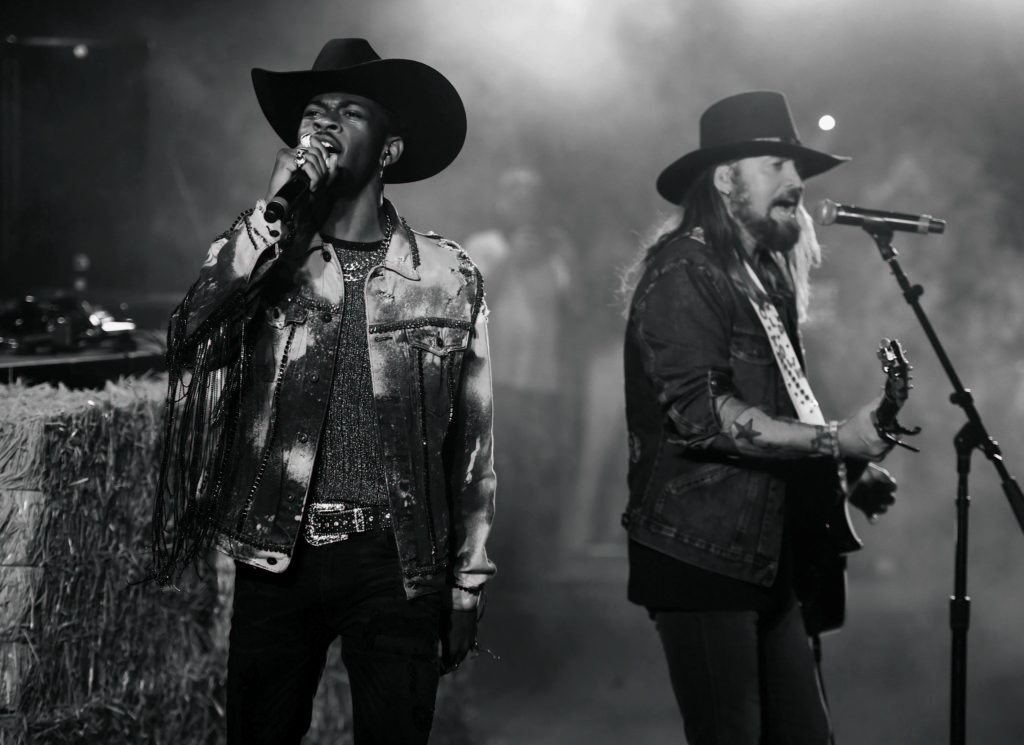
Lil Nas X and Billy Ray Cyrus

On the flip side is a stylistic adventure pursued by Black artists blending Country and Hip-Hop, like Lil Nas X (Old Town Road) and Blanco Brown (The Git Up), running parallel to the emergence of a generation of Black Country artists like Mickey Guyton, Kane Brown,  Jimmie Allen,  Brittney Spencer, and Willie Jones—all upending the mirage of Country as an exclusively hite zone, then or now.         

Willie Jones – This song got a standing O at the Grand Ole Opry.

Black musicians certainly do, as noted, take on White influences. Most of the forms they use are of European origin. As Barry O’Connell described the interaction, “influences moved both ways, crossing, doubling on each other, reinforcing, and playing back.”[lv] That said, from its roots to the present, Black folk musical style tends to transform the European-based forms, to pull other styles toward it because it is rhythmically (a) more sophisticated and (b) less stiff, more fluid.[12] These are two things a musician leans toward eventually, and a lot of civilians do too. Listen to several versions of the fiddle classic “Orange Blossom Special” and note the rhythmic tricks the soloists (and also the rhythm section) resort to when they tire of playing it straight. They make it Mean a Thing!

[12] Listen, for several examples, to Rhythm, Country and Blues (see Discography).
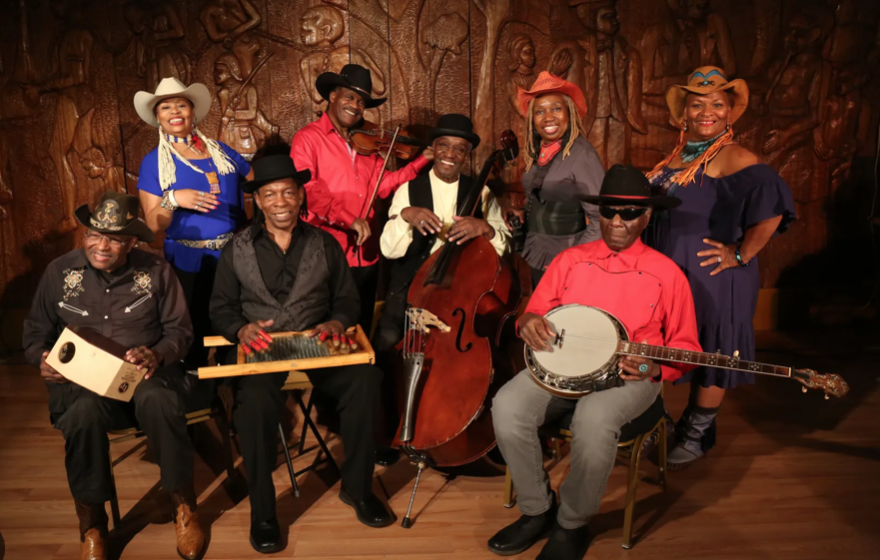
Country musicians, 21st C.

[i] Conway 1995, 138, 145.
[ii] Archie Green 1965, 214.
[iii] Robert S. Jamieson in Wolfe, 1989.
[iv] Johnson, JEMF, 1981, 77.[v] Russell, 67.
[vi] Abbott and Seroff, op. cit.., 5-8.
[vii] Tosches 1996, 112.
[viii] https://www.youtube.com/watch?v=_-s-1nKQGNY, accessed 2-15-23
[ix] Niles, Edward Abbe, “Ballads, Songs and Snatches,” column in The Bookman, 1928.
[x] Wolfe, “A Lighter Shade of Blue: White Country Blues,” in Cohn 1993, 251.
[xi] Niles, op. cit., September 1928.
[xii] Douglas Green, 1976, 55.
[xiii] Fry, Macon, “Aaron Neville,” Wavelength, May 1985, 22.
[xiv] Wolfe, Charles, in Cohn, op. cit., p 233-37.
[xv] Wolfe, op. cit.., 262.
[xvi] Douglas Green, 1976, 50.
[xvii] Lightfoot 2003, 187.
[xviii] Cantwell, 79.
[xix] Wolfe, op. cit.., 242.
[xx] Clarke, 145-56.
[xxi] Malone 1968, 22.
[xxii] John Cohen, 1964.
[xxiii] Russell, 51.
[xxiv] Daniel 1990, 7.
[xxv] Lipsitz 1994, 312.
[xxvi] Cantwell, 52.
[xxvii] Norman Cohen 1969, 235-36.
[xxviii] Cohen, Norm, “Early Pioneers,” in Malone and McCulloh, 1975, 33.
[xxix] Schlappi 1978, 28-30, 107.
[xxx] Archie Green 1965, 217.
[xxxi] Winans, Robert, “The Folk, the Stage, and the Five-String Banjo in the Nineteenth Century,” Journal of American Folklore 89(1976),407-37. 
[xxxii] Niles, Introduction and notes, in Handy, 1972, 17.
[xxxiii] As noted by O’Connell in his monograph.
[xxxiv] Lightfoot 2003, 181.
[xxxv] Cantwell, 56.
[xxxvi] Interview with Mike Seeger, quoted in O’Connell, 9.
[xxxvii] Flippo, 21-23, 50, 70.
[xxxviii] Malone 1968, 233. Dudley is heard on The Blues Roll On, Atlantic Records, No. 1352, good luck.
[xxxix] Bane, 87.
[xl] Perry, 78.
[xli] Douglas Green, 1976, 55-57.
[xlii] Spottswood, Richard, liner notes for The Slide Guitar: Bottles, Knives and Steel, Columbia Roots and Blues Series, 1990.
[xliii] Titon, 45.
[xliv] Uncredited liner notes from Sol Hoopii: The Master of the Hawaiian Guitar, Rounder, 1977,1991, and Obrecht, Jas, “Slide Routes: The Honolulu-Hollywood Connection,” Guitar Player, August 1994, 94.
[xlv] Cantwell, 31.
[xlvi] This section is drawn from Lightfoot, “A Regional Musical Style: The Legacy of Arnold Shultz,” and Lawrence, “Arnold Shultz: Godfather of Bluegrass?”
[xlvii] Lawrence, JEMF, 7.
[xlviii] quoted in Lightfoot, 132.
[xlix] Lightfoot, 132.
[l] Lightfoot, 132.
[li] Lawrence, Bluegrass Unlimited, 41.
[lii] Kienzle, 46.
[liii] Bane, 82.
[liv] See Francis, Billboard, for a number of examples from 1995.
[lv] O’Connell, 30.
Crooners And Their Sweet Inspirations

  With jazz out of the running for America’s popular music, the forties gave rise to new mainstream blends, some would say blands: The Andrews Sisters, Crosby, Como, and Sinatra; Doris Day and Dinah Shore; and so many more. The remarkable and forgotten thing about all these icons of middle America is that they all started out singing jazz. So what happened? 

Perry Como & Martha Stewart, Dig You Later, 1945

  Most of the top singers of the forties had begun by singing in big bands, which were all swing-propelled to varying degrees. The bands folded and singers became stars. The choice of styles and instrumentation was now increasingly dictated by the recording industry—the arranger hired by the record company, not the arranger hired by the swing band. Meanwhile, new entertainment media reached new audiences, dictating new styles. Reality bites, demographics rule: bigger means Whiter.

  The surrounding social environment had its effect too. The forties and early fifties were a period of militant social and racial denial in White America; “The American Way” was held to be democracy and opportunity, but the lack of either one for the underclasses was given little thought. And there was music to match the ideology. 

  In a short while the country would get back to Black, turning once again to African-Americans for song and dance. This time it would be an urban update of the blues: the nation would now get its R&R from R&B. But in the meantime, the youth had come home from the war, had babies, and switched on the TV. Dancing was out. Besides, it had become too expensive for big bands to tour. And music was now dominated by recordings, not live shows, which meant personalities, which meant singers.

  The popular music industry built a roster of White singers who resonated with White audiences, in an idiom and style that concealed their Black influences. Pop music had long since absorbed jazz and diluted it. But at what point does the dilution obliterate all trace of the original? That depends on how closely you listen. 

Bille Holiday

  Listen to Billie Holiday. She sings behind and around the beat, full of blues and personal and caste angst. Frank Sinatra, the “singer’s singer,” said that Billie Holiday had the greatest influence on him of any singer.[1] (He was also influenced by Tommy Dorsey toward a sweeter, lighter sound.) The White crooners who came to prominence with and after Sinatra are not generally thought of as jazz singers, yet without jazz they wouldn’t have had that swing, and would mean very little to anyone. 

[1] Here’s one lyric as it ran before the music industry cleaned it up for Sinatra and Peggy Lee:
Basin Street is the street  
Where the dark and the light folks meet.

  Sinatra is famous for “The Voice,” but also for making the song his own, through personalized phrasing, stretching the lyrics across and against artificial, square, four-beat divisions—in other words, jazz. He was a huge fan of Billie. In 1944, Holiday told columnist Earl Wilson that she’d offered Sinatra advice on his singing. ‘‘I told him certain notes at the end he could bend. … Bending those notes — that’s all I helped Frankie with.’’ Sinatra made no secret of his debt to Holiday: ‘‘It is Billie Holiday … who was, and still remains, the greatest single musical influence on me,’’ he said in 1958.[ii]

As Peggy Lee, the jazziest of this group said, “I really have no sense of time except swing time.” 

  Another Holiday acolyte was Dinah Shore, who grew up with a Black nursemaid who took her to a Black church, where she found the singing “electrifying.” Not too many Whites have ever gone to Black churches (recall, however, Stephen Foster, and mixed southern camp meetings), but today they don’t really need to. The music has spilled out the door and flowed across town and is in the house.

  Billie was also a strong influence on Judy Garland, who was partial to the bluesy compositions of Harold Arlen, though she gained fame by going Over his Rainbow, in a smoother, lusher style. 

  Dinah Shore was a brunette who started out singing blues, but for the movies she bleached both her hair and her style. Shore was Jewish, as were Barbra Streisand and Mel Tormé. Tormé —the name was an immigration processing error—reflected,

I wanted to be a jazz-oriented singer—I don’t know what a jazz singer is, since all good popular singers are jazz-influenced.[iii]

Sinatra, Tony Bennett and Vic Damone were Italian,[2] another ethnic group that, like the Jews, had suffered from being “not quite White.” They learned to pass.

[2] Most of them changed their names: Tony Bennett from Anthony Dominic Benedetto, Dean Martin from Dino Crocetti, Vic Damone from Vito Rocco Farinola, Frankie Lane from Frank Paul LoVecchio. They were thought of as American, but not also as Italian
– a loss to our collective understanding of our own culture.

  Back to Billie: Lady Day may have led the way for many vocalists, but they didn’t have to follow her down Jim Crow Lane. [3] When she sang in the South with mixed bands, Black and White musicians had to stay at different hotels. And when she sang with Count Basie, Billie herself was too mixed: in Detroit, the theater managers told her she was “too yellow to sing with all those black men.”[iii]

3] Columbia Records wouldn’t issue Billie’s lynching ballad “Strange Fruit,” however; they released her from her contract for the one tune, and it was brought out by a smaller label. (Clarke, 246.)

___________________________________

THE ANDREWS SISTERS

The Andrews Sisters were smooth, yet jazzy, being direct musical descendants of the Boswells. Their first hit, 1937’s “Bei Mir Bist Du Schoen,”[4] sold a million. What an odd song for a gentile trio from Minneapolis. Actually, the lyricist who wrote the English words, Sammy Cahn, had just heard it sung, in Yiddish, by two Black men to a Black audience at the Apollo.[iv] It was procured for the Minnesotans by singer Maxene Andrews’ husband, music publisher Lou Levy. Fair enough.[v] Levy was a “hep cat,” as was Maxene, but Lou advised the act not to record jazz—”It isn’t commercial.”[vi]

[4] Actually a German version of the original Yiddish, “Bay mir bistu sheyn.”

Andrews Sisters, “Give Me Some Skin, My Friend”

The Sisters’ next big hit was “Rum and Coca Cola,” an import from Trinidad. It was beginning to seem like the public had a taste for the exotic. In the forties they proceeded through a series of Boogie-Woogie hits: “Rhum-Boogie”; “Scrub Me, Mama, With a Boogie Beat”; “Beat Me, Daddy, Eight to the Bar”; and “Boogie Woogie Bugle Boy of Company B.”

The Andrews appeared in a film called Syncopation in 1942, along with seven big bands, including Harry James, Benny Goodman, Charlie Barnet, Gene Krupa, Joe Venuti—in other words, all the top bands, except the Black ones. They became famous for their extensive USO tours during World War II, playing for White soldiers. To their regret, White entertainers did not play for Black soldiers, though the other way around was common. 

The Sisters recorded with Les Paul, master over-dubber and multi-style guitarist, and with Danny Kaye, Carmen Miranda, Bing Crosby—all of whom also waxed with the Boswells—and Guy Lombardo. Their music is not thought of as jazz, and it isn’t. But listen. It’s in there. The influence of Black culture on this act is perhaps best expressed by the promotional graphic reproduced next to the Table of Contents, and by this verse from their wartime version of “Hot Time”:

They’re going to start a row and show ’em how          
We paint the town back in Michigan          
They’re going to take a hike through Hitler’s Reich           
And change that “Heil” to “Gimme some skin.”[vii]

___________________________________

  Doc Haines, a bandleader in Valley City, North Dakota, called young Norma Dolores Engstrom his “little blues singer.”[viii] She became Peggy Lee and came up through the band of Benny Goodman, with whom she enjoyed attending many Fats Waller shows. Louis Armstrong and Maxine Sullivan were her inspirations. Like Jo Stafford, who came out of Tommy Dorsey’s band, she took the swing along with her to the next era. “Actually, I didn’t intend to be a jazz singer, but jazzmen say that’s what I am,” said Lee. Count Basie once asked, “Are you sure you don’t have a little spade in you, Peggy?”[ix] A serviceman stationed overseas was startled when he met her—from her records, he thought she was Black.[x]

Bing Crosby, “Try a Little Tenderness”, 1933

  Bing Crosby also credited Satchmo as a formative influence on his style. Bing started out a lot more syncopated than he ended up, jazzing up Paul Whiteman’s band from 1926-30. In fact, a theater owner once demoted Crosby to a lower-profile role in Whiteman’s band for being too jazzy. So it came to pass that, like so many others, Bing toned the jazz down till you couldn’t hear it anymore. The record industry later employed his talents to water down blues and country tunes that were surging into popularity—for instance, Louis Jordan’s “Is You Is or Is You Ain’t My Baby.” 

Otis Redding, “Try a Little Tenderness”, 1967

  Have a look at Bing’s 1941 flic, “Birth of the Blues,” in which he retells the story of Dixieland Jazz being popularized—in this version, by a White band. All the minstrelsy still prevalent in that era is on offer, including the obsequious janitor (played by Eddie “Rochester” Anderson) who teaches young Mary Martin to swing. In a Johnny Mercer song, the film credits the origins of the music to three avatars: “The Waiter and The Porter and The Upstairs Maid.” This was not code for Italians. Though the film focused on a White band, at least they didn’t claim to have invented jazz, as did the “Original” Dixieland boys. In a telling bit of dialogue and a foreshadowing of Elvis, Mary Martin reminds Bing that a musician named “Memphis” is “the only White cornet player that can play your blue music.”

  Which brings us to Doris Day, born Doris von Kappelhoff. She too rose to fame singing in a big band—i.e., swing—but she came to personify the mainstream culture as it reasserted its Whiteness. Day’s solo career was largely a construct of record man Mitch Miller, who also made Tony Bennett and Johnny Mathis household names.[xi] Her story reminds me of Elvis Presley’s journey from rhythm and blues rebel to denatured pap star, manipulated by a cynical manager and industry that wrung every last dollar out of him and destroyed the music in the process. It sets me to wondering what might have been, in so many cases, if musicians had been able to follow that dream instead of the money. 

♬substitution: Doris Day’s records use a lot of big band arrangements, sometimes even hot solos, but her singing pulls them into the slow lane. Press play on her tracks and insert your version of Billie Holiday’s phrasing. You can do it; no one’s listening.

  Speaking of money, it seems that under Mitch Miller, head of A&R and therefore possessed of a certain influence, 95 percent of the tunes recorded by Columbia were registered with ASCAP. Neither Miller nor ASCAP were fans of jazz or R&B; recall that ASCAP had restricted songwriters’ access to the industry to the Tin Pan Alley gang, and any other writers reached the airwaves mainly through ASCAP’s new rival, BMI. No less than Frank Sinatra complained that Miller fed him rancid tunes.[xii]

  A corporate drive for profit dictated what got recorded, distributed, purchased, and perhaps appreciated. The nation was, unwittingly, singing along with Mitch. And over on the rock and roll side, the development of the Top 40 format was a money move designed to maximize profits by releasing fewer records and pumping them repeatedly—just like the advertising of any other product. It had the ultimate effect of homogenizing tastes and quarantining “minority” styles in their own charts, radio stations, and fan bases.

  And yet Black styles continued to percolate through, albeit often without recognition as such. In the later wave of African American northward migration, the blues got amplified and generally charged up—“They shouted and declared instead of crying and moaning,” as one critic had it.[xiii] And the White crooners made a similar move: “I’m not a crooner,” said Frankie Laine, “I’m a singer who shouts.”[xiiv] Thus did the crooners become the belters.

  With regard to the general Whitening of popular music, it is also worth considering the cultural effect of the United States’ emergence from World War II as the dominant world power. White flight from redlined Black inner cities fueled the growth of the suburbs, and the “Greatest Country on Earth” ideology was bolstered by a blinkered view of America that looked mainly at its White, suburban, comfortable sector. People drove their Chevies to the levees and ignored those who had built either one, especially the levees. An honest look at the class and racial caste system was clearly no longer in order; a bleached cultural image served as a cocoon to shelter the comfortable from the afflicted.


[i] Balliett, 150.
[ii]Frank Sinatra and Billie Holiday: They Did It Their Way, https://www.nytimes.com/2015/10/19/t-magazine/frank-sinatra-and-billie-holiday-bond.html
[iii] Crow, 133.
[iv] Ewen, 285.
[v] Andrews, 20.
[vi] Andrews, 162.
[vii] Andrews, 208.
[viii] Lee, 61.
[ix] Lee, 12.
[x] Lee, 140.
[xi] Ewen, 458.
[xii] Clarke, 400.
[xiii] Shaw, 1979, BM6.
[xiv] loc. cit.

Broadway, Part Two: The Great White Way

  In the forties, as jazz accelerated in several directions, an interesting thing happened to Broadway musicals. The European thread of the music, operetta, came to the fore and virtually buried jazz. Beginning with Oklahoma in 1943, composers relegated the African‑based syncopation, swinging rhythms, blue notes, and other elements of jazz to a very few tunes in each score. Why? 

  The Depression had destroyed lives and livelihoods. It destroyed Harlem—the Renaissance petered out. It also diminished Broadway: there was no money to mount extravagant productions. The writers fled to Hollywood, where they wrote for much larger audiences, including rural folks and people from towns and cities with a less diverse cultural environment. The search for a common musical language for that size of audience led towards a more European-American sound. 

  Yes, swing had been the thing for America, but not necessarily for all of America. A lot of those folks out there away from the coasts were about to make their presence felt, thanks to new media and big-thinking corporate entertainment. Le Jazz, Not. By the forties, with writers and composers commuting between Broadway and Hollywood, and with recordings and radio replacing sheet music, popular music took a turn to the White: America was bleaching its roots. 

  Richard Rodgers began working with lyricist Oscar Hammerstein, and together they hammered the jazz out of show tunes in a series of major productions, including Oklaho-ma (1943), Carousel (1945), South Pacific (1949), The King and I (1950), and the gloriously/notoriously syrupy Sound of Music (1959). The songs endure: “Oh, What a Beautiful Morning,” “People Will Say We’re In Love,” “Some Enchanted Evening,” “I Enjoy Being a Girl,” and “Surrey With the Fringe on Top.” 

Camelot, 1960

  The other top writing team of the era did likewise: composer Frederick Loewe, another Viennese, along with lyricist Alan Jay Lerner, wrote Brigadoon (1947), My Fair Lady (1956), and Camelot (1960). This was the classic period of great Broadway songwriting, done in a more European style that shuffled Black culture into a corner to wait for more propitious times. It was the defining moment of a mass culture, for better or whatever.

Julie Andrews, “Wouldn’t it be Loverly,” My Fair Lady

  There were exceptions to the trend: some of the older writers continued in a jazz-based, dance-oriented style, including Berlin (Annie Get Your Gun, 1946) and Porter (Kiss Me Kate, 1948; Can-Can, 1953; Silk Stockings, 1955). Eventually jazz influence resurfaced in Leonard Bernstein’s West Side Story (1957) and swing-derived works like Frank Loesser’s Guys & Dolls and Jule Stein’s Gypsy. Later the backbeat would come back to Broadway in a big way, as the Rock Musical, and eventually, Hamilton. But in regard to what is generally considered the peak period for show tunes, my friend from the Introduction (“There isn’t any relationship”) was basically right: Broadway and Jazz Alley didn’t even intersect.

Swing And Its Kings

  In the thirties, the swing bands of Count Basie, Duke Ellington, the Dorseys, Benny Goodman et al took over from what became known retroactively as “classic jazz.” The bands were bigger, and they read arrangements from sheet music, while retaining improvised solos. The texture of the music was lush and smooth after the frenetic stomp of New Orleans jazz, with even stress on all four beats replacing the jumpier emphasis on the one and three. Swing bands featured sections of brass and reeds calling and responding en masse, and playing short repeated riffs under the solos. Gradually, singers were brought to the fore. Above all, swing was really made by the behind-the-scenes musical arrangers, which led to some interesting Black and White relationships.

  Swing was the style that brought Whites closer to jazz than any other form before or since. It was the popular music of the late thirties and early forties, which is something that merits a session with the music microscope. Some credit this popularity to the growth of radio and the recording industry, which forced the record companies to modify the music to make it palatable to larger audiences. It was easy for Whites to embrace swing because it was a smoother version of the original rough stuff. That’s no different from the route any other form of folk music has taken into the popular embrace, but it’s interesting that it took place during the Depression, which was a period of increased interracial cooperation in some quarters. 

  Let’s look at some of the principals who schooled a nation. 

  Duke Ellington had one of the most remarkable careers in popular music history. It went on forever. Playing as he often did to all-White audiences in Harlem, it didn’t hurt to have a White manager, although it might have hurt that Irving Mills took forty percent of the Duke’s fees, including composition royalties. Mills did write some lyrics, though not as many as he was paid for. In fact, Duke sideman Louis Metcalf claimed that under the band’s early contract, any and all new compositions had to be sold to Mills for twenty-five dollars.[i] Adam Clayton Powell likened it to sharecropping. But Mills did get Ellington the Cotton Club gig and many more, including clubs that had never had a Black band and didn’t want one, and railroad cars to travel and sleep in so they wouldn’t have to find the one Black hotel, at most, in each town. Ellington stayed with Mills till 1939.

From the 1948 film “A Song Is Born,” Lionel Hampton teaches Professor Magenbruch (Benny Goodman) a thing or two about jazz.

  And then there was Benny Goodman, the King of Swing. That was hype, of course, which wouldn’t have mattered except that it relegated the likes of Duke Ellington and Count Basie to lower echelons of the royal court. Goodman’s main Black musical arranger was Fletcher Henderson. He could have been called the Grand Vizier of Swing, but no one called him that because his work for the clarinetist wasn’t well advertised: the general public enjoyed the music without knowing who really made it. When John Hammond first approached Goodman about teaming with Black musicians on record, he replied “John, you know I worship these guys, but if I play with Negro musicians I’ll never get another job on the radio.”[ii]

____________________________________

JOHN HAMMOND

A single visionary from the recording industry “discovered,” recorded, and steered the careers of Billie Holiday, Aretha Franklin, Bob Dylan, Bruce Springsteen and Stevie Ray Vaughan. John Hammond put Benny Goodman on a Bessie Smith record, then brought Goodman together with Teddy Wilson to create the first integrated swing band. He also matched Goodman with Fletcher Henderson and Billie Holiday.[1] Hammond brought Billie to Basie’s band, which connected her to Lester Young, with whom she made her most important music.

[1] Holiday’s dad Clarence had played guitar with Fletcher Henderson,
who had also arranged for Goodman.

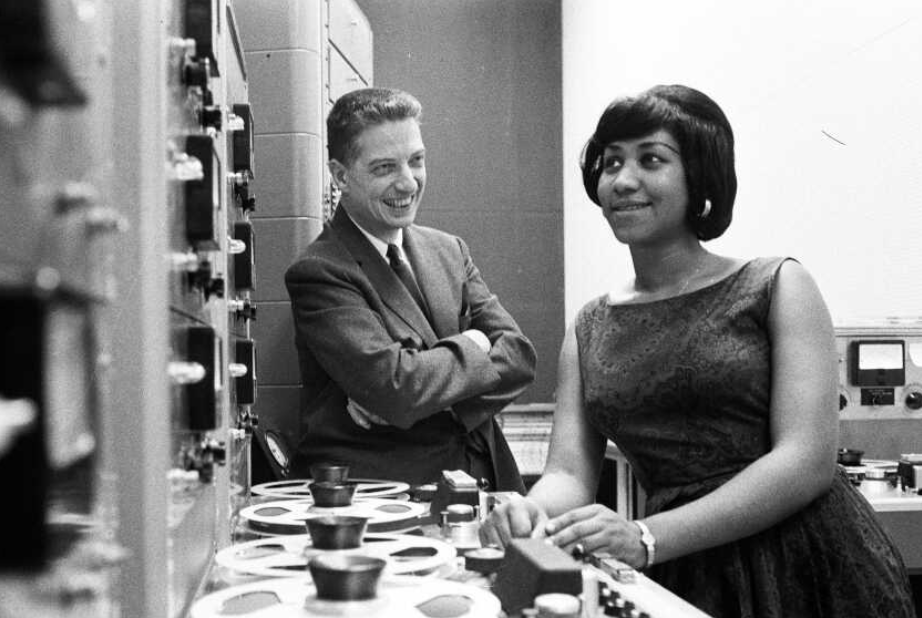
John Hammond with Aretha Franklin

Hammond organized the “Spirituals to Swing” concerts at Carnegie Hall in 1938-39. They opened with West African music and swept through American spirituals to swing and the blues. Performers included Count Basie, Joe Turner, James Rushing, Helen Humes, Big Bill Broonzy[2] and the Golden Gate Quartet.

[2] Broonzy, who followed the blues from his home in Clarksdale, Mississippi to Memphis and later Chicago, played guitar on hundreds of recordings, from which he made, perhaps, hundreds of dollars. He ended up in Europe, embittered over the American treatment of Black musicians and Blacks in general.

Hammond, a Vanderbilt heir who, like Stephen Foster, learned music from folks working in his family’s kitchen, forced the integration of Greenwich Village’s cafés in the thirties, bringing in Billie Holiday and Count Basie and demanding integration of the audience. He did it again at the Newport Jazz Festival in 1954, transforming the whole town and the whole idea of American popular music festivals. Not content just to integrate racially, he risked a taste riot by bringing Chuck Berry to the jazz crowd. And when Pete Seeger was blacklisted, he brought him to Carnegie Hall.

By the time Hammond died in 1987, he had done as much for race relations as anyone in music.

_________________________________

  Henderson had the best swing band of all in 1932, before Goodman really got going, but he couldn’t get the gigs in the White halls, and as his musicians got better offers in Europe, they drifted off and the band dissolved.[3] Henderson was thus apartheided out of his just acclaim. He proceeded to make good money arranging for Goodman, which made Goodman even better money. Here we recall the arranger in the background for the Ziegfeld Follies.

[3] Jazz and Black musicians in general had long been better accepted in Europe. In 1921 a German-American woman living in Austria complained:

  Vienna has been flooded with them. We are hardly able to live from hand to mouth while these jazz band players strut around in fur coats and diamonds. I even saw one the other day driving an automobile…It is positively disgusting the way the kids have gone crazy over them…And worst of all I have seen women dancing with them. It makes my blood run cold. We ought to form a society here to teach the “darkies” that they have no more rights than in America. (quoted by Rayford W. Logan in The Negro Caravan, 1048.)

  Some would argue that no one played better than Benny. I like Benny, though he had a tendency to substitute pyrotechnics for more thoughtful innovation. Go back and listen to Henderson’s band and decide for your own self.[iii]

  The Henderson/Goodman formula took familiar tunes, added a Harlem taste, and put a White face on it. In fact, some of the arrangements were the same ones Henderson’s band had used. 

  Sharp businessman though he was, Goodman subordinated profit to principle and scrupulously refused to play for segregated audiences. He also pioneered integrated bands (see section on John Hammond), despite his early caution. He also ended up using a lot of Black musicians on recordings, including Charlie Christian, Cootie Williams, and Count Basie. On one session the group was all Black except for Benny. 

  A number of other great White big bands formed in this period, including those of Artie Shaw, Charlie Barnet, Woody Herman, Harry James, Gene Krupa, Bob Crosby (Bing’s brother), Bunny Berigan, and of course the Dorseys. Tommy Dorsey’s biggest hit was his Boogie Woogie, based on Clarence “Pine Top” Smith’s 1928 piano solo hit. Dorsey’s Black arranger was Sy Oliver, from Jimmy Lunceford’s band.[iv]

  Charlie Barnet came from a rich family, and he exercised his privilege to play outside the rules of the business. He was quite open about his love for Black music, and hired more Black musicians than any other White bandleader. Barnet recorded a tune called “The Wrong Idea,” lampooning “sweet” bands; on the flip side was “The Right Idea,” jazzed more to his taste. He only played where integrated bands were kosher.[v]

  As the record companies turned swing into their cash cow, they encouraged the production of recorded hits, to be reproduced note-for-note in live performance. Jazz became Pop, if not pap. Even the improvisations were rehearsed: real improvisation was being drummed out of the bugle corps. The companies, and their White customers, also influenced the music in a calmer, sweeter, more respectable direction. As Duke Ellington wrote in 1939, “Once again it is proven that when the artistic point of view gains commercial standing, artistry itself bows out, leaving inspiration to die a slow death.”[vi]

  Sanding and bleaching, the industry sold millions of records. Today there are people who associate swing with Glenn Miller or Tommy Dorsey—a bit like saying Irving Berlin invented ragtime. For those who love Miller and Dorsey, I can only say that it would sound sweeter to me if I hadn’t followed the money trail. It’s a clean sound with a dirty secret. As Schuller put it, “The public did not know that its White musical idols, bandleaders or instrumentalists, had acquired their jazz and swing conceptions from the Blacks.”[vii]

  Miller in particular pursued a formula calculated to capture the White youth market. Compared to the jazz coming out of Harlem, it was simple and smooth, and was barely jazz at all. There’s nothing wrong with that, aside from the unfair advantage given to it by the industry. The unfairness continued until big bands played more like Guy Lombardo than Duke Ellington.[4] Glenn Miller still played dance music, but without the pizzazz it just wasn’t jazz. As his sax player Al Klink put it, “We were too scared to swing.”[viii] However, as with General Motors, what’s good for RCA is good for the country.

[4] Much later, the 29 year-old King of Thailand, who was a big jazz fan, came to visit the U.S. He got Duke Ellington’s autograph in Los Angeles – the high point of his visit – and then went to the White House, where he was treated by President Eisenhower to a concert;
the featured attraction was Guy Lombardo.

  Lombardo followed a similar path, diluting the jazz elements gradually until my grandmother, who preferred Lawrence Welk, could recommend it to me. Lombardo was the third biggest seller of the first half of the century, after Bing Crosby and Paul Whiteman.[ix]

  At this point one might make the standard case that the industry was only giving the young dancers what they wanted. Usually such a case conceals the work of the industry in determining for the audience what it wants, and then giving it to them. The result in this case, as in so many, was some kind of compromise between the previous European-derived music the kids were used to and the Black dance music that was sweeping the country. 

  But let’s dig a little deeper. It is often true that most White Americans prefer a milder blend. It’s partly because many of us are brought up in greater alienation from our bodies. As Donald Clarke puts it, “a lot of people still clapped on one and three, and things are not much different fifty years later.”[x] OK, that’s only alienation from two and four, but it leads to the harder stuff. The Puritan heritage has an enduring influence that is seldom recognized. Compare with Italian gesticulating, Latin American hip-friendly dancing, French cheek-kissing, African-American women’s neck-slide-point-making, etc. etc., to see who shakes their boodie. The relatively subdued sensuality (or RSS) of so many among us is partly a holdover from the self-denial of the “Protestant work ethic” used to conquer the frontier. It’s an inheritance from the Calvinists and Puritans. Its effects have radiated out through churches, barn dances, and proms for three centuries.[5] It’s another often-unacknowledged influence.

[5] Baptist-based Baylor University in Waco, Texas, founded in 1845, 
first permitted dancing on campus in 1996.
Still prohibited were “vulgar gyrations.”
(San Francisco Chronicle, 1/3/96, A4.)

  In any case, freedom of taste is a pretty poor excuse for eviscerating someone else’s culture for your own use. But sometimes that’s just the way the culture crumbles.

____________________________________

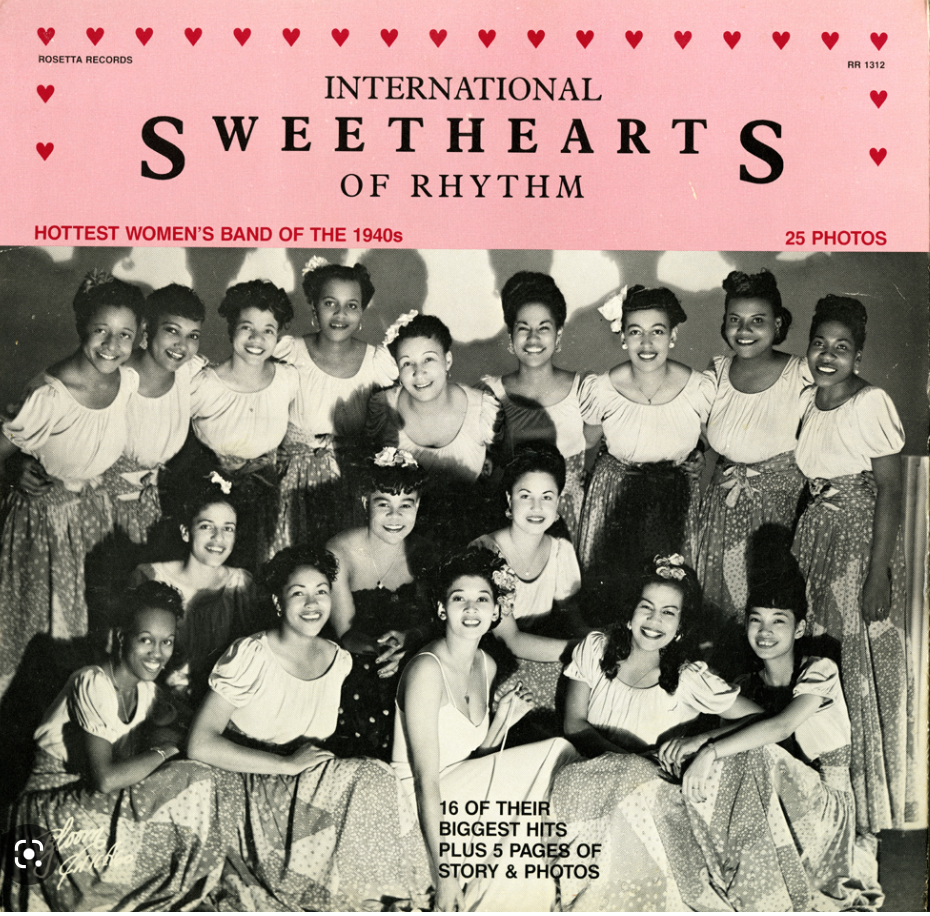
THE INTERNATIONAL SWEETHEARTS OF RHYTHM

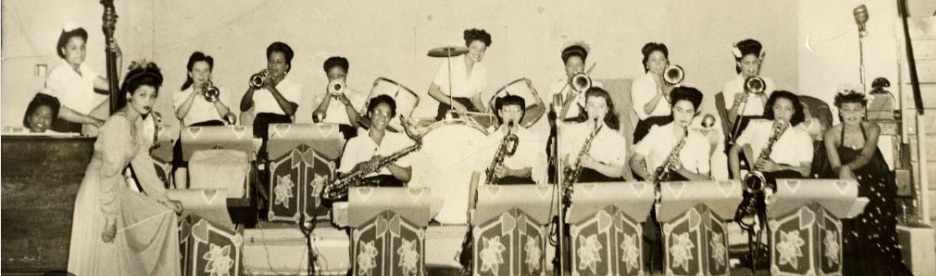
One of the most remarkable bands ever assembled was an all-women’s outfit that toured all over the country and in Europe in the late thirties and early forties. The Sweethearts, formed in 1937, was a band of teenaged girls living at a school for poor and orphaned children. Following the model of the Fisk University Jubilee Singers, school founder Dr. Laurence Jones had been sending out groups to sing for their supper and schooling since 1921. When he heard some of the “girl groups” then making the rounds in show biz, he got his charges a music teacher and turned them into a dance band. It was the height of swingtime, and the time was ripe. 

  The Sweethearts rose to become a top dance band, playing the Apollo and entertaining the occupation forces in Europe in 1945. The band was International long before its travels, counting among its number Willie Mae Wong, Chinese saxophonist; Alma Cortez, Mexican clarinetist; Nina de La Cruz, Indian saxophonist; and Nova Lee McGee, Hawaiian trumpeter. The rest of the original members were Black, with White players joining down the line.[xi]

  The band was a splendid example of music as a communicator across race lines. Saxophonist Roz Cron said of the Black women in the group, “What they had was a relaxed way of approaching the music. Their beat was different from our uptight white rhythm.”[xii] Living, working, and playing together, confronting discrimination with joyful jazz, they touched their audiences with a larger vision of American culture. 

  Mixed hues led to challenges for the group. The White women, along with the mixed race members, often had to blend themselves in with dark makeup or hide in the bus to escape the Jim Crow authorities and their never-ending defense of American apartheid. “We white girls were supposed to say “My mother was black and my father was white,” recounts Roz Cron. “I swore to the sheriff in El Paso that I was black.”[xiii]

  The band was virtually ignored in the White press, as well as in a number of later books about the swing era.[7] Count Basie used to hover backstage at Sweetheart shows and grin enthusiastically, but he was in no position to overthrow the caste system.

[7] Even the White female bands got pretty short shrift,
but Ina Ray Hutton and Her Melodears were quite successful. Hutton wasn’t actually a musician,
but more of a show biz front woman/conductor. She had the advantage of agent Irving Mills, who was
also Duke Ellington’s agent, and Black arranger Alex Hill, who worked for Mills.

  The band criss-crossed the country in their own tour bus and did a convivial tour with the Fletcher Henderson band, but were able to record only three poorly-distributed singles.[8],[9] Most of the White folks who heard them were occupying Europe; in America the Sweethearts played mainly for Black audiences. When Whites did attend, they sat in the balcony (in an ironic twist on traditional segregation) and watched the Blacks dance. Other Black touring acts made progress: when mixed audiences were first allowed, a rope was tied across the dance floor to keep them separate—a new rope trick, this time keeping both races in their places. But once the dancing began, it was only a matter of time before the rope came down.

[8] Radio broadcasts have been collected and re-released;
there is also a lively film on the band.
Both are eponymous, and they swing.

[9] James “Buster” Williams, a Black man who passed for White in Virginia, became President of a Whites-only American Legion post and concealed the fact that the old bus he talked them into buying had been the touring bus of the Sweethearts.

____________________________________

The end of the swing era saw a branching of jazz players and fans into swing diehards, New Orleans revivalists, streamlined swing (“jump blues”—see below under Rock and Roll), and the more experimental beboppers and modern jazzers. Fed up with White bands takin’ home the bacon in the swing era, the Young Turks resolved to make a music “they can’t copy,” and came up with bebop, a music of greater rhythmic complexity but narrower commercial appeal.[6] Whites did eventually get the hang of it, and all the forms that followed it, and became, in many cases, respected contributors. 

[6] Seattle trumpeter Leon Vaughn tells a story from the forties about White musicians coming to hear black bands and writing down the improvisations they heard – “and the next night they’re playing your licks!” When asked if Blacks went to the hotels where the White bands played to pick up a lick or two he replied, “We weren’t allowed in.” (Remarks in panel discussion, Seattle, July 1994.)

  Bebop was a sophisticated music that required a kind of attention beyond that required for dancing. Solos were longer, chords more complex; drums floated atop the rhythm rather than grounding it, the cymbal keeping time and the bass keeping the pulse while the rest of the drums embroidered. The piano’s left hand no longer anchored the rhythm either, instead bopping around the beat. Dancing to such rhythmically experimental—and sometimes fast—music as modern jazz was left to experimental modern dancers. 

  Bop and its evolutionary children rescued improvisation and revitalized the function of jazz as community expression, but they had to compete with other forms that had arisen over the first four decades of mass music dissemination. Modern jazz secured a place in the soundscape of America and the world, but the nation would soon groove to a new and different drummer, schooled in swing and the hard knocks of rhythm and blues.

________________________________

[i] Nicholson, 80.
[ii] Hammond, 52.
[iii] Schuller 1989, 9.
[iv] Clarke, 216.
[v] Clarke, 218-20.
[vi] Downbeat, February 1939, 16.
[vii] Schuller 1989, 662.
[viii] Clarke, 221.
[ix] Clarke, 129.
[x] Clarke, 224.
[xi] Reitz, Rosetta, liner notes to International Sweethearts of Rhythm, Rosetta Records RR 1312, 1984.
[xii] “International Sweethearts…”, see Videography.
[xiii] Handy, 27.

Broadway: Operetta Meets Jazz

  Vaudeville, which replaced minstrelsy while absorbing many of its attributes, made liberal use of ragtime, jazz, and blues.[1] Among the enduring performers to come up through vaudeville were , W.C. Fields, Abbott and Costello, the Three Stooges, and George Burns and Gracie Allen. The musicians included Sophie Tucker, Jack Benny, and Al Jolson. They were the link between the centuries, between the old coons and the new condescension. They softened the stereotypes, gradually. They participated in the building of an industry that would come to entertain—and in some ways control—millions. The styles and formats of vaudeville, or variety, would persist on Broadway, in the movies, and longest still in TV sitcoms and variety shows.

[1] Satirical songs were big in the vau de Vire, a valley in Normandy, France, in the 15th century, and the modification vaudeville (literally, valley of town) came to describe a variety of variety entertainments. (Clarke, 44.) For samples, see memory.loc.gov/ammem/vshtml/vshome.html , tinfoil.com , vaudeville.org

  The nascent Broadway musical industry, which until the 1910s had been dominated by European styles, began to take notice of changing popular styles, which is to say jazz.[i] Up to this time, the primary influences on Broadway musical theater had been the French comic opera (opéra bouffe), notably Offenbach (Orpheus in the Underworld, 1858; Tales of Hoffman, 1881); and Viennese operetta (Johann Strauss II, Die Fledermaus, 1874; and Franz Lehár, The Merry Widow, 1905). The British light opera wizards, Gilbert and Sullivan (H.M.S. Pinafore, 1878; Pirates of Penzance, 1880; The Mikado, 1885), brought wit, plot and brilliantly clever songs to the equation; their productions were the very model of a modern major musical. Pinafore played in twelve theaters, and was produced in some with all-Black casts.

  The American composers were led by European immigrants: Dublin-born Victor Herbert, who dominated the “charts” (Babes in Toyland, 1903); Hungarian Sigmund Romberg (The Desert Song, 1926); and Czech Rudolf Friml (The Three Musketeers, 1928).

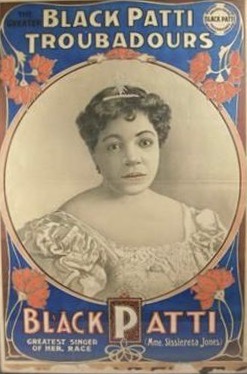
  The immediate prehistory of Black Broadway commences with Sissieretta Jones, an important opera singer known as “Black Patti.”[2] Despite wide acclaim and having sung for three Presidents and Queen Victoria, she was blocked from receiving her operatic due by virtue of color. In 1896 she founded Black Patti’s Troubadours, comprising 40 jugglers, comedians, dancers, and singers who amalgamated vaudeville, minstrelsy, musical review, and grand opera. Their shows included A Trip to Africa (1909-10), In the Jungles (1911-12), Captain Jaspar (1912-13), and Lucky Sam from Alabam’(1914-15).

  The troupe included Bob Cole, an ambitious and talented writer who in 1898 produced A Trip to Coontown, the first New York musical put together entirely by African Americans. It was seen as a significant break from the minstrel mode. 

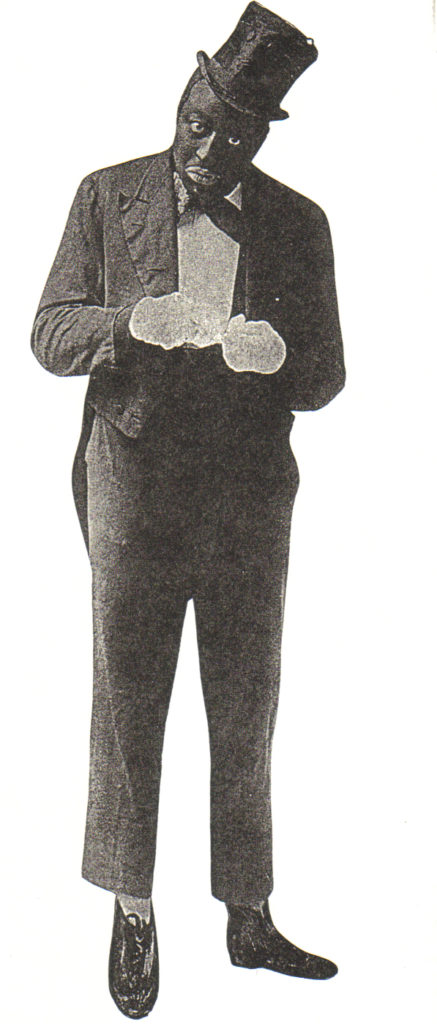
Bert Williams

  Subsequent Black Broadway productions included Will Marion Cook’s Clorindy or The Origin of the Cakewalk(1898) and In Dahomey (1903), which starred Bert Williams and George Walker. Dahomey was a hit in England first, then returned home in triumph like Jimi Hendrix. Clorindy, featuring Ernest Hogan, took New York by storm, providing the first staged version of African American syncopation.[ii] American culture never recovered. In 1905 Cook brought together twenty crack players of banjo, mandolin, guitar, sax, trumpet, trombone, violin bass, and drum in the “Memphis Students,” an aggregation that broke the mold of both popular orchestras and Black musical style. It enlarged on folk roots; by 1920 they had, together with Jim Europe, converted Europe. And parts of America. 

  Williams and Walker, by the way, were not above a little back door self-promo; their 1898 hand-delivered letter to William K. Vanderbilt—son of Cornelius, and in his day the richest man in the country—provides us with an amusing first-hand document regarding the ability of White power networks to appropriate Black creations:

In view of the fact that you have made a success as a cake-walker…and having posed as an expert in that capacity, we, the undersigned world-renowned cake-walkers, believing that the attention of the public has been distracted from us on account of the tremendous hit which you have made, hereby challenge you to compete with us in a cake-walking match…”[iii]

Recall that this dance originated as a satire on Master’s manners. (In this case, Black musician Tom Fletcher had taught the dance to the Vanderbilts.) Though Williams and Walker offered a purse of $50, there is no record of a reply. But their dancing in Dahomey triggered a cake-walk craze in England and France in 1903, something that would repeat itself as dances and musical styles jumped the pond in the coming century.

  In 1899 the English composer Leslie Stuart premiered Florodora, with jazz-inflected music updated from minstrelsy. It was a smash, and inspired many composers; Stuart became the idol of Eubie Blake.[iv]

  Most Black songwriters of that era labored in obscurity and lie there in state today. They could not procure concert halls, agents, or other necessities, and if their songs were made into hits by White singers, it didn’t help them much. Who wrote “Sweet Georgia Brown?” No less than Maceo Pinkard. His tunes were recorded by the Original Dixieland Jazz Band, Paul Whiteman, Fletcher Henderson, and many more. He was very famous in his own house. 

  With the death in quick succession in 1911 of George Walker, Bob Cole, and Ernest Hogan, Black performers lost their high profile on Broadway, giving way to the next wave of writers and to blackface operators like Al Jolson and Eddie Cantor.

  Back in the bright lights, composer George M. Cohan brought in more American musical forms, including brass marching band styles that had evolved a bit from their European origins. His songs included “Over There,” “You’re A Grand Old Flag,” and “Give My Regards To Broadway.” He was a major figure in the Americanization of American theater.

  One of the leading writers for the marching bands was John Philip Sousa, who drew heavily on ragtime, cakewalks, and other southern Black folk music. Barroom and parlor ballads, characteristic of the “Gay Nineties,” also came into play—songs like “The Sidewalks of New York” and “Shine On, Harvest Moon.” These tunes were influenced by English and German music hall traditions, and also by ragtime. 

  Today we tend to think of this period as a shimmering musical era peopled with gifted White composers; we are mostly unaware of the essential Black component of the music, the cakewalks and rags on which so much of New York’s song industry based its product and profit. 

  Irving Berlin was the first composer to bring jazz to the White Broadway musicals. He wrote in a variety of styles, out-Cohaning Cohan with “There’s No Business Like Show Business” and “God Bless America,” and putting Bing on top with “White Christmas.” He got involved with ragtime, from which he made a lot of money; he later said “I never did find out what ragtime was.” His first big hit, Alexander’s Ragtime Band (1911), wasn’t really ragtime, mostly, though Scott Joplin did claim that Berlin took the melody from his opera Treemonisha.[v]” Either way, the title sparked a craze that had been smoldering, waiting to catch fire. 

Ruth Etting sings an Irving Berlin embarrassment


  Before his songwriting success, he played Black, Italian, Irish, German, and Jew as a singing waiter in a Chinatown slumming joint called “Nigger Mike’s.” Which was in fact owned by another Russian Jew. At Mike’s he learned ragtime piano from  a Black pianist, Lukie Johnson. Berlin’s song “I Love A Piano” was an ode to the African pentatonic scale (black keys) and employed syncopation and mock-Black dialect. But the more success he achieved, the more he downplayed his debt to Black culture—and his Jewishness.[vi]


Berlin proved to be a very savvy operator in the musical market, and his tunes were later covered in jazz versions, as were the songs of most of the major Broadway composers, especially the jazzier ones. In other words, not only do “jazz musicians play show tunes,” but show tunes are themselves based as much on jazz as anything else. Or were—but that story is yet to come.

  Ragtime opened the door to the Jazz Age, and Berlin wrote many a jazz-inflected tune for Broadway, some of which appeared in a series of revues called The Ziegfeld Follies. Florenz Ziegfeld had been the music director of the Chicago World’s Fair in 1893, where early ragtime pianists appeared. His Follies featured the remarkable Jewish singer Eddie Cantor, known for his blackface numbers, and the beloved Black singer Bert Williams (formerly a minstrel player), who was also obliged to cork up. In fact, Williams and his partner George Walker billed themselves as “Two Real Coons,” just so’s you’d know.[vii] Soon everyone knew, and violent racist reactions forced Williams’ silent films off the market.[viii] It was, as noted above, a time when the race question had come to the fore. As Martin Williams wrote in his 1977 liner notes for the LP “Ziegfeld Follies of 1919,”

[Most] of the songs in this set are written and delivered full of Afro-American musical devices and would-be Afro-American attitudes. That is, in a kind of musical and cultural blackface, if you will…One could argue, with much validity, that here was the United States attempting to confront one of its most urgent, unsolved, even unrecognized problems—its race problem—on the level of popular entertainment…In any case, the enormous (and largely unconscious) effort on the part of white Americans somehow to absorb the patently irresistible culture of Black Americans is as evident here in 1919 as it is today at any suburban high school dance.

Many of the jazzy musical arrangements were written for Ziegfeld by Will Vodery, the group’s music supervisor for 22 years. Many dancers were taught by Billy Pierce. Ford Dabney was a sometime conductor of the orchestra. These African American talents produced, for a White audience, a White show full of hidden Blackness—Williams hiding his own under another layer of Black. James Weldon Johnson maintained that New York, the primary force in American musical theater, could not have happened without Harlem.[ix]

  Berlin was followed by George Gershwin (Lady Be Good, 1924; Funny Face, 1927; Girl Crazy, 1931; Porgy and Bess, 1935). Gershwin wrote what might be described as a variation on jazz, though Zora Neale Hurston called him “about as Negro as caviar.” Still, he was a dedicated fan of Black musicians; and his music moved White Americans toward jazz. He studied Gullah dialect on a South Carolina island for Porgy, another milestone show dealing with Black life. His songs, including “Fascinatin’ Rhythm,” “I Got Rhythm,” “Summertime,” “Nice Work If You Can Get It,” and “Let’s Call the Whole Thing Off,” were popularized by many musicians, Black and White. He also penned jazzy symphonic pieces like Rhapsody in Blue, commissioned by Paul Whiteman.

  Harold Arlen was hooked by jazz early, and had a penchant for the blues, e.g., “Stormy Weather,” “My Mama Done Told Me,” “I Gotta Right to Sing the Blues,” and “Blues in the Night.” He also wrote the melody for “Somewhere, Over the Rainbow,” a most un-jazz number that was later jazzed up by a number of artists. But his most interesting distinction, to my mind, was being a staff writer for the Cotton Club in the early thirties, as replacement for McHugh and Fields (see below). With Ted Koehler he wrote hits for Cab and Duke, Lena Horne and Ivie Anderson, including “Kickin’ the Gong Around,” “Stormy Weather,” “It’s Only A Paper Moon,” “Let’s Fall in Love,” and “Minnie the Moocher’s Wedding Day.” He also wrote for a Black Broadway show, St. Louis Woman, collaborating with Johnny Mercer. He was accepted in Black musical circles as an equal, something that seems to happen most often in the arts and sports. 

  Cole Porter, the consummate sophisticate, blended jazz with operetta (Gay Divorce,[3] 1932; Anything Goes, 1934, Silk Stockings, 1955). Among his most endearing and enduring songs were “Night and Day” and “In the Still of the Night,” “Let’s Do It,” “Begin the Beguine,” “Most Gentlemen Don’t Like Love,” and “Don’t Fence Me In

.[3] Changed to Gay Divorcée for the movie.

__________________________________

AL JOLSON

  Russian Jewish immigrant Asa Yoelson was America’s first superstar pop singer. His fame derived largely from his blackface act. As George Burns said, “Jolie was a cantor’s son, and everybody thought his mother was a mammy.” Well, he sang “My Mammy” (written by Maceo Pinkard), and pretty well. He also sang songs by Gershwin, who must have been embarrassed by the blackface shtick, given the respect he was trying to foster for jazz.

Al Jolson, “Swannee”

Jolson joined Lew Dockstadter’s (blackface) minstrels and played “the Black Peter Pan” and other “darkie” roles on Broadway in the 1910s and 20s.  His most famous movie, The Jazz Singer (1927),spotlights the commonalities between Yiddish music and jazz. The plot details his struggle between (blackface) show biz and Jewish religious loyalty. 

       In addition to heisting Black faces, he lifted his signature shout, “You ain’t heard nothin’ yet,” from Joe Britton, a Black vaudeville actor.[x]

___________________________________

  Throughout the twenties and thirties, jazz and operetta coexisted, within a single show, often within one song. The work of Jerome Kern (Show Boat, 1927; Swing Time, 1936) was a good example. Show Boat was a major milestone, the first native-spun Broadway musical with a coherent plot, and one based on a story about racism at that. The lyrics were by Oscar Hammerstein II. The tunes became standards, including “Can’t Help Lovin Dat Man,” “Smoke Gets In Your Eyes,” and “All The Things You Are.”

  Hammerstein was the nephew and namesake of a Viennese immigrant impresario. Although he was surrounded by composers making use of jazz, and was himself a staunch proponent of the Black freedom movement, Hammerstein never came to terms with syncopation, polyrhythm, and everything that was jazz. He never left the old country behind in his work and always nudged his collaborators’ styles toward Vienna. He accomplished this partly by writing the lyrics before the music was conceived. The best and worst example of Hammerstein’s mix of pro-Black work in non-Black genres was the 1954 movie “Carmen Jones,’ in which the all-Black cast sang the Hammer’s lyrics to Bizet. Well, not sang, exactly: operatic singers were dubbed in—even Harry Belafonte lip-synched as the professionals intoned “da” for “the” and “dis’ for “this.” To many, this seemed like trying to have it both ways; in fairness, some liked it. In retrospect, it was not the best of times for Black culture.

  Richard Rodgers would come to work with Hammerstein; Rodgers’ earlier collaborator, Lorenz Hart, by contrast, was a lyricist decidedly jazzy in his taste: bouncy, colloquial, brash, always bending and stretching the musical structure. 

  Most of the jazzy Broadway composers were Jewish. It’s no accident that Jewish writers and composers were prevalent among those who interpreted African‑American music for White America. Jews had a long tradition of marginalization and homelessness, the soul of the outsider, empathy for other oppressed peoples. Many worked in the arts. The thousands of persecuted Jewish émigrés who arrived around the turn of the century were kept out of most of the respectable businesses, so as always they went into whatever was permitted. Traditionally this included writing and music, followed by publishing and show business. 

  Jewish composers assimilated America’s culture and wrote their version of it, much as Irish minstrels had in the previous century. In Europe many had been salesmen; now they sold songs. In effect, they sold America its own subcultures. This was a service by which mainstream America has been culturally enriched, though it was not always to the financial benefit of the music’s originators. From 1920, Black entertainers circulated on the circuit organized by the Theatre Owners Booking Association (TOBA), also known as Tough On Black Artists (or Asses). They averaged $20 a week.

  The New York tunesmiths essentially monopolized access to the song-buying public through their song-publishing organization, the American Society of Composers, Authors and Publishers, or ASCAP. This gave them status in the industry, but did little for those who were the source of the styles. Although some of the more successful writers, like Berlin and Kern, were generous to ASCAP’s lesser known writers, it didn’t help the folks down on the farm and in the poor neighborhoods that birthed the music. As Tony Palmer described it, “Alexander’s Ragtime Band was not so much White or Jewish genius as a notice that whatever the Black musician invented, the White music industry was sure to steal.”[xi]

  In fairness to the songwriters, it was often the publishers who were the control freaks. Writing of the publishers’ practice of buying songs for ten dollars, E. Simms Campbell adds:

These smart publishers would keep the scores of songs stowed away in drawers…and at a propitious time they would revise here and there—change the title and lo!—a popular hit tune was often launched on the market in New York. It often made a song writer who never would have reached the top, unless he had the ideas of these Negroes to fall back on.

Simms distinguished between early New Orleans jazz composers and other budding songwriters:

True, many a white musician shared the same fate, but he was not continually relegated to the bottom as were these early-day Negro pioneers.[xii]

  Fats Waller and his writing partner Andy Razaf (Andreamenentania Paul Razafinkeriefo—he hailed from the royal family of Madagascar, a long island with long names) hit on the idea of selling their songs to several publishers on the same day, to get back at them for not paying royalties.[xiii]

  The song publishers held sway until the radio industry, in a tiff with ASCAP over royalties, formed its own publishing company (Broadcast Music, Inc., or BMI) in the thirties. This gave the folks who actually created the source material—southern Blacks and Whites, along with Latin American stylists—their first chance to get their own creations aired.[4]

[4] Another factor in widening the talent pool was Chicago’s industrial base. When the demand for phonograph records spread, it outstripped New York’s ability to produce, and the task fell to Chicago. The western producers set out for the South to record the hillbillies and blues artists,
making an end run around Tin Pan Alley.

  Industry shenanigans aside, Jewish immigrants made lasting contributions to the popular arts. Later, in the forties, Jewish entrepreneurs living in Black communities would start up the first independent record labels dedicated to bebop and rhythm and blues.[xiv] Jerry Leiber and Mike Stoller, a Jewish songwriting team, wrote loads of R&B hits for Black acts in the fifties. And Jewish‑American and African‑American humor as well as music have a long common history; together with the Southern and Western traditions exemplified by Mark Twain[5] and Will Rogers, they largely defined American humor. The vaunted Jewish tradition in humor took on new forms in America that were strongly influenced by Black comic traditions. 

[5] Here’s another American icon who drew much of his inspiration for his books and lectures from Blacks: he was raised on Uncle Remus, Br’er Rabbit, and the Fisk Jubilee Singers.

  In the twenties, the “Jazz Age,” African‑American music captured the hearts and feet of the nation; Black dance styles took America by storm. In 1921 Noble Sissle, who had worked with Jim Europe, teamed with Eubie Blake to mount a Black musical on Broadway, Shuffle Along, which ran for over 500 performances. It featured Florence Mills and also Josephine Baker, who later became a star in Europe. Ziegfeld hired some of the show’s cast members to teach his White dancers the Charleston. The popular Black dances of the era came to be associated with flappers—in other words, White folks—Ziegfeld’s teachers being blacked out. And in their effort to appeal to a wider/Whiter audience, Sissle and Blake subsequently stumbled on the slope of crossover commerce. As a reviewer said of their show “In Bamville,”

This show seems to suffer from too much white man…There is too much politeness, too much platitudinous refinement and not enough of the racy and the razor-edged.[xv]

]

Either that, or it didn’t fit in with the chap’s stereotypes.

  In 1923 James P. Johnson wrote the song “Charleston” for Runnin’ Wild, and the dance took the nation by storm. Blackbirds of 1928, including “I Can’t Give You Anything But Love, Baby,” was a Black show written by a White team, Dorothy Fields and Jimmy McHugh. The show featured Bill “Bojangles” Robinson. In 1929 Louis Armstrong played “Ain’t Misbehavin'” in Hot Chocolates.

  Under the relentless steamroller of commerce, Black dance styles were mashed into milder versions to be purveyed by and for Whites, and precious few consumers of cultural commodities ever since have thought to question the roots of the moves. A slavery-era step called the Essence became the softshoe, the basis of half of modern tap dancing, and Buck and Wing became hard shoe, the other half. Dance styles from West Africa, adapted in America, were acquired for Broadway and the nation at large.[6] Commerce, abetted by racism, produced a counterfeit culture. As Ann Douglas noted, 

It was part of the ethos of the day that white performers absorbed African-American art and performance styles, sometimes consciously, sometimes not. It was understood on Broadway: You started black or ethnic and got whiter and more WASP as, and if, success came your way. It was a class pattern as much as a racial or ethnic one—black to white, ethnic to Wasp, lower class to upper.[xvi]


.

[6] The Elvis of social dancing was Fred Astaire, a superb dancer who paid tribute to Bojangles and used his act of dancing up and down stairs on film. Robinson danced the stairs in “Blackbirds of 1928” and later with Shirley Temple in “The Little Colonel,” but others had stepped up and down before, including King Rastus Brown, a vaudevillian (and in 1895 a member of Black Patti’s Troubadours)
who around 1910 accused Robinson of stealing the routine.
But then, he borrowed it from someone, too…(Stearns, 1964, 179.)
The master of smooth did an extensive study of the moves of Robinson and also of John Bubbles (John William Sublett), of Buck and Bubbles dancing fame, but failed to mention their contribution to his work in his memoir. (Douglas, 11)

Harlem

[i] Much of the information in this section comes from an interview with musician/historian Peter Sokolow in New York, 1993.
[ii] Weldon Johnson, 1930, 103.
[iii] ibid., 105.
[iv] Rose, 18.
[v]http://www.edwardaberlin.com/scott_joplin__brief_biographical_sketch___33423.htm
[vi]Douglas, “Siblings and Mongrels,” 10-11.
[vii] Jenkins, 184-85.
[viii] Clarke, 63.
[ix] Weldon Johnson, 1930, 225-6.
[x] Douglas, 8.
[xi] Palmer, 17.
[xii] E. Simms Campbell, “Early Jam,” The Negro Caravan, 985.
[xiii] Clarke, 235.
[xiv] Clarke, 270.
[xv] Ashton Stevens, Chicago Herald and Examiner, March 31, 1924.
[xvi] Douglas, 11.

Up River: The Bleached Chorus

  In 1913, New Orleans’ Storyville district, where much jazz was heard and much illegality was shared, was temporarily closed by the city after two men were killed in a fight. Musicians began to emigrate north and east. Storyville reopened, but economic changes and war forced continued migration. In the 1920s, many New Orleans musicians drifted to Chicago, St. Louis, Kansas City, and later New York. In their encounters with jazz musicians already resident in those cities, the influences were mutual. 

  In Chicago, King Oliver and Louis Armstrong inspired a generation of White jazz players including Benny Goodman, Gene Krupa, and Jack Teagarden. Jazz was in ferment, growing up, growing complex and sophisticated—and somewhat more accepted. The maturing of jazz was apparently timely: it proceeded to transform the nature of mainstream popular music, reaching into its rhythms and forms, twisting and reordering them into a twentieth-century music of mixed influences from which there would be no going back.

  In the second half of the nineteenth century, the various threads of American music had been gradually weaving together, and in the first two decades of the twentieth century they were finally being recognized at home and abroad as a distinctly American art. The interplay between African‑American and European folk and classical forms defined this new music.           

  The African‑American community, meanwhile, was in a dynamic state: expectations of progress were energizing Black organizations, which included the NAACP and the Garvey movement. This atmosphere also encouraged an artistic movement, exemplified by the Harlem Renaissance and Chicago’s “Fat Years.” African‑American writers and artists came into their own; so did—over the misgivings of some of the African‑American intelligentsia—jazz music and dance. 

  W.E.B. DuBois, for one, was not as enthusiastic about it as were Langston Hughes and Zora Neale Hurston. Among African-Americans there was a difference over cultural/social strategy; on the part of the White establishment, the resistance to jazz was a reaction to the upsurge in Black pride. Of a bumper crop of hysterical articles, perhaps the cleverest title was “Does Jazz Put the Sin in Syncopation?”; but the most telling may have been “Jazz is a signboard on the road that was traveled by Greece and Rome.” The New York Times, in its usual fine, if equivocating, style, ventured in an article “Jazz and Its Victims,” that jazz players

…seem to have made themselves the vanguard of the movement to do away with repression in America…while {the listener] is half conscious of the main melody, a subtle bombardment is carried on by all the other overtones, the curlicues, the rasps, the blares, the moans.[i]

A simpler view was voiced by a critic for the New York Post: “Jazz isn’t music. Not by a long shot.”

Vernon and Irene Castle, 1915

  But plenty of people thought it was music, at least music enough to dance to. Vernon and Irene Castle, famous for teaching the foxtrot, had help with the dance’s development from Black bandleader James Reese Europe, at the instigation of W.C. Handy.[ii] “It was Jim Europe who suggested the fox-trot to us,” said Irene, “and [he] deserves all of the credit for the most popular dance of today.”[iii] Castle, along with Eileen Southern, was saying that Europe invented the foxtrot.[iv] His partnership with the Castles introduced syncopating orchestras and dance steps from the black community to the nation. Their work together was essential in inaugurating the jazz age, distinguished by two widespread enthusiasms: for African American popular music and for dancing.[v]

  Alabama-born Jim Europe gave the first “syncopated concert” in New York in 1904, then brought the saxophone from Europe to New York around 1910. He also founded the most popular army band in Europe during World War I. The band led the New York parade after the armistice—the first parade to go up Fifth Avenue instead of down, so it could end up in Harlem, where the band’s original fan base was. This band brought Just-Before-Jazz, or Swingin’ Military, to Europe and to the armed forces. I hate to say anything nice about war or conquest, but as Europe said of his Champs-Elysées concert:

Before we had played two numbers the audience went wild. We had conquered Paris. General Bliss and French high officers who had heard us insisted that we should stay in Paris, and there we stayed for eight weeks…We played to 50,000 people at least, and, had we wished it, we might be playing yet.”[vi]

James Reese Europe in Europe

  Other African American army bands played the European theatre, led mostly by New York bandleaders. Tim Brymn’s outfit was called the Seventy Black Devils of the U.S. 350th. Such bands set the styles for the next musical era, and paved the way for Josephine Baker and all the African American chic in Europe since.

  Seven year-old George Gershwin (Jacob Gershvin) sat on a Harlem curb for hours, listening to Jim Europe’s band.[vii] Some of Europe’s bands were actually orchestras; his Negro Symphony Orchestra incorporated up to ten pianos, eight banjoes and 47 mandolins. He took control of New York’s music scene by organizing the African American musicians of the city into the Clef Club and booking various sorts of bands all over town, all in the service of his vision: to transmit the essence of African American harmony and rhythm through dance music. 

  James Europe’s music perched on the cusp between ragtime and jazz. At a wartime concert in France,

The drummers hit their stride with shoulders shaking in syncopated time…The audience could stand it no longer, the “jazz germ” hit them and it seemed to find the vital spot loosening all muscles…[viii]

European bands examined Mr. Europe’s band instruments with furrowed brows, certain they had been modified to produce the jazz germ—“smears, slurs, rhythmic or dynamic shifts…”[ix] After the war, Europe took New York by storm, offering what the New York Sun called “a gorgeous racket of syncopation and jazzing;”[x] the presentation combined New Orleans jazz with a big band sound. He presented “A Concert of Negro Music” at Carnegie Hall in 1912 with a 125-piece orchestra. Jim Europe would have been one of the most important bandleaders of the twenties, had he not been stabbed to death in 1919. Eubie Blake later called him “the Martin Luther King of music.”

  Other black bands in New York scoured the nation for innovation; in 1918 Will Marion Cook’s New York Syncopated Orchestra hired Sidney Bechet, a Creole fella straight outa Downtown New Orleans, by way of Chicago. A few years later top black bandleader Fletcher Henderson would woo Louis Armstrong from the Windy City, strengthening the national profile of New Orleans trendsetters.

Cab Calloway

  With the advent of Prohibition, Harlem night spots like the Cotton Club and the Apollo Theater drew large and enthusiastic White audiences. Popular African‑American musicians like Cab Calloway, Fletcher Henderson, and Fats Waller were top of the pops.[1] What they played, as always, was affected by their all-White audiences. It became a smoother sound, less raw, less gutbucket: Fletcher Henderson put a gloss on Louis Armstrong; Ethel Waters polished Bessie Smith’s style. Waters’ polish got a rave from Harlem Renaissance patron Carl Van Vechten, who patronized:

In her singing she exercises…subtle skill. Some of her songs she croons; she never shouts. Her methods are precisely opposed to those of the crude coon shouter, to those of the authentic Blues singer, and yet, not for once, does she lose the veridical negro atmosphere. Her voice and her gestures are essentially Negro, but they have been thought out and restrained, not prettified, but stylized.[xi]

[1] He could do more than pops, Waller could.
He once sat down at a party and played the entire score
to the ballet Petrushko. While drunk. (Hammond, 50.)

Ethel Waters

These were all great musicians who made fantastic music that we all love dearly, but do let’s observe that the sweetening was necessary for the task of the day. Likewise, the widespread use of an “octoroon”[2] chorus line—what Zora Neale Hurston called “the bleached chorus”—was clearly developed to accommodate White tastes.

[2] A person alleged to have one-eighth African ancestry.


________________________________________

 CHICAGO BOYS

            The impetus for new artistic styles in society often comes from the disenfranchised groups.[1] This doesn’t mean somebody else can’t join in. On the contrary, anyone who is born to respectable society but somehow doesn’t fit in, doesn’t find meaning in it, must search elsewhere. The search for meaning is, after all, the central quest of life (after food, clothing, and smart phones), and those who must struggle as a community to survive are bound to create an art that speaks to the soul and gives meaning to it. 

[1] Look to the literature on Roman use of Greek styles
(alluded to above by a jazz-age magazine writer),
the classic case of the “conquered conquering the conqueror.” 

            So it was with Chicago jazzman Bix Beiderbecke, born in Iowa in 1903. He took to jazz and it took him in. His cornet playing was widely acclaimed – critic Phil Elwood credited his hot solos with the Paul Whiteman orchestra with selling a lot of records for that otherwise rather square ensemble. Bix played in a somewhat European style, directly on the notes, unlike the slurring style of Louis Armstrong. In fact, his original inspiration was the Dixieland Jazz Band of Nick LaRocca. He later soaked up Black bands on Chicago’s South Side, but he had little or no involvement with the blues, and on recordings he backed up singers like Bing Crosby.[xxi]

            All the White Chicago jazz cats frequented Black clubs, to the bemusement of the doormen, who would remark “You came for another music lesson, didn’t you?”[xxii] Doormen and others were well aware of what would happen if a Black musician went to a White club to study. But Mezzrow, Beiderbecke, Eddie Condon et al were able to study King Oliver and Satchmo, Jimmy Noone and Earl Hines, up close, carrying on the American musical apprenticeship tradition. 

            The White Chicago players were later compared to the famed “Second Line” of people who danced along in the march behind New Orleans jazz bands.[xxiii] Perhaps rock and roll is rhythm and blues’ second line. The problem with these second-liners from the Black musician’s perspective was that, given the isolation of the South Side from any other side, it was easy for White visitors to take back souvenirs of their travels and present them without attribution. Blacks are not unaware of White library patrons’ borrowing habits. So Joe Oliver used to be quite cagey with information about his tunes, even their titles, when visitors inquired[xxiv].

            Still and all, Bix and the boys were a key link in the expansion of jazz throughout the country and beyond its Black origins much as, forty years later, white Chicago boys Mike Bloomfield and Paul Butterfield would plunge into the world of the blues and bring them to White youth. Bix must have had the blues, to drink himself to death at 28.[2]

[2] Among Bix’s friends were violinist Joe Venuti and Indiana’s Hoagy Carmichael,
who wrote the music for “Stardust,” “Georgia on My Mind,” and “Up A Lazy River.” He was a songwriting giant, and recorded with Beiderbecke. 

________________________________________

Jean Goldkette Orchestra with Bix Beiderbecke, 1926

  Art Hickman and Ferde Grofé were developing the call-and-response section sound—strings here, horns there, reeds up yonder, etc.—in their pre-jazz San Francisco bands around the time Jim Europe was in Europe. Jean Goldkette, a French immigrant working in New York, hired Beiderbecke, the Dorseys, Eddie Lang and Joe Venuti for a band that played hot, interesting arrangements. He also hired Don Redman of the Fletcher Henderson band to rehearse his groups.[xii] He went on to manage the Casa Loma Band, which was sweeter and played widely on the college circuit.

  One of the most influential bands of any color was that led by Paul Whiteman (which he was). Not just a musician, he was a businessman to beat the band, owning or controlling 28 bands at once and making a million 1920s-style dollars a year. His activities were summed up at the time by writer and anthropologist Zora Neale Hurston:

Paul Whiteman is giving an imitation of a Negro orchestra making use of white-invented instruments in a Negro way. [xiii]

Paul Whiteman Orchestra, “At Sundown”. Dorseys in the band.

Whiteman’s sole arranger for five years was Ferde Grofé. After this he was also making use of Black arrangers, such as Don Redman, who also arranged for Fletcher Henderson’s band and later (like Henderson) for Benny Goodman. Redman was a pioneer in developing the call and response sections for swing band arrangements, getting ideas from Bill Challis, who had arranged for Jean Goldkette and picked up some concepts from Grofé and others from Bix. Redman invented the “swing choir,” with musicians chanting a paraphrase of the lyrics under a melody solo. Tommy Dorsey copied this to good effect.[xiv]

  Other crossover arrangers included Sy Oliver of Jimmy Lunceford’s band, working for Tommy Dorsey, and Andy Gibson writing for Charlie Barnet and Harry James. Black bands were not known for using White arrangers; there was little money and rare call for it. But White bands’ use of Black arrangers was standard practice in the twenties. Redman was paid $100 each for twenty arrangements.[xv] Compare that to what Whiteman, the “King of Jazz,” made from Redman’s work and you’ll have a gut feeling for Karl Marx’s concept of “surplus value”: the worker provides the value and the king reaps the surplus.

  There were exceptions: Bill Challis also arranged for Henderson, whose famous saxophonist and arranger Benny Carter called Challis his idol. Other White Henderson band arrangers included Will Hudson and trombonist Russ Morgan.[xvi] Henderson’s was the top band in the New York scene, and this was a time of great interplay between jazz and the traditions of orchestras, a time of swiftly evolving arrangements. The interaction across the color line seen here would be repeated in soul music in the sixties. 

  To his credit, Whiteman was one of the earliest to promote jazz from the bully pulpit, paying for new music by Gershwin and Black composer William Grant Still[3] and employing singer Mildred Bailey as well as Bing Crosby (before industry figures importuned Crosby to cut out all that jazz). He helped lay the groundwork for the big band fashion fifteen years ahead of the swing era. He was an important popularizer and synthesizer (acoustically) of modern popular music. Odd, then, that he cautioned his musicians against syncopation, saying that “to-day it is no longer a necessary thing,” and made heroic attempts to modernize, sanitize, stylize, formalize, and de-Africanize the music. [xvii]

[3] Still is known primarily for classical composition,
but he also composed jazz, wrote arrangements for W.C. Handy,
and played in the Harlem Symphony along with
Fletcher Henderson and James P. Johnson.

________________________________________

THE BOSWELL SISTERS

A seismic event in vocal style, this jazzy White sister act emerged in New Orleans in the late twenties. They excelled at vocal imitations of instruments—already a jazz tradition—and revolutionized group harmony. During the thirties they were the hit of the air waves, and recorded with the Dorsey Brothers, Les Paul, Carmen Miranda, Guy Lombardo, Bing Crosby, and, notably, the Mills Brothers, a Black quartet that broke new cultural and musical ground. The Boswells’ recordings included “Boogie Woogie Bugle Boy,” “That’s How Rhythm Was Born,” “Rock and Roll,” and plenty of Duke tunes. 

Boswell Sisters, “Crazy People”

Connee Boswell, the arranger (and one of the first women to be respected as such in the industry), was confined by polio to a wheelchair from the age of three. Later, after her two sisters retired, she went on to a solo career and was one of the most influential White singers—no less than Ella Fitzgerald said “When I started out, all I wanted was to sing like Connee Boswell.” Her syncopated phrasing, diction, swing, and frequent changes of tempo were exciting and unusual, especially for a White singer of that era. Her main influence was fellow New Orleanian  Louis Armstrong.[xviii] From him, or from Barbershop singing generally, the sisters incorporated vocal slides and similar techniques. And  before encountering Satch, the sisters used to visit a local Black theater that admitted Whites on Fridays, where they were wowed by Mamie Smith.[xix] 

And before that, they learned something about Black music from their African American servants. Downbeat noted in 1944 that

the Boswell household had “colored women” in the household who “jived,” “crooned,” and “rocked”; and because of this, “No wonder [they] … sang the way they did! It was only natural for them to sing blues on the pop tunes, and spirituals on the blues.”[xx]

The Boswell Sisters, left to right, Martha, Vet, and Connie, ca. 1932

At this early stage of the recording industry, non-southerners were not familiar with southern accents or singing styles except for a few scattered Black performers, along with the caricatures purveyed by minstrelsy. The Boswells, eschewing exaggerations and offering their natural accents combined with jazzy vocal chops, were perceived by many as a Black act, as was Elvis 25 years later.  In fact, when they were scheduled into Paris and no promo photos had been provided, a French artist drew them as Black. After all, light-skinned Black singers in vaudeville had frequently passed as White—including sister acts. And the New Orleans music world was a rainbow of color mixes, thanks in part to the plethora of “Creoles of Color” in the jazz scene there. 

Though the White record-buying public had just recently been (more or less) weaned off of minstrelsy, they still needed to sort out their relation to Black musicians (and people, of course), and the appearance of the Boswells on the scene was an opportunity to begin a transition in that fraught relation. But it had to be carefully constructed in order to sell—thus the emphasis on their Southernness, and Southern Whiteness as well. Jack Kapp, the charge d’affaires at Brunswick Records, took charge:

In the Boswells, Kapp had found his marketing Holy Grail. They were white singers that sang white material (i.e., Tin Pan Alley rather than blues) but sounded black, who could ride the crest of the popularity of black music while simultaneously drawing in more racially conservative white audiences. [xxi]

We’ll encounter this again with Elvis and his own Kapp, Sam Phillips—and, less famously, throughout the history of the industry. And we’ll see other Whites adopting Black styles whole cloth, including the second version of the Chicago Boys (Butterfield, Bloomfield, et al), who took up the blues in the sixties. 

But this time, the mix of Southernness with the female (Southern Belle[1]) aspect maneuvered White audiences forward. The contemporary listener might ambivalate, “Yes, they sound Black, but that’s ok, because they’re Southern.” They were presenting the South, including its Blackness, to the North, rather than presenting themselves as renegade Whites adopting Black culture.

[1] One can, however, make the case that the Belle persona,
or stereotype, inevitably carries with it the plantation culture itself—
reduced in potency, but still a vessel for (hidden) white supremacy.

And in that era, the rise of Black performers alternately enthralled and threatened the White cultural consumer. Laurie Stras, in White Face, Black Voice: Race, Gender, and Region In the Music of the Boswell Sisters, speculates that the deployment of Louis Armstrong’s signature styles—vocalized “instrumental” solos, scat, etc.—by the Boswells helped to make Satchmo more acceptable by spreading his musical manners across the color line and recasting them as not only Black but as Southern: inescapable fingerprints of the evolving music of the era. As Southern Belles, they were nearly above conservative reproach, even as they served up a stew of African American jazz-pop. Not everyone appreciated it, though: a complaint to a San Francisco radio station demanded:

Please, please, if you are going to keep those Boswell Sisters tell them to change their stuff and quit that squawking and harmonize a tune. All my friends say the same thing. They call them the savage chanters and tune them out.”[xxii]

But the die was cast: popular music, and the people that made it popular, were moving forward with a new amalgam of styles taken, once again, from the Black community. Together with their friend Bing Crosby, the Boswells stepped into a new era—not always without resistance from audiences and industry commissars alike, but step they did, and certainly it was a step above minstrelsy.

__________________


[i] “Jazz and Its Victims,” New York Times, October 7, 1928
[ii] Badger, 52.
[iii] Locke 1936, 67.
[iv] Ibid. and Southern, 1971, 350.
[v] Charters and Kunstad, 31-34.
[vi] Southern, 1971, 364.
[vii] Ewen, 228.
[viii] Badger, 56
[ix] ibid., 58
[x] loc. cit.
[xi] cited in Kellner.
[xii] Clarke, 167.
[xiii] Zora Neale Hurston, quoted in Hemenway 1977, 80-81.
[xiv] Clarke, 169.
[xv] Buerkle, 106.
[xvi] Lees, 201.
[xvii] Ogren, 1989, 160. 
[xviii] Friedwald, Will, Jazz Singing, New York:Collier/MacMillan, 78.
[xix] Placksin, 23.
[[xx] John Lucas, “Cats Hepped by Connee’s Chirping,” Down Beat, 15 October 1944, 3
[xxi] Laurie Stras, White Face, Black Voice: Race, Gender, and Region In the Music of the Boswell Sisters, Cambridge University Press, May 16, 2007, accessed May 13, 2023 at bit.ly/strasboswells
[xxii] David McCain, liner notes to The Boswell Sisters Collection, Volume 5, Nostalgia Arts NOCD 3023, 2001

Latin America: US

  Latin American music has continually enlarged the culture of the United States and repeatedly tinted our various music genres, blasting in through New Orleans, Mexico, and later New York. Part of the United States is still Mexico, culturally, which we’ll come to shortly. New Orleans had French, Spanish and West African elements in its Caribbean gumbo. In fact, the city was under direct Spanish control from 1763 to 1803—compare the iron latticework on the balconies to those in Puerto Rico. 

  Afro-Latin rhythms have pulsed side-by-side with other styles of popular music, and often merged with them. They have ramped up our use of percussion, Africanizing our nation as Ford feared. And keep in mind as we proceed through the particulars that any music influenced by Spain was already influenced by the Arabs who occupied and ruled that corner of Europe for hundreds of years. Even flamenco turns out to have been influenced not only by its prime practitioners, the Roma, and obviously by Arabs and Berbers who ruled Spain, but also by the thousands of Africans who were captured and brought to Spain in the later European conquering period, where they lived in slavery until the 19thcentury.[i] This influence is widely ignored or denied in Spain to this day.

  The strongest influences, stateside, come from Cuba, a highly Africanized Hispanic nation.[ii] Yoruba religion survives there, and so does the music, the most basic rhythm of which is the clave (pronounced cláh-veh). It has many variations; let’s look at the “son” clave, common in both son and salsa (see below). Learn this one yourself by slapping your thigh with your left hand on every beat, counting one to eight, then starting over. Then slap with your right hand on the following beats: beat 1, between beats 2 and 3, beats 4, 6 and 7. Or get a partner and split it between you. Or just clap on the italic words in “Shave and a hair cuttwo bits.” Take it slow. Then try clapping or vocalizing this rhythm over various US musics, and see how it variously fits. You just saved the price of a Popular Music Appreciation class. Unless you’re in one. (Don’t quit.) 

Clave rhythm

  This is a basic clave, an alternation of three beats and two. There are many clave variations, showing up as the basis of salsa and lots more. The next most common variation is the reverse clave: emphasis on beats 2, 3, 5, between 6 and 7, and 8.

Mariano Dugatkin explains development of Habanera

  A French version of the English country dance was brought by Spain to Cuba in the form of the contradanza, which gave birth to the habanera.[1] Afro-Cubans made it swing, and it swung into the U.S. as early as 1865. The habanera rhythm is close to that of the cakewalk; Louis Moreau Gottschalk, widely-traveled pianist and composer, combined cake and contra in “Ojos Criollos,” written around 1850, during the first cakewalk craze, forty years before ragtime.[iii] And leave us not forget the Spanish-American War—first prize: Cuba. Black regiments helped beat the Spanish and brought a bit of the Cuban beat back home—just in time for the birth of jazz.

[1] Named after Havana.

Mariano Neris & Bella Malekian – Rumba Cubana

  But more directly influential was the son (pronounced sone), which led to the rumba boom of the thirties and forties. When it came from the Cuban countryside to Havana in the 1920s, it fell under the influence of a new urban music it found there, called jazz. It then hopped the sea to repay the debt.

  Next came the mambo—derived from Congolese religious groups—and the chachachá, both from Cuba. After that came the Communism, and Cuban rhythms, always subversive, were embargoed by the U.S.

  From the Dominican Republic came a syncopated polka, the merengue. Puerto Rico incorporated Cuban and Haitian beats into its mix and passed them along, along with a million and more messengers, to the U.S. Result: salsa. Among the Puerto Ricans who came to New York were musicians who would play with Duke Ellington, and others who played together with Cubans in Latin bands, giving birth to a new, mixed, New York style.

  Brazil contributed the samba, based on a ring dance (remember the ring shout), and then the bossa nova, a creation of jazz-oriented folks, mostly White Brazilians, influenced by “cool” west coast jazz. 

  From Argentina came the tango, an innovation dating to the 1880s (banned at Yale in 1914 but popular on Broadway).[2]  Allow me a digression here, or perhaps just a wider angle view to enlarge our perspective on U.S. cultural history by considering another part of the hemisphere, likewise colonized and peopled by kidnapped Africans and their kidnappers, along with assorted more or less innocent bystanders. Let’s talk tango.  The habanera was an influence, and so were Black Argentines, a factor as widely ignored as the African is in flamenco. 

[2] Vernon and Irene Castle, at the request of a society grand dame,
bleached the tango down to the Innovation, a non-touching version.

We think of Argentina as a White country – what happened? During chattel slavery, Africans comprised 50% of the population in many Argentine provinces. Today it’s down to a few neighborhoods in Buenos Aires: San Telmo, Merlo, Ciudad Evita. Some Argentines who otherwise don’t want to talk about the historical Black presence will admit that it was severely reduced by yellow fever in 1871, foreshadowing Memphis. Africans were also sent in great numbers to wars against Spain (early 1800s), and later Paraguay (1864-70). Mostly what remained were the women, who intermarried, partly thanks to a massive European immigration. Blacks, depending on someone’s subjective definition, are now 2%. “There are no Blacks in Argentina,” say many Whites, including former President Carlos Menem, who added “Brazil has that problem.”[iv] We can see from this who has a problem, and also what it is. 

Mariano Dugatkin in video Tango Origins & its Black-African Roots

  Buenos Aires, like New York, is a melting pot. The culture is melted from contributions from Genoa, London, Paris, Barcelona, Madrid, and Mbanza Kong and Lwangu, the two capitals of Kongo, a huge African kingdom (1390-1914, roughly) that comprised parts of modern-day Congo, Democratic Republic of Congo, Gabon, and Angola. Among other important achievements, they exalted dance, as observed by Portuguese visitors/conquerors in the 16th century.  People from this kingdom were enslaved and shipped to, among other places, Argentina and the United States. 

By 1820 there were five organizations representing these central Africans in Buenos Aires. These groupings were called candombes,[3] as were their music/dance/religious gatherings. They represented the whole of their African culture. (Later, their cousins in central Africa used the same word in their resistance against Belgium, in the 1940s-50s.) In the Argentina-Uruguay border area, candombe, the dance, joined with milonga and other dance developments to form the tango. Robert Farris Thompson tells us that “Kongo speech, music, instruments, dance, gestures, and even drum syllables were present in Buenos Aires at the birth of the tango.” He goes on to compare the dancing of Juba, observed by Charles Dickens at P.T. Barnum’s show, with similar moves in Argentina around the same time, and describes similar moves in the early tango, around 1903.[4],[v]

[3] Not candomblé, a religious tradition in Brazil.
[4]  Even the very name can be traced across the water.
Of the many words sourced from the Ki-Kongo tongue,
tango can be traced to variations of tanga,
from tangala to tanganana, with various overlapping meanings
having mostly to do with different styles of walking.
The Ki-Kongo mambu became the Cuban mambo,
and the name candombe in Ki-Kongo means “pertaining to Blacks.”

It is not any more odd to think of dance moves, rhythms, or words showing up thousands of miles apart, and thousands of miles from their cross-Atlantic source, than it is to note traditional English or Scottish ballads and dances turning up in Appalachia and Australia. Given the efficacy of the Facebooks of the day, neither should we be surprised that no less than the cakewalk filtered south from the US early in the 20th century. It featured the leaning-forward-and-backward moves typical of Kongo dancing and later of tango.  George Reid Andrews, in the The Afro-Argentines, 1800-1900, described the practice in candombe of “bodies alternately thrown forward and back,” like in the cakewalk, as being continued into the tango.[vi] “Today,” Thompson tells us, “white Buenos Aires is not supposed to know about such things.”[vii]

  The tango intermeshed with ragtime; the Charleston is derived from both the cakewalk and the tango, and possibly the cotillion, as performed in Black dance clubs like the “Jungle Casino” in New York.[viii]

  Mexico was heavily influenced by European music, especially French, which was important in the 18th century. There were Germans, too, with their polkas and waltzes. But there were also mixes of indigenous and African forms. 20,000 Africans were there by the mid-1500s, mostly in the Gulf region, and this area belongs to the Black Caribbean in a way the rest of Mexico does not. In the 19th century, Cuban rhythms sailed in and prevailed in cities throughout the land, and as of the late 20th, Colombia’s African-influenced cumbia dominated the dance floor. 

Dizzy on Chano

  But the important thing about Mexico to this story in progress is Texas. Remember, our Great Southwest used to be someone else’s Great Northeast. The cultures that met in Texas had in common the waltz, polka, and schottische—recall the discussion of common stock—and with the help of the German accordion, a great blending took place here. Germans engineered railroads in Mexico—bear in mind the Black and Irish railroad builders in Appalachia. Before that, another kind of train brought cultures together: the wagon train. As detailed earlier, cowpokes from Mexico and the U.S. had occasion to trade songs over the campfire, in between wars. By the time Bob Wills was swingin’, the northern Mexican feel had long since seeped into western styles: consider also the corrido-like sound of some of Woody Guthrie’s numbers, or Leadbelly’s guitar runs in the same connection.[ix]

  There was another important occasion for Mexican influence on U.S. music. Not a war this time, but a fair: the World’s Industrial and Cotton Centennial Exposition, New Orleans, 1884-85. The Mexicans sent a Cavalry band, dozens strong, that was the hit of the fair, with New Orleans publishers releasing sheet music for their numbers that sold thousands. But duly note: prominent among these numbers were the Mexican versions of the Cuban habanera. And next thing you know, some of the band’s members took up residence in the Crescent City, going on to play in early jazz bands. Among the fabled  “creoles” were some who were actually of Mexican origin, including clarinetist Lorenzo Tio and Alcide “Yellow” Nunez.

  Broadway, like jazz, was in the habit of latching onto foreign influences, though more often as exotic trivializations by New York pop songwriters; still, the cut and paste contributed to the ongoing integration of styles. And in the forties came the first wave of overtly Latin jazz, with Dizzy Gillespie adding Cuban percussionist Chano Pozo to his band, Nat King Cole adding bongos, and the rumba generally taking over. But as noted earlier, Jelly Roll Morton had already declared that any music without a “Spanish Tinge” couldn’t possibly be jazz. He played it on piano with a rumba beat in the left hand, syncopating with the right. When pioneering big band leader James Reese Europe recorded his first four songs in 1913, two were Latin—a tango and a maxixe. Europe also hired his entire clarinet section straight out of Puerto Rico.[x]

  As for blues, W.C. Handy had been to Cuba in 1900, heard the son, and afterwards began to experiment with various Latin beats with his orchestra. He noted audiences’ “sudden, proud and graceful reaction” to the rhythms; as a result he slipped in a little of the rumba when formulating his version of the blues. Listen to the midsection of “St. Louis Blues,” our nation’s most famous tango: it’s a habanera.

Arthur Migliazza plays St Louis Blues

  Decades later in Jelly Roll’s town, Professor Longhair (Henry Roeland Byrd) mixed several Latin American influences in his piano style, which helped ensure the Latin presence in rhythm and blues.

Hank Williams, Professor Longhair

  So we can see that Latin music is folded into many of our important African-American-related styles. But more important is to hear it. Longhair’s music is good for that; listen to a whole album—it won’t be hard work—and hear how he divides two four-beat bars into three-three-two in the bass. (The Professor actually started as a tap dancer, then became a drummer before moving to piano.) Longhair also incorporated calypso, and credited some of his style to the “Spanish beats” used by a mysterious bandmate from the forties: 

This other kid claimed to be Hungarian. That’s why I named my band Professor Longhair and the Shuffling Hungarians…he wasn’t white…he wasn’t really black either.[xi],[5]

[5] Could this Hungarian actually have been Rom?
Sometimes the Roma identify by their host nationality,
just to be on the safe side.

  Now listen to Fats Domino, Dr. John, the Neville Brothers, and Little Feat. (Meanwhile, compare the famous Fats tune “Blueberry Hill” to the 1941 version by Gene Autry to see what a difference a beat makes.) You can hear this rhythm in any number of tunes that came out of New Orleans in the fifties and related decades.[6] It’s more blended and subtle in styles further afield. But listen. It’s there. 

[6] See New Orleans Originals and Louisiana Piano, Discography.

Gene Autry, “Blueberry Hill,” 1941
Fats Domino, “Blueberry Hill,” 1956

  Jazz and pop music funneled Latin songs into the cultural body politic. Singers Bob Eberly and Helen O’Connell, with the Jimmy Dorsey band, were particularly Latin-inclined. They recorded “Amapola” and “Andalucia” (Spanish), “Besame Mucho” and “Maria Elena” (Mexican), and “Green Eyes” (Cuba). Artie Shaw did Cole Porter’s “Begin the Beguine” and the Mexican tune “Frenesi.” Later, rock and roll writers Leiber and Stoller set “Anna” and “There Goes My Baby,” to the Brazilian baion beat.[xii] It wasn’t always so obvious: “What A Difference A Day Makes,” first a hit for the Dorsey Brothers in 1934, was a rewrite of a Mexican bolero, “Cuando Vuelva a Tu Lado.”

  But the most important thing going on in the 1930s in the fusion of Latin and other U.S. musics was Spanish Harlem. Here the Puerto Ricans et al kept Xavier Cugat honest, if from a distance. He was thrillin’ the downtown crowds with half-baked rhythms that gradually got to cook better—hotter— as the Yankees developed the taste for it. Meanwhile back uptown, the Puerto Rican base, the New Yorquiños, kept their roots alive in their own dance halls. Spanish Harlem was also situated hard by non-Spanish Harlem, and the combination of sounds and spirit began to blend a bit, sometimes more than a bit. Latino musicians were featured in the bands of Benny Carter, Chick Webb, Don Redman, Fletcher Henderson, Cab Calloway, and Duke Ellington. [7]

[7] Among the first Anglo leaders of Latin bands were New York Jews,
including them Alfredo Menez, née Mendelsohn.

  The forties brought more Cubans, and more Black Cubans. Singer Machito (Frank Grillo) and his musical director Mario Bauza hired arrangers who also worked for Cab Calloway and Chick Webb, and Cuban music with sax appeal and spiffy charts began to hit the charts. They also added congas. The New York hybridization process was paralleled by a series of Latin-themed Hollywood films that helped soften up the Yanks for the Latinization of northern music. Part of the blending was more like blanding: many tunes of Latin origin hit bigger as cover versions by the Dorseys, Glenn Miller, Gene Autry—some of them damped down, some with the Latin sources thoroughly bleached out.

Eddie Torres and His Mambo Kings and dancers

  The mambo surfaced in the late forties, along with Cubop—Afro-Cuban fusion jazz spearheaded by Dizzy Gillespie, Stan Kenton, and Machito. Fusion is perhaps a bit misleading, as there are differences between the north and south that are not easily bridged. Restructuring of arrangements and instrumentation often sits more easily on a traditional form than do changes in rhythm. The rhythms of African-Americans in the U.S. have some things in common with various Afro-Latin rhythms, and some things not. Some of what we hear here is Afro-Pan-American common stock, dating back through early jazz and beyond, especially in meeting grounds like New Orleans. Some of the African beat that persisted in Latin America, especially in Cuba, had to be recaptured up north where the drum had been banned. Max Roach went to Haiti, while Art Blakey went to North Africa, to study.          

On the flip side, the commonalities that remained helped jazz to be adopted and adapted in Cuba, Brazil, and beyond, as it helped the habanera and other beats to resonate up North. But some of the rhythms are different; the blues and swing emerged in North America, not elsewhere. The results are unstable and the fusion experiments fleeting, but the long-term changes to all the musics involved are as subtle and pervasive as the Black and White common stock interplays of the previous century. 


[i] Gurumbe: Afro-Andalousian Memories, dir. M. Angel Rosale. Intermedia Productions, 2016.
[ii] The following discussion relies heavily on that of John Storm Roberts in The Latin Tinge, Ch 1-5.
[iii] Roberts, 30.
[iv] “¿Hay negros en Argentina?” BBC Mundo, March 16, 2007.
[v] Thompson, 90.
[vi] Andrews, 1980, 74.
[vii] Thompson, 109.
[viii] Smith, Music on My Mind, 66.
[ix] Ibid., 97.
[x] Badger, 67.
[xi] Living Blues, No. 26, Mar-Apr 1976, 19,24. 
[xii] Clarke, 431.

Jazz: What Is It?

  Early jazz drew on marches, ragtime, French quadrilles, blues, and minstrel and vocal group traditions. But jazz is a way of approaching any musical material. Just as you could “rag” any tune, you could make jazz out of anything that got in your way, including popular tunes of all description. So what is the jazz way? Here I will expand on some key aspects of West African and African-American music mentioned earlier.

  Jazz is characterized by syncopationrhythmic emphasis on the backbeat and a slight anticipation of the beat, playing around the beat instead of always on it, so that the listener is kept guessing how the player will relate to the basic rhythm. The very basis of this playing around and guessing is, again, the division of a two or four-beat measure into three parts. This jostles the music into that swing, in which “the feeling of relaxation does not follow a feeling of tension but is present at the same moment.”[i] For the dot readers among us: it turns 4/4 into 12/8, and can be felt, played and written a number of ways. Try counting a typical 4/4 like this:

  ONE two three four

and a 12/8 like so:

  ONE two three four five six seven eight nine ten eleven twelve

Feel it? It gives later rhythm and blues, soul, and some of rock and roll that flavor called funk. It’s that particular rhythmic universe about which Louis Armstrong said, “If you gotta ask, you’ll never know.”[ii] The best way to get to know is to dance to it. But think about Marshall Stearns’ explanation of “complicating the rhythm”:

By means of ‘rhythmic suspensions’, that is, by subdividing the usual stresses into many unusual accents that carry over, around, and about the basic beat…The analogy of stepping stones across a brook is helpful here—the more stepping stones there are, the easier it is to cross the brook in your own style.[iii]

  As mentioned before, this syncopation derives from a process of compromise between African polyrhythm and rhythmically simpler European forms. It had already been heard on the plantation, in minstrel shows and barbershops, in blues and ragtime.

  The Caribbean location of New Orleans encouraged an infusion of diverse European and Afro-European rhythmic influences, especially what Jelly Roll Morton called the “Spanish tinge.” “In fact,” said Morton, “if you can’t put tinges of Spanish into your tunes, you will never be able to get the right seasoning, I call it, for jazz.”[iv]

Jelly Roll Morton and Jim Hession explain the Spanish tinge.

  Jazz is also known for its blue notes, tones “in between” the European’s standard seven-note scale tones, as discussed earlier under Blues. These notes appear to be an adaptive strategy, just as syncopation works to fit African rhythm into European forms.

  Jazz has become known for its sophisticated harmony—the use of elaborate chords with more notes in them than other kinds of music tend to favor. The chords became increasingly complex as jazz progressed through swing and bebop. West African cultures, like the Celtic tradition, often use pentatonic (five-note) scales; the complicated ninths and thirteenths and the innovative progressions used don’t show up in African or European folk traditions. Their development seems to have resulted from the combining of cultures, including the classical training of some of the early jazz pioneers, notably the “creoles of color.” In general the harmonies of jazz are more likely to be from European than African sources.[v]

  A fundamental feature of early jazz was collective improvisationwhich must have sounded like noise to some non-African-Americans, what with everyone blowing at once. This is a direct continuation of West African tradition. You hear it in the old New Orleans discs, but in the twenties it gave way to individual solos. The use of the break, a short solo improvisation between group passages, was expanded into the longer solos that came to dominate jazz. 

  Improvisation was, and remains, a key element. In 1908 Freddie Keppard took his Original Creole Band on the first national tour of a jazz band. They were the first to be heard coast to coast improvising on a theme: play it straight once, then bend it six ways from Sunday in each succeeding chorus. James Europe commented on trying to corral the energies of his Black military bands: 

I have to call a daily rehearsal of my band to prevent the musicians from adding to their music more than I wish them to. Whenever possible they embroider their parts in order to produce new, peculiar sounds.[vi]

Today we take this for granted, but it was then an innovation in the nation.  And not just by way of embroidery, but with the very uses of the instruments. Europe recounted that 

With the brass instruments we put in mutes and made a whirling motion with the tongue, at the same time blowing full pressure. With wind instruments we pinch the mouthpiece and blow hard. This produces the peculiar sound which you all know. To us it is not discordant…[vii]

  Jazz also integrated the African/African-American tradition of call and response. In a possible echo of West African leader-chorus singing, the New Orleans trumpet sometimes acted as the leader, with the clarinet and trombone replacing the female and male voices. In later, bigger bands, entire instrument sections conversed. Call and response existed in some western European church music, but never to the extent of its African cousins.

  Also important to jazz is the highly individualized tone of the players, as compared with the western classical or folk traditions. Classical musicians cultivate an individual excellence within the ensemble, while jazz emphasizes personal inflection over perfection. There are certainly classical virtuosi known for their own styles, but the range of style is much more important in jazz, where individuality is the rule rather than the exception.[viii]

  There is also the inclusion of a distinctive set of tone qualities particular to the African-American experience, especially derived from the South, described by Wynton Marsalis as “Southern shouts and moans, those slides and growls and cries and screams.”[ix] The varying of tonal qualities within a single sustained note, and the wiggling around of the melody in relation to the rhythm, now ahead and now behind it, are also peculiar ways of playing with the tune that are noted in Africa. Sometimes players will change the tone in the middle of a note; often they glide down from the note and back up—singers too (think Billie Holiday). As the note decays, they may allow the pitch to fall—a kind of speech-like technique uncommon elsewhere.[1] Ernest Borneman compares these particular approaches to rhythm and pitch to the African language practices cited earlier:

The same tendency towards obliquity and ellipsis…no note is attacked straight; the voice or instrument always approaches it from above or below, plays around the implied pitch without ever remaining on it for any length of time…[x]

[1] There may be a relation between this pitch practice and
the use of varying pitch in speech in some African languages
to denote different meanings.
See Gridley and Rave, 52, and Lipsitz 1994, 306.

  Another notable Africanism is the use of roughly textured sounds like rasping, buzzing, and sizzling achieved through alteration of instruments or bending their playing methods. [xi] Trumpeters resorted to a dizzying array of mutes: toilet plungers, drinking glasses, cups and bottles. And of course vocalists imitated instruments, and instrumental imitations of voices.

  Jazz can be seen, as it was by Harlem Renaissance figure Alain Locke, as a return to the essence of African-American music, which had suffered from being parodied by the minstrels, who were just trying to make a living but managed to distort a culture in the process. Jazz was based on the collective improvisation that had “generations of experience back of it; it is derived from the voice tricks and vocal habits characteristic of Negro choral singing.” [xii]

  There are other musics formatted around a series of improvised solos, including certain Arabic and Indian traditions, and of course flamenco, with its strong Arabic and also sub-Saharan African influences.[xiii] Forms of scat singing can be found in Gaelic and Hungarian Romani tradition (“mouth music”). Even European classical music included improv, when composers stepped up or sat down to play their own works. And let us not overlook taxims (taqsims), improvisatory breaks in everything from Arabic and Turkish classical music to Greek, Macedonian, and Serbian brass bands (especially Romani). 

  Each of these cultures gave a different role to improvisation. Many of these traditions interacted through migration, trade, and conquest, the study of which would take longer than you or I can spare this week. Many musics have some of the characteristics of jazz, but none of them has all of them. Flamenco is not jazz, blues are not corridos, and the samba is not the tango. BUT, all these pairs are related, and without relations, we don’t exist.


[i] Hodeir 1956, 196, 200.
[ii] Collier 1978, 4.
[iii] Stearns, 273.
[iv] Quoted in Rublowsky, 126.
[v] Gridley and Rave, 49.
[vi] Southern, 1971, 365.
[vii] Europe, 1919, 12-14
[viii] Schuller 1968, 57.
[ix] Marsalis, 1995, 72.
[x] Borneman, “Roots of Jazz,” 17.
[xi] Gridley and Rave, 48.
[xii] Locke 1969, 78.
[xiii] See film Gurumbe: Afro-Andalousian Memories, dir. M. Angel Rosale. Intermedia Productions, 2016.