Minstrelsy: Whites Acting Black?

  The key ingredient in the jelling of American popular music in the nineteenth century was the minstrel show. Traveling troupes of White musicians brought a smorgasbord of cultural influences to small towns and plantations from the early 1800s into the next century. Borrowing, stealing, humiliating, and remixing, they created the first secular music that was truly American.
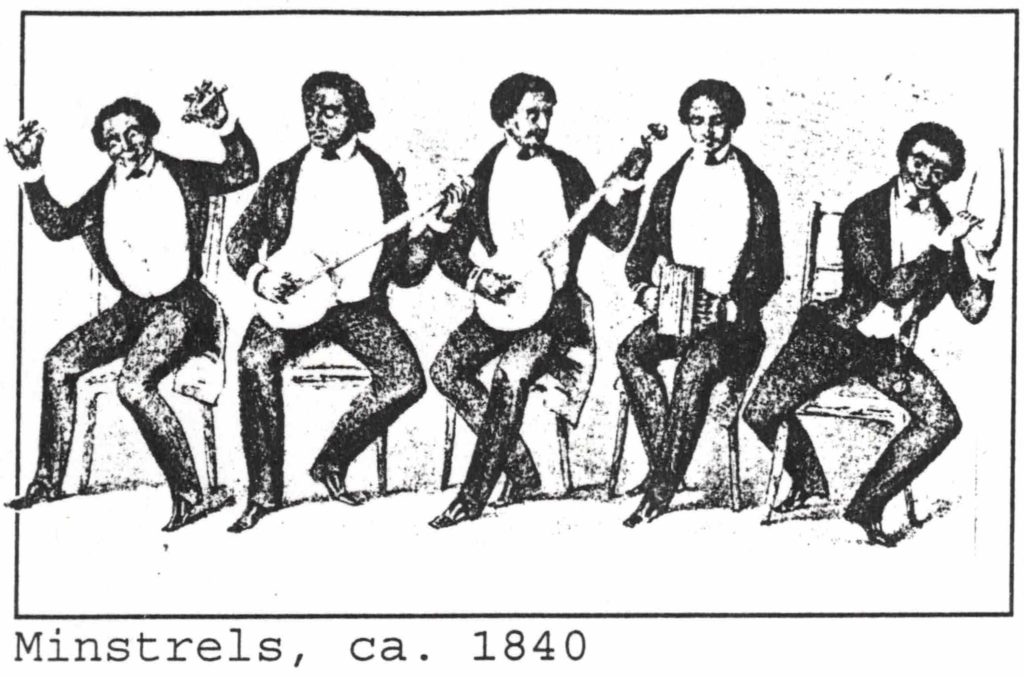
  Many of the early minstrels were Irish or Scots-Irish. Many thousands of Irish people had been displaced by English conquest, and Scots had been cleared from their highlands to be replaced by sheep. Later, thousands of Irish fled the famine of the 1840s; in great numbers they came to America. The Irish were an economically and culturally marginal group,[1] and the populace at large found their songs and accents amusing, as they would come to find Black culture, as purveyed by the Irish. The Irish held a special underclass status in America, in keeping with their colonized status back at home. Many convicts and prisoners of war had been sent from Ireland to Jamaica (as well as to Australia and elsewhere) after 1664 as indentured servants. One of their roles there was to guard against Black rebellions. Intercourse ensued; among the Black musicians with Irish ancestry are Jimi Hendrix and Bob Marley. 

[1] No Irish needed apply to many occupations,
which drove them into disreputable pursuits
such as show business and police work.

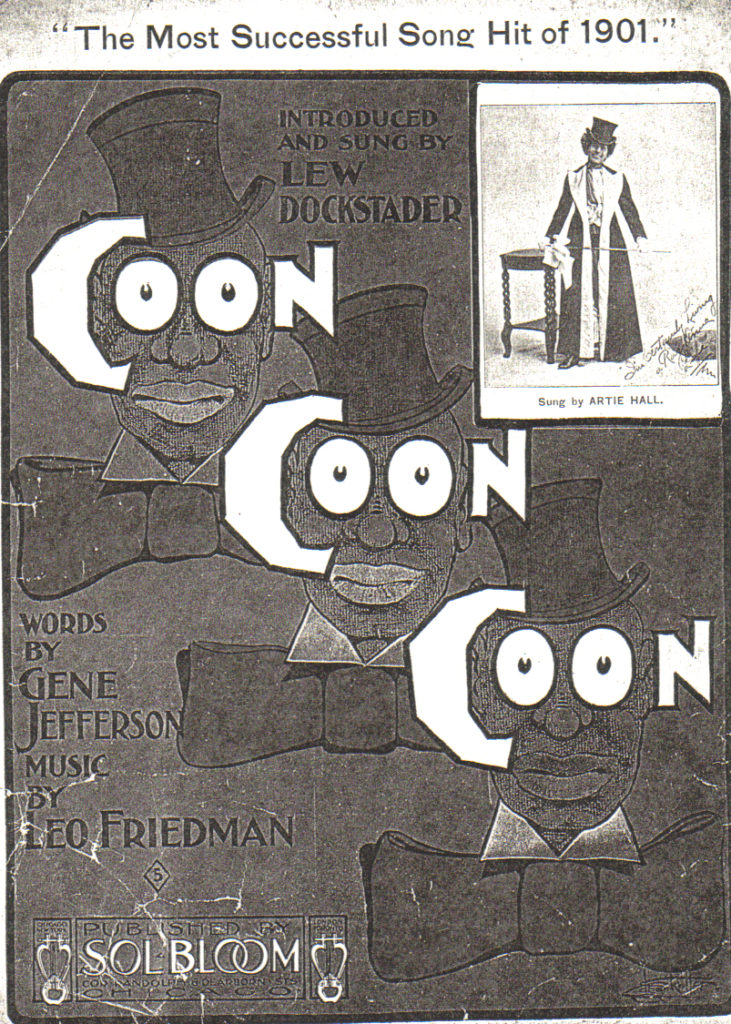
   Meanwhile, some of the best singers of Irish dialect songs in the 1870s were said to be Black stevedores in Ohio.[i] The interplay was endless: an old Irish folk tune—or was it a frontier fiddle tune? or both?—became “Zip Coon,” a song that fostered an enduring stereotype of a pretentious Black dandy; the same song with its lyrics removed became “Turkey in the Straw.”[ii] In Chicago in 1870 an Irish/coon caricature duo was a big hit.[iii]
  American minstrels brought new instruments to the British Isles: tambourine, bones, banjo. Meanwhile English performers also had an influence on minstrelsy: British troupes toured the U.S., blackface and all, from about 1822. Many of the British minstrels were Cockneys—lower class Brits entertaining by imitating lowest class Americans. 

  One Cincinnati day[2] in 1828, a minstrel named Thomas “Daddy” Rice happened upon an old Black groom named—well, we don’t know his name, of course—but as he went about his work he was singing and dancing a little number:
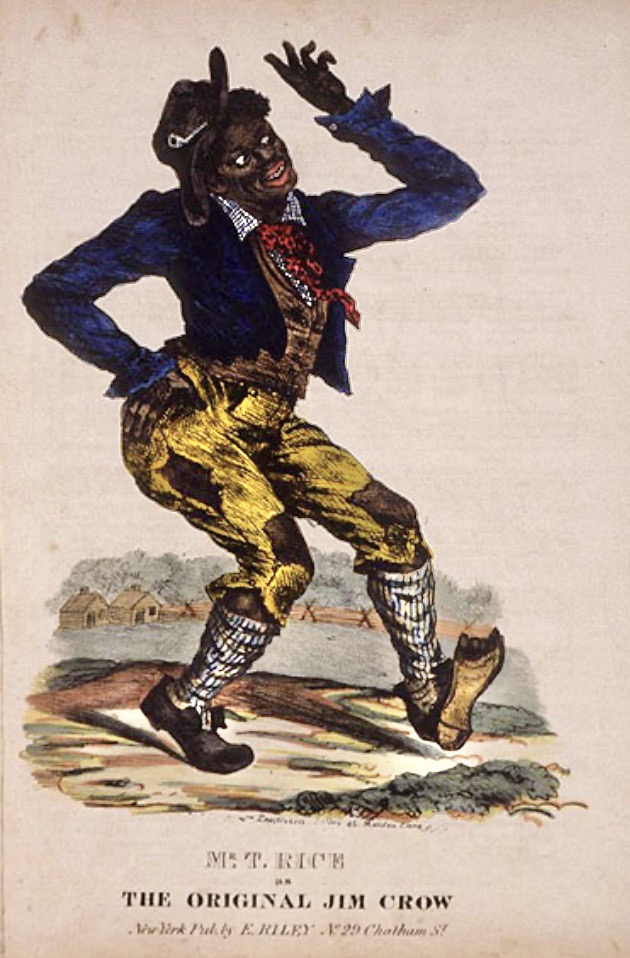
Turn about and wheel about and do just so,
And every time I wheel about I jump Jim Crow[3]       

[2] or Louisville; historians don’t know for sure.

[3] From a lyric in a (borrowed) minstrel tune,
possibly referring to a dance in imitation of a bird,
possibly used in plantation corn shucking frolics,
Jim Crow would go on to become synonymous with
segregation laws.
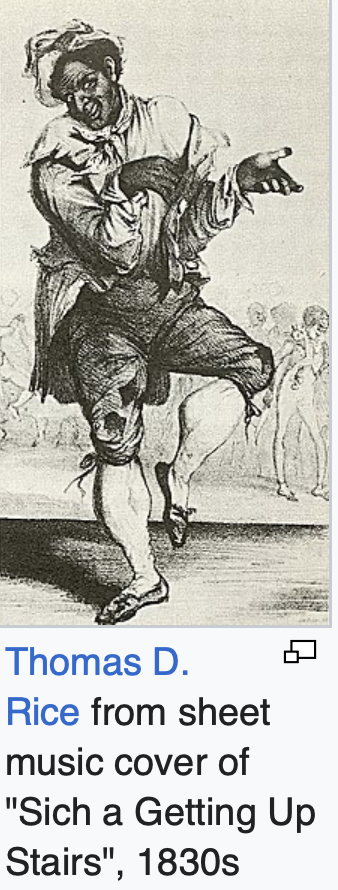
Rice pursued the artiste, copped the riff, blacked his face, and out popped a hit. The old fellow who caught his performer’s eye was not only Black but also physically afflicted, or at least possessed by rheumatism, and thus his movements were not only exotic but peculiar—today we would call the imitation “victim humor.” In any case, the new bit was a smash, and it changed show business, not unlike an early-day Twist.[4]

[4] Ten years later Rice would add a skit
based on a song done by a New Orleans street vendor
called Mr. Corn Meal, after a song he did
about the Indian corn he sold.
(Conway 1995, 92, 327
)

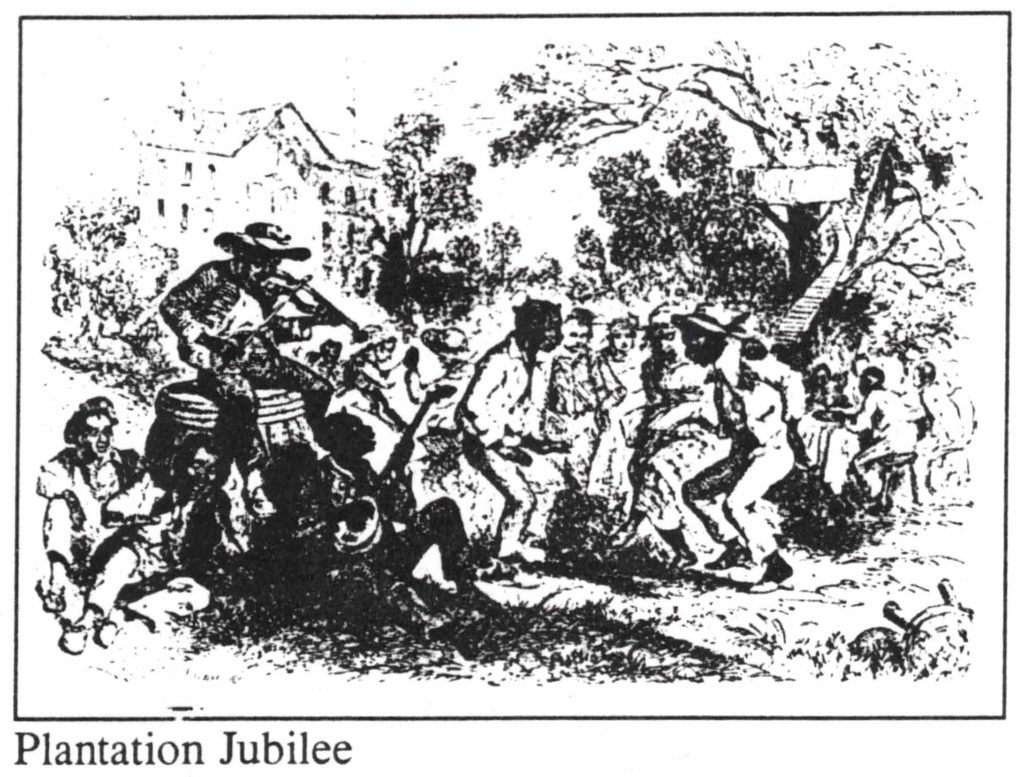
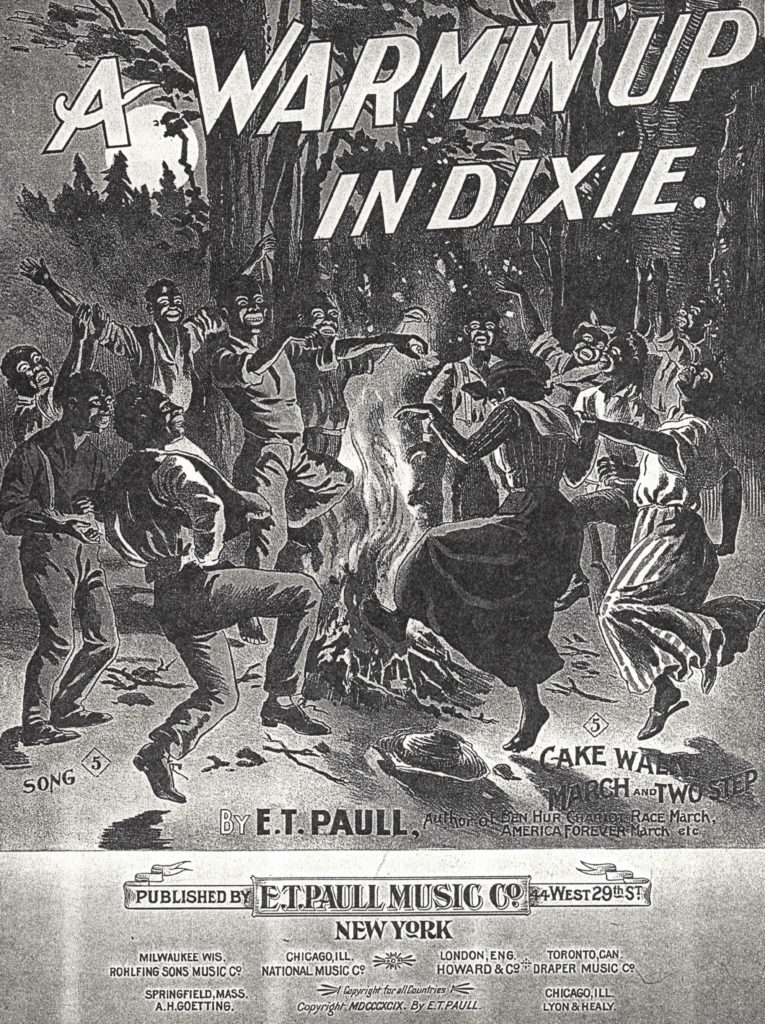
  Other minstrels took notice. Performers from the South visited plantations—if they didn’t live on them themselves – and were swept away by the artistry of those in bondage. The largest part of the resulting material was an imitation of the plantation entertainments, including the song and dance styles. A contemporary observer recalled a plantation festival in Virginia as being full of “laughter and song, antics and buffoonery which would make a modern minstrel show appear tame…”[iv] Having Pat Booned or Vanilla Iced it down a bit, the promoters gave their shows names such as “Plantation Revels” and “Plantation Frolics.” The shows customarily ended with a cakewalk, just as actual plantation revels did. 

Minstrel show, 1913

  As the nation was a diverse stew of peoples, if not a melting pot, so with the music. John Rublowsky describes minstrel music as “an Anglo-American modification of an Afro-American modification of African, English, Scotch, Irish, German, French and Spanish originals.”[v]
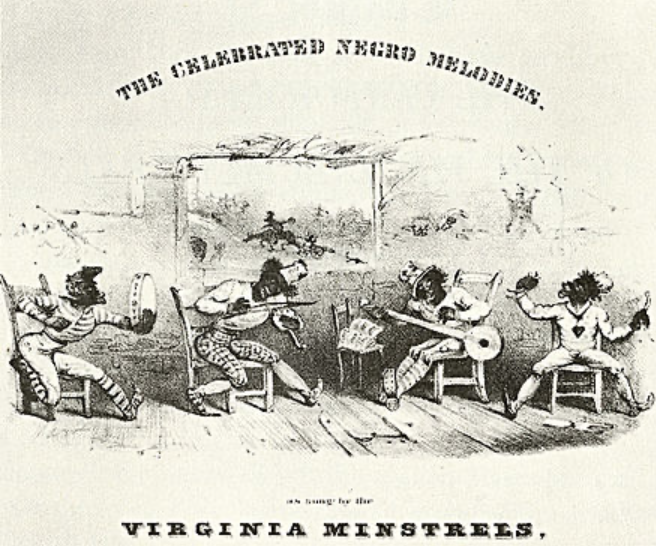
  In this connection, Old Dan Tucker can help guide us back through the mists of time and shed some light on the mysteries of cultural origins. Most of us think of Dan in connection with an amusing square dance tune, but let’s hit the roots trail. The song was scribbled by Dan Emmett of the Virginia Minstrels around 1830, and was blown up into a skit with Dan playing Dan, White playing Black. The humor was the usual minstrel mix; today’s bleached version retains the humor while covering the tracks of its tears. Take a look at the sheet music of the day to see where folks got their entertainment. Emmett’s other tunes included “I’m Gwine Ober De Mountains” and “The Fine Old Colored Gentleman.”
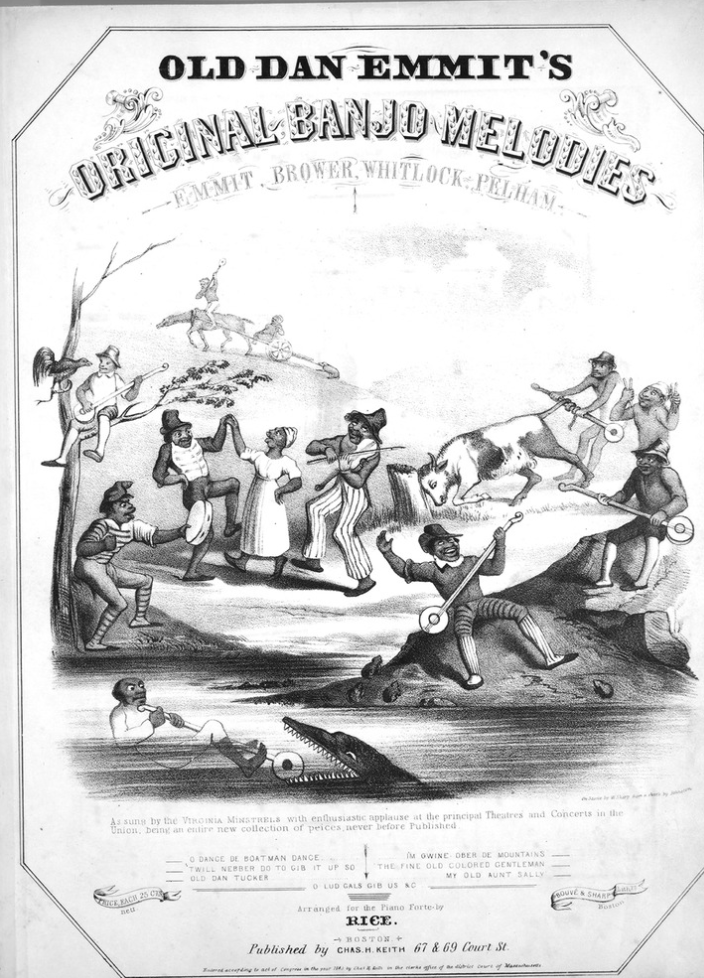
  The arts of this period were characterized by gross caricatures of ethnic groups—something that has been, more or less, diminishing with time. All kinds of groups came in for stereotyping, most of all the lowest of the low. Minstrelsy often portrayed Blacks as lazy, cowardly and stupid; yet at other times their characters were witty and talented. The “lower” Black characters, Tambo and Bones—named for their musical instruments—were the customary winners in the tricky and sophisticated punning contests, beating the supposedly superior “interlocutor” (MC) and the audience as well.[vi] Their rattling instruments told the audience it was time to laugh, and constituted perhaps the first laugh track, or at least cue card.[vii]
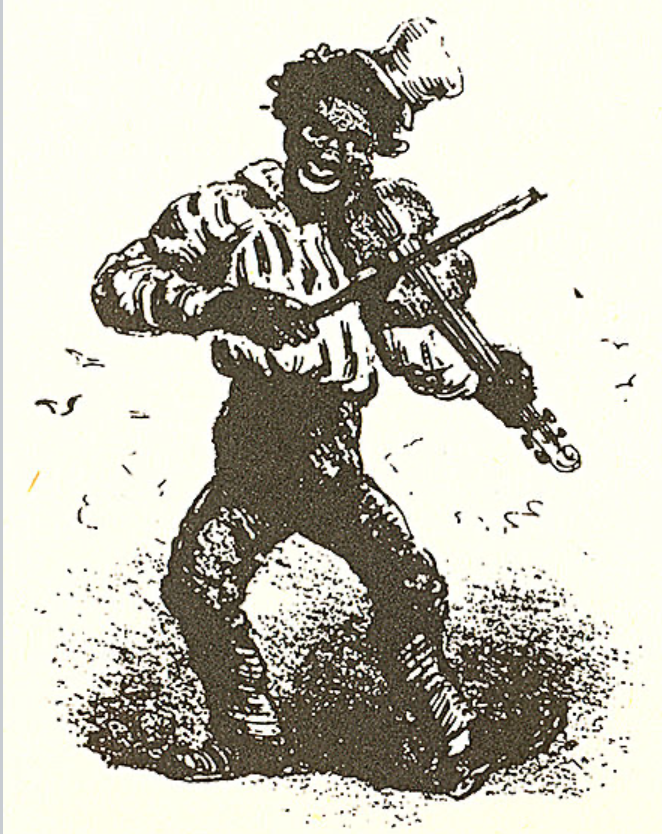
  And there were instances of outright reversal of racial stereotypes, including one story in which Cain and Abel were Black, with Cain turning white in fear of God after murdering his brother. Another story has Adam and Eve turning white in fear of God after their own transgression.[viii]

Minstrel show, 1935

  The standard critique of minstrelsy is that it was pure racism on the stage. But William F. Stowe and David Grimsted critiqued the critique by exposing the multiple functions of the form: the White performers were making fun of Blacks, but at the same time identifying with them, or at least with their idea of them. “White men put on black masks and became another self, one which was loose of limb, innocent of obligation to anything outside itself…and thus a creature totally devoid of tension and deep anxiety.”[ix]
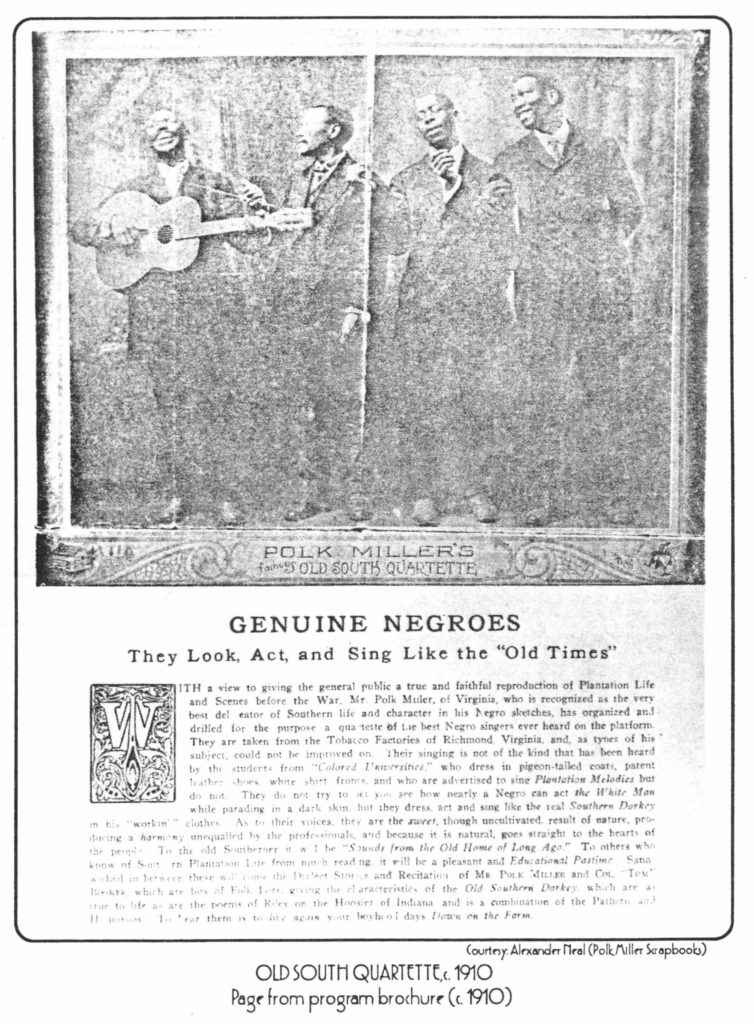
  As simplistic and caricatured as that is, it is not antagonistic. Many performers were acclaimed for accurate, even “profound” impressions of Black styles. The original minstrels, who hailed from the south, learned their musicianship from Blacks; they would go on to teach their northern colleagues, who had less direct contact with the source. A White banjoist from Virginia named Ferguson, for example, was described around 1840 as “nigger all over except in color.”[x] A wannabe? Or just another White dude appreciating Black culture? Contemporary descriptions of the minstrel shows indicate that White audiences were able to identify with the black images on the stage, which included “Wit and buffoonery, music sentimental and comic, dancing stately and grotesque, pretension and simplicity, pathos and farce.”[xi]For White audiences there was always a tension between, on the one hand, the desire to dominate Blacks by reducing them to caricatures; and on the other, the desire to become one with them, to identify with them, through appreciation of their artistic expression. Appreciation vs. appropriation—such racial schizophrenia continues to this day. 

Excerpt from “A Complete Authentic Minstrel Show,” 1958

  The rerouting of emotional issues through caricatured characters by use of the “mask” opened the possibility of social criticism, which dealt with class as well as race questions. Stowe and Grimsted quote one exchange in which the interlocutor maintains that American society equalizes rich and poor, to which Tambo replies, “Sho, de rich gets ice in summer, and de poor gets it in winter.”[xii] The authors go on to point out that although it’s true that the stereotyped characters were buffoons, it’s also true that court jesters of old were buffoons: that was precisely the cover that allowed them to make sharp social commentary. 

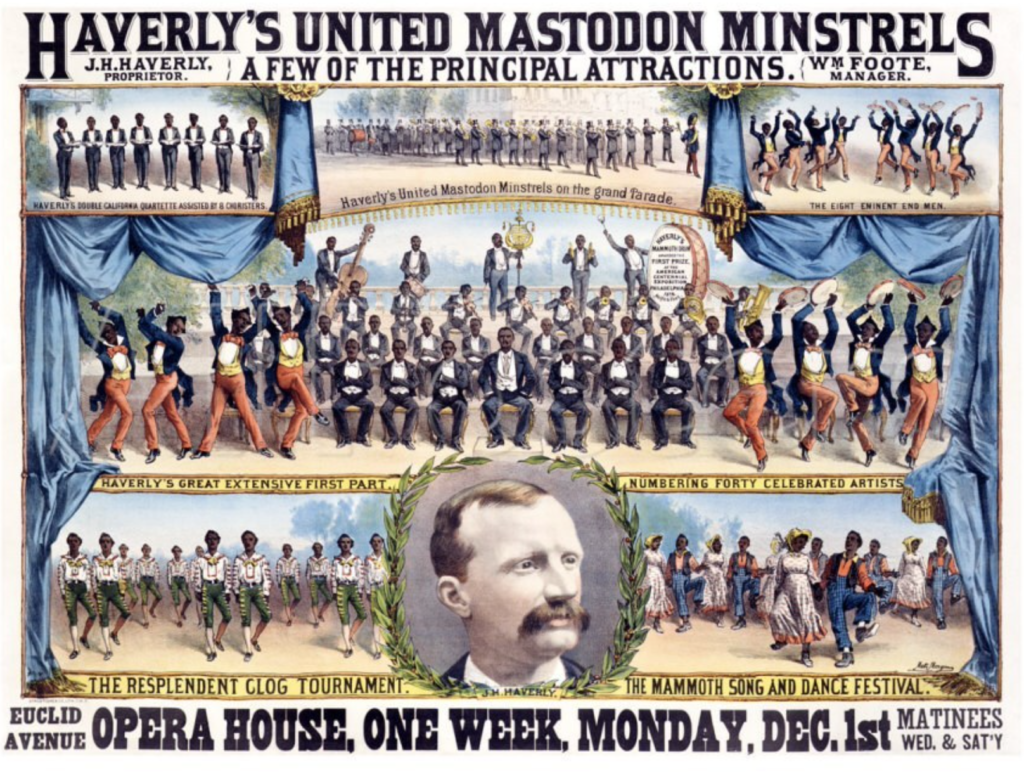
  Many enduring elements of American show business have their roots in minstrelsy: soft-shoe dancing, vaudeville humor, political caricature, and of course, music. George Christy, of Christy’s Minstrels, was the first to bring Stephen Foster’s tunes to a wide audience. He had observed Black musicians up close at Congo Square in New Orleans, where the captured Africans were allowed to maintain African culture with drum and dance.[xiii] Minstrel Lew Dockstader got Al Jolson started in blackface, and Broadway producer George M. Cohan had his beginnings as a minstrel company manager.[xiv] Minstrel-style humor can be viewed in the Marx Brothers’ movies, and in much of stand-up comedy.
  The minstrels copied songs that were originally sung by a kidnapped workforce to survive the backbreaking labor that built the South.[xv] Here we have a clear case of talking the talk without walking the walk: the White audience wants the style without the content, the gain without the pain. They receive, or seize, as Greg Tate pointed out, everything but the burden.[5] They are able to enjoy the earthy, grounded, fluid music and movement that has sprung from physical labor, without thinking about how their own lives have been softened by the labors of others. It is not unlike tourists in a tropical clime, admiring the bronze bodies of the natives who cannot afford the luxury tourist hotels. No pain, but vicarious gain.

[5] Or as Charles Keil put it, “They want the music,
but they don’t want the people.”
(City and Society, June 2002)

   The blackface rendition was the dominant form of musical entertainment right up into the 20th century. Minstrel shows were often advertised, straightforwardly enough, as “imitations,” and were described by an actress of the day as “faint, feeble, impotent—in a word, pale Northern reproductions of that ineffable black conception.”[xvi] Such treatments form part of what Cecilia Conway would call the “mental terrorism” of inter-cultural relations.[xvii]

___________________________________

STEPHEN FOSTER
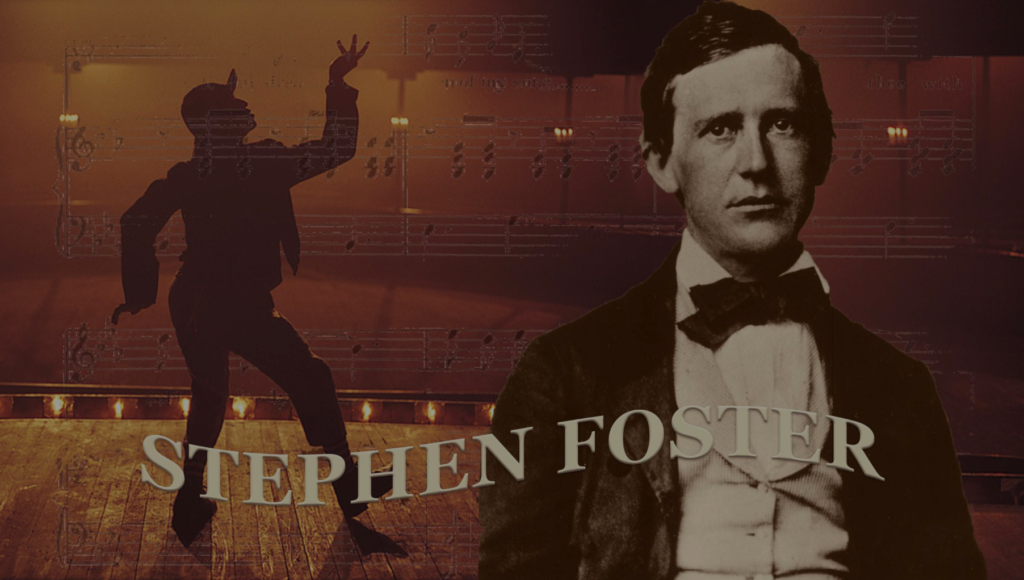
In the late slavery period we encounter the first quintessential American songwriter, Stephen Foster. Born near Pittsburgh in 1826, he frequented a Black church from age seven, escorted by one of his family’s two illegally enslaved staff (slavery being already outlawed in that section of the country). The “bound girl,” Olivia “Lieve” Pise, attended a church of “shouting colored people,” and Stephen was permanently impressed by the music. He is said to have preserved melodies he heard there in his “Hard Times Come Again No More” and “Oh, Boys, Carry Me ‘Long.”[xviii]

There was a large Black community in Pittsburgh and an underground railroad station, and Foster came in contact with freedmen, escaped bondswomen, and their families, along with his family’s “own.” He became a star performer in a childhood theatre company with his friends, singing “Zip Coon,” “Long-tailed Blue,” and “Jim Crow.”[xix],[6] While still a child, Foster saw “Daddy” Rice perform. Later he submitted songs to him, and they became friends.[xx]

[6] All three songs have roots in Irish or Scottish folksongs,
filtered through enslaved singers and minstrel showmen.

As a young man, Foster lived in Cincinnati, where he heard Black stevedores singing as they loaded boats on the Mississippi. He was supposed to be working a day job at his brother’s warehouse, but biographer John Tasker Howard tells us

[H]is heart was not in his work. He was more interested in the Negro roustabouts who sang and danced on the nearby river wharves.[xxi]

He went on to a smashing career in songwriting, his works being featured by major minstrel companies. His hits included “Oh! Susanna,” “The Old Folks at Home (Swannee River),” “My Old Kentucky Home,” “Old Black Joe,” and “Camptown Races.”           

        ♬SUBSTITUTION: Compare “Camptown” with the Spiritual “Roll, Jordan Roll.” Was one substituted for the other?

        Foster originally published his “Ethiopian” or “Plantation” tunes under a pseudonym, thinking they would detract from his reputation as a ballad-writer of such successes as “Jeanie With the Light Brown Hair.” Eventually he realized what a hit he was making with the less reputable style, and reclaimed his authorship.[xxii]

        Foster engaged in some considerable struggle over the content and use of his work. He gradually eliminated demeaning dialect and offensive words from his songs, and changed their generic title from “Ethiopian Melodies” to “Plantation Melodies.” He penned realistic lyrics showing the harshness of the subjugated life, eschewed insulting caricatures on his sheet music covers, and tried to elevate the tone of the genre so that it might be more generally accepted. All of this was rather unusual in the 1840s minstrel world. He sold one song to Daddy Rice—”Long-Ago Day”—that was never heard because, according to Foster, a Rice colleague said it was a bit anti-slavery and would be rejected in the South.[xxiii] His efforts at social-musical uplift are little known because of his family’s ties to the slave-ocracy[7] and a brother who destroyed much evidence of Stephen’s deviance in the course of executing the estate.[xxiv]

[7] Foster’s father was a Democrat – the party of slavery –
and one of his sisters married a brother of James Buchanan,
the last Democratic President under slavery.

        Because of the subject matter as well as the style of his work, Foster’s career is a matchless example of the centrality not only of Black musical influence, but of the race question in general to life in the United States. Brilliant songwriter he was, no question, but there always remains the matter of Blacknowledgements; J.K. Kennard in Knickerbocker Magazine (1845) noted of singing bonds(wo)men:

Let one of them, in the swamps of Carolina, compose a new song, and it no sooner reaches the ear of a white amateur, than it is written down, amended (that is, almost spoilt), printed, and then put upon a course of rapid dissemination, to cease only with the utmost bounds of Anglo-Saxondom, perhaps with the world. Meanwhile, the poor author digs away with his hoe, utterly ignorant of his greatness.[xxv]

These comments were, it is said, satire. Kennard apparently was less than jazzed by the works of untutored swamp songsters. Despite this disdain, the point intrigues. Alain Locke would later compare Foster to Joel Chandler Harris and his relationship (through Uncle Remus) to Black storytelling:

Both watered the original down just enough to give it the touch of universality, and yet not enough to destroy entirely its unique folk flavor…the sentimental side of the plantation legend wormed its way into the heart of America for better or worse, mostly worse.[xxvi]

And as Rod Stewart would point out a bit later, “There are a lot of colored guys who can sing me off the stage. But half the battle is selling it, not singing it. It’s the image, not what you sing.”[xxvii] Stewart’s words ring true, as do Kennard’s, despite being a poorly-informed satire against those who championed the Black origins of minstrel style.[8]

[8] Ostendorf (1979, 584) says
“the author half-believes what he parodies”;
Lott (1991, 236) speaks of him lampooning
“Young Americans’ quest for a national art”
through Black music as portrayed in minstrelsy.

_______________________________________

JUBA
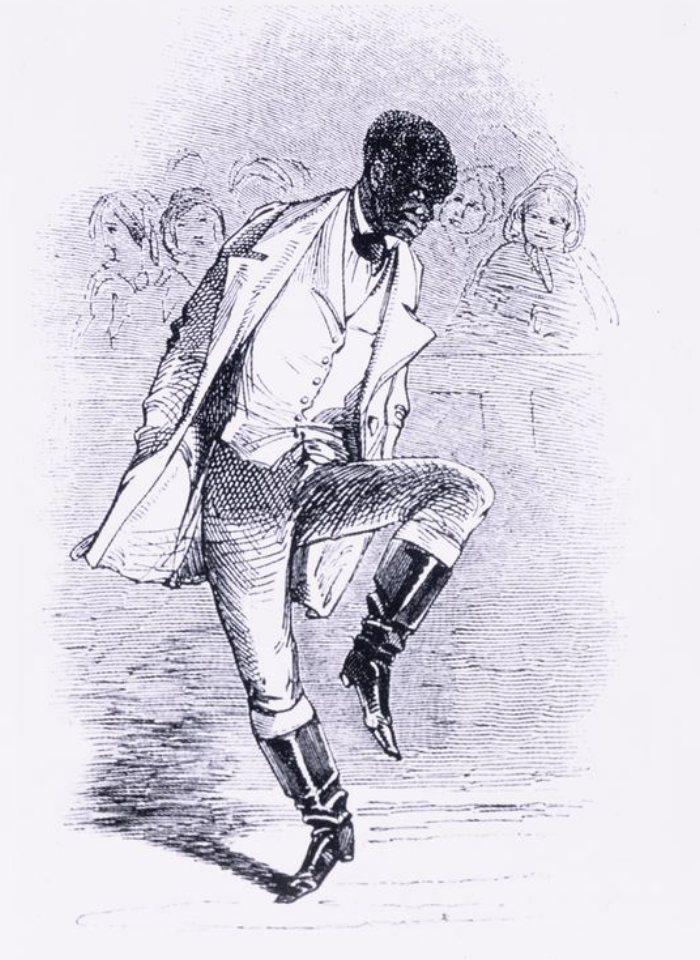
In the minstrel tradition, the real thing was never enough—or maybe it was a bit too much—so when Blacks themselves entered the field, even they had to black up, lest they be taken too seriously as, let us say, people. A notable example was Rhode Island’s William Henry Lane, who danced under the name of Juba.[9] He outdid all the other dancers, Black and White alike, and was hired by P.T. Barnum around 1841. Charles Dickens described Juba’s dancing thus:

Single shuffle, double shuffle, cut and cross-cut, snapping his fingers, rolling his eyes, turning in his knees, presenting the backs of his legs in front, spinning about on his toes and heels like nothing but the man’s fingers on the tambourine…[He dances] with two left legs, two right legs, two wooden legs, two wire legs, two spring legs, all sorts of legs and no legs…he finishes by leaping gloriously on the bar-counter and calling for something to drink…[xxviii],[10]

[9] “Patting Juba” was already a practice at least from the 1820s.
Epstein & Sands in Burnim and Maultsby, 37.

[10] Robert Farris Thompson compares this to similar steps
seen in Argentina in the 1800s, among people of similar origin
in the Kongo kingdom (Thompson, 86.)

Only one problem:

“[H]e was a genuine negro; and there was not an audience in America that would not have resented, in a very energetic fashion, the insult of being asked to look at the dancing of a real negro…”[xxix]

Barnum blacked him up, topped him off with a wig, and presented him as an excellent White imitation of a Black dancer. This particular form of debasement didn’t last long; he was soon receiving top billing on his own, in theaters where only Whites had trod the boards before Juba. Advertisements for his shows promised he would imitate the principal dancers of the day—those who had imitated him—and then offer “an imitation of himself.” The single person most credited with the development of tap dance, Juba took some inspiration from White Appalachian clogging– itself influenced by African American dancing—and Scottish dances known for a kind of syncopation called the “Scottish snap.”[xxx] He also got a lot of steps from Jim Lowe, a Black saloon dancer who remained on the margins of show biz.[xxxi]

White minstrel dancer John Diamond challenged “any other white person” to dance competitions, circumventing a pointless meeting with his master.[xxxii]

_____________________________________

  Minstrelsy disturbed not only those who were the targets of its insults but also those who saw Black culture gaining in popularity through these entertainments. James K. Kennard wrote in 1845 of the “Jim Crows, the Zip Coons, and the Dandy Jims, who have electrified the world,”[xxxiii] fearing that Black style would swamp European culture. For Kennard and others, the great fear was the “blackening of America.”[xxxiv] As Kennard agonized, minstrel man Joel Sweeney would nightly “steal off to some Negro hut to hear the darkeys sing and see them dance.” He had learned banjo as a child from the imprisoned workers on his family plantation in Virginia. He was credited as the man to “distill the native musical genius of the American Negro into…an art form.”[xxxv]
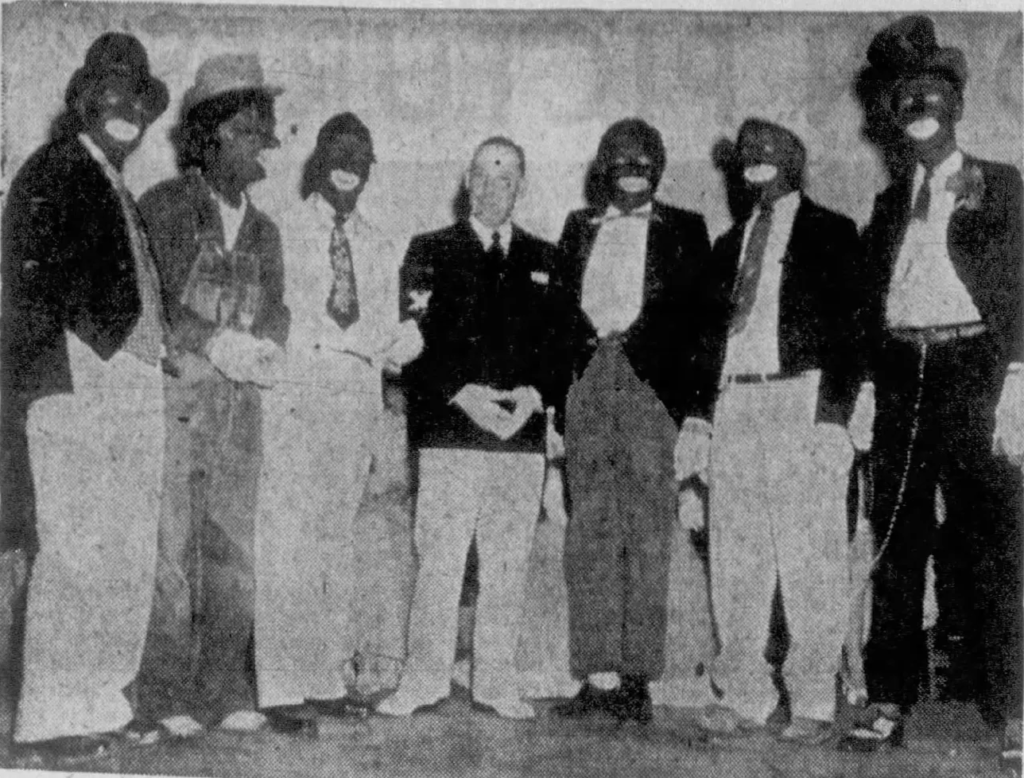
Minstrels, 1959

  The work of the minstrels spread African-American music, in a caricatured form, to Whites throughout the country. The minstrel shows, caricature and insult though they were, paved the way for later successes by Blacks themselves. They were the nation’s major form of entertainment for many decades. Eventually there would be minstrels without blackface, and even mixed-race groups: In 1848 the Ethiopian Serenaders, a group of three White and three Black minstrels, dropped their blackface, and 1893 saw a tour by The Forty Whites and Thirty Blacks. African American troupes came to the fore in the 1860s, putting more emphasis on music and amusements than on insults and denigration, though they still expended artistic energy imitating the imitations of themselves. The Georgia Minstrels formed in 1865, followed in 1882 by Callender’s Consolidated Spectacular Colored Minstrels. James Bland, a New Yorker of Black, White, and indigenous heritage, wrote “Oh, Dem Golden Slippers” and “Carry Me Back to Old Virginny.” Trouper Sam Lucas joined forces with non-minstrel singers to produce musicals like Out of Bondage and The Underground Railroad.  

Much of our entertainment today is a more genteel version of minstrelsy: Whites acting, singing and dancing Black, but without the blackface.[11] Whites continue to use and enjoy Black styles like so much rubber, spice, petroleum or any other resource. And the appropriation continues to soften up the White populace for the eventual arrival of the original article. It’s not justice, it’s just cultural trickle down.  Or up. It’s a combination of racial insult with racial envy, a “peculiarly American structure of racial feeling”[xxxvi] that was first expressed artistically in minstrelsy. The envy was summed up eloquently in an African-American version of “Jim Crow” from 1833:

[11] One notable but little-noted exception was Bonnie Bramlett,
who, before her brief stardom in the “White soul” duo of
Delaney and Bonnie in the late sixties,
performed as an Ikette in Ike Turner’s backup trio –
in blackface. (Kiersh, 172.)
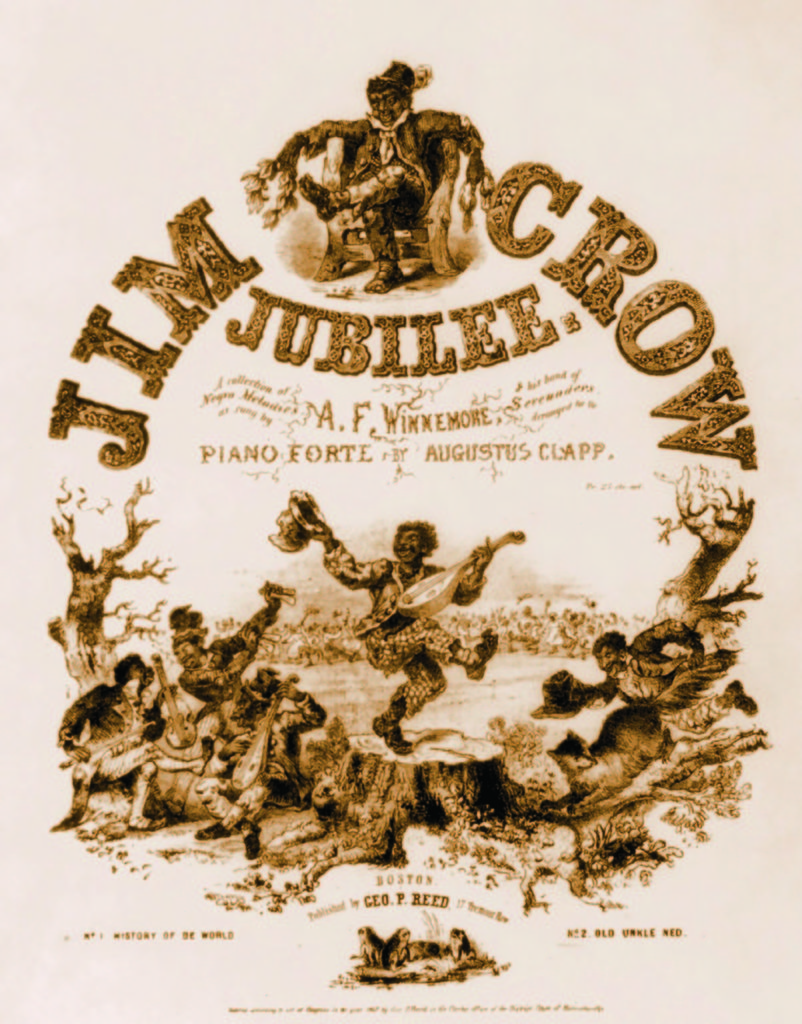
 

I’m so glad dat I’m a niggar, 
And don’t you wish you was too 
For den you’d gain popularity,  
By jumping Jim Crow.

Now my brudder niggars  
I do not think it right,  
Dat you should laugh at dem  
Who happen to be white.

Kase it dar misfortune, 
And dey’d spend ebery dollar, 
If dey only could be  
Gentlemen ob colour.[xxxvii]


[i]Reported by Lafcadio Hearn, cited in Ralph Ellison 1964.
[ii]Ewen, 25.
[iii] Clarke, 44.
[iv] Mary Newton Stanard 1917, 136-37.
[v] Rublowsky 1971, 100.
[vi] Stowe and Grimsted, 84.
[vii] Clarke, 24.
[viii] ibid., 92.
[ix] Nathan Huggins, quoted in Stowe and Grimsted, 81.
[x] Nathan 1962, 110, cited in Conway 2003, 155.
[xi] ibid., 82.
[xii] ibid., 87.
[xiii] Clarke, 23.
[xiv] Spitzer, The Saturday Evening Post.
[xv] Lomax 1960, p 494, 514.
[xvi] Frances Ann Kemble, Journal of a Residence on a Georgia Plantation in 1838-1839, 1863, reprinted Chicago, 1969; 96, quoted in Lott, 1991, 230.
[xvii] Conway 1995, 117.
[xviii] Morrison Foster, Biography, Songs and Musical Compositions of Stephen C. Foster, Pittsburgh, 1896. Quoted in Howard, 83.
[xix] Howard, 83.
[xx] Howard, 125.
[xxi] Howard, 1.
[xxii] Ewen, 42-45.
[xxiii] Howard, 128.
[xxiv] Root, American Music Research Center Journal.
[xxv] In Clarke, 23.
[xxvi] Locke 1936, 47-48.
[xxvii] Jefferson, Harper’s Magazine, 45.
[xxviii] Dickens, 1842/1957, 91-92.
[xxix] Thomas Low Nichols, Forty Years of American Life, London, 1864, 369; quoted in Lott 1991, 227-28.
[xxx] Martin, ibid., 30.
[xxxi] Conway 1995, 94. 
[xxxii] Conway 1995, 95.
[xxxiii] James K. Kennard, Jr., 1845, 332.
[xxxiv] Berndt Ostendorf, Black Literature in White America, 67, quoted in Lott, 1991, 236.
[xxxv]Conway 1995, 105, 109.
[xxxvi] Lott 1991, 227.
[xxxvii] Quoted in Dennison, 54.
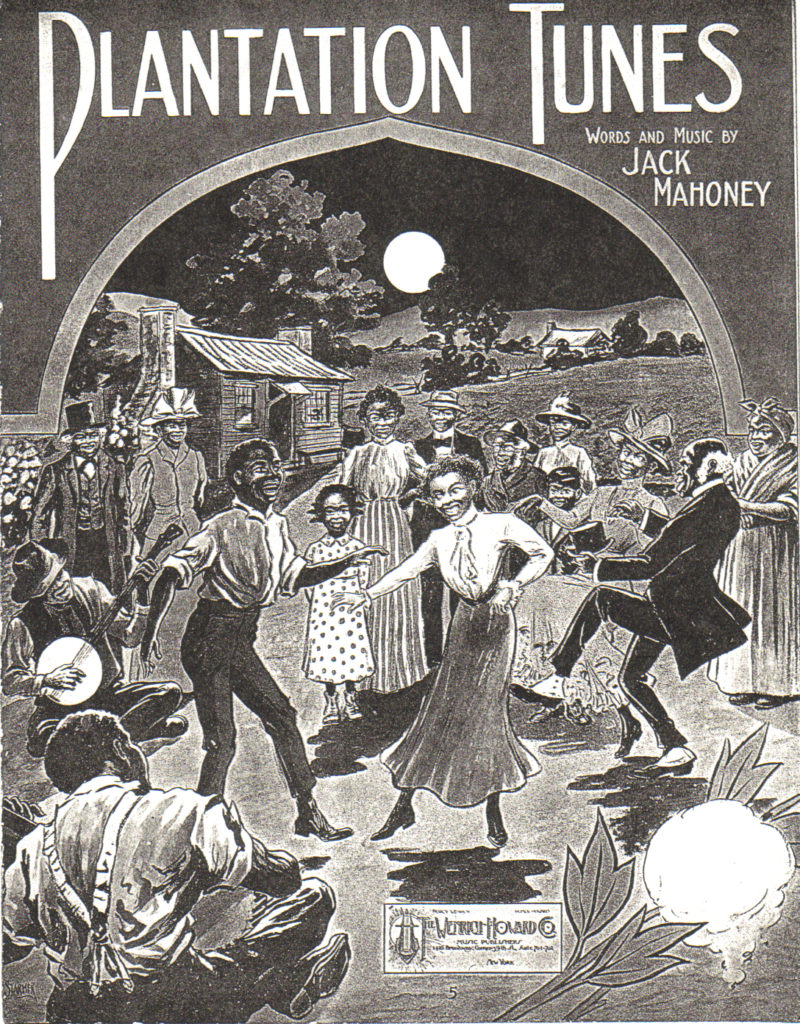
The Plantation

  The ring shout is at once the founding religious rite and the fount of music-dance of the Africans in the Americas.  It is a counterclockwise dance, communicating to gods and ancestors. It is a piece of Africa transported by Africans to their quarters of enslavement across the Atlantic. Thomas Wentworth Higginson observed it in a civil war army camp: 

That strange festival, half pow-wow, half prayer-meeting, which they know only as “shout”…singing at the top of their voices…accompanied with a regular drumming of the feet and slapping of the hands, like castanets.[i]

Ring shout re-enactment by Geechee/Gullah women

   He called it “Half bacchanalian, half devout.” Indeed. Bacchus was, after all, a god.  In some countries dance is a critical part of worship; in fact, in some places dance is mainly a form of worship.[ii]

__________________________________

THE BUNNY HOP

This dance is a variation on the conga line, brought from Cuba courtesy of US colonialism. It was (re)created in Balboa High School, San Francisco, in 1952. Even in the dreaded suburban fifties–especially in the fifties—it was necessary to create a thinly disguised African dance that White kids could entertain themselves with. I did it, and grew up a shade of Black without knowing it.

__________________________________

  Marshall Stearns witnessed a shout remnant in South Carolina in the 1950s:

The dancers form a circle in the center of the floor, one in back of another. Then they begin to shuffle in a counter-clockwise direction around and around, arms out and shoulders hunched. A fantastic rhythm is built up by the rest of the group standing back to the walls, who clap their hands and stomp on the floor….Suddenly sisters and brothers scream and spin, possessed by religious hysteria….[iii]

   The clapping and stomping, of course, developed as replacement for the outlawed drum.

      Later the shout is brought into more or less “proper” churches, where worshippers sit in rows of benches or chairs. When they leap up, they go into the aisles. This leaping about under the influence of spirits becomes the new form of the shout: the ring is confined to the aisle, and the choir grows in importance. 

   We see the grandchild of the original in the Black church, especially the Holiness churches. And this is what the shout is about: possession of congregants by spirits. 

  Sterling Stuckey, commenting on Higginson, expanded on the (mis)underestimation that would become a permanent feature of American life:

Since he did not grasp the substance of their religious belief…As principled and faithful a friend of Blacks as he could comment, ‘They seem the world’s perpetual children, docile, gay, and lovable…’ Little did he realize that their tales of greatest depth—he had heard only those in a humorous vein—contained attacks on oppression sharper than anything managed by the keenest and most sympathetic intellectuals in the North.[iv]

So it wasn’t only religion that hid under the mantle of amusement or was misperceived as such: the overall social cohesion of the African community was the function of these rituals. Cohesion was also fostered through such activities as the Parade of Governors in New England. Commencing around 1750 and continuing for 100 years, the revelry cloaked religion, as did the shout, but also cloaked actual governance. Whites promoted these activities as a means of control, but in the bargain they facilitated cultural transmission as well as the recognition of leaders who ended up with more influence than the facilitators had bargained for. They dismissed African languages as gibberish and African spirituality as entertainment; the wisdom of hiding actual beliefs and practices from the boss was learned early and well by the Africans. 

  When African royalty are mistaken for jesters, nothing is what it seems. In short, what was noticed of African culture by Whites was a small part of what was going on, right under their noses. And the denial continues: take the case of Pinkster, a Dutch celebration (from the Dutch word for Pentecost). It went from a religious holiday to a celebration of spring, but over time came to be considered an African American holiday, widely celebrated in New York and New Jersey, peaking around 1790-1810:

Nine tenths of the Blacks in the city, and of the whole country within thirty or forty miles, indeed were collected in thousands in those fields, beating banjos, singing African songs…[there was] a marked difference between this festival and one of European origin.[v]

And yet, when I encountered a remembrance of it in Teaneck, New Jersey in the early 2000s, the local government sponsors made no mention of the African American aspect, and took no interest in a critique of it. The erasure of a supposedly free and equal people from history in many instances small and large constitutes a continuing insult and disempowering distortion of history.

Meanwhile, back in the 19th century: White ministers charged with Christianizing the heathens certainly noticed the shout, and crusaded against it. So over time it gets outlawed here and there, but persists: it continues in Philadelphia into the 1870s, long after slavery was permitted there; in Tennessee into the 1880s. It is observed by John and Alan Lomax in mid-20th century Texas, Louisiana, Georgia, the Bahamas; they see a similar ceremony in Haiti. And why should it not persist? As Stuckey points out, attempts to suppress the shout amounted to “asking them give up the products of ancestral genius as well as the means by which spiritual autonomy was preserved.”[vi] In fact, a minister—himself African American—attempting to quash the singing of spirituals in a Baltimore church in 1850 found himself confronted by “a congregation led by two women who, rising from a front row and approaching the pulpit with clubs, attacked him and an assistant pastor.”[vii]

  Most enslaved people brought to the Americas came from Dahomey (Benin), Nigeria, Togo, Ghana, Congo, Angola, Cameroon, Equatorial Guinea, Gabon—essentially the arc of territory all along the center of West Africa. So when we talk of the roots of culture among the enslaved, we are looking for its antecedents and essentials in this part of West Africa.[1] We must also bear in mind the presence of Muslim Africans, mostly from Senegal and Gambia, in the west central arc.[2] The rice farmers of the Carolinas and Georgia in particular were brought from Senegambia, where they had plied that trade. And linguistic influence from Mali, slightly inland from there, has been found in the Gullah language spoken in the Carolina-Georgia Sea Islands.

[1] There is also evidence of significant trafficking
of enslaved central Africans. See Holloway, 18-38.

 [2] The Arabic word saut (pron. shout) means to walk or run around the Kaaba
(the holy building in Mecca). Remember,
there were lots of Muslims from Africa
enslaved in the Americas.
We draw conclusions, however, at our peril.

  So these are the people who create the culture that fans out into and threads through the centuries of American culture. European-derived folks have often considered Africans, or Blacks, or “primitives,” simplistically, as being somehow mere physical beings, exotically sensual, not cerebral. But the banning of dance from religion that is so common among Euro-Americans might help us to understand that the Euro-Afro divide is not a mind-body divide, but rather a divide over whether the body can participate in the activities of the soul; that is, the two cultures differed over what spirituality encompasses. The western segregation of sacred and profane, casting out earthly concerns from religiosity, would catch up with the Black church, separating the blues from spirituals and Saturday night from Sunday morning. But African spirituality, in its origins and its practices for many generations in America, included what we would think of as secular under the umbrella of the sacred. Even when Africans in America adopted Christianity, they brought to it other ways of being, most obviously the physicality of their worship, which continues to express itself in movement and song, and shout. 

  So finally, what is the effect of all this? Broadly, we can contemplate a continued struggle between worldviews and spiritual approaches; focusing directly on music, we can consider the perpetuation of Africanisms in the various subsequent forms of African American—and thus American—music, as did Marshall Stearns:

The continued existence of the ring-shout is of critical importance to jazz, because it means that an assortment of West African musical characteristics are preserved, more or less intact, in the United States—from rhythms and blue tonality, through the falsetto break and the call-and-response pattern, to the songs of allusion and even the motions of African dance.[viii]

In other words, African American culture came in on a ring and a shout, survived, and conquered.

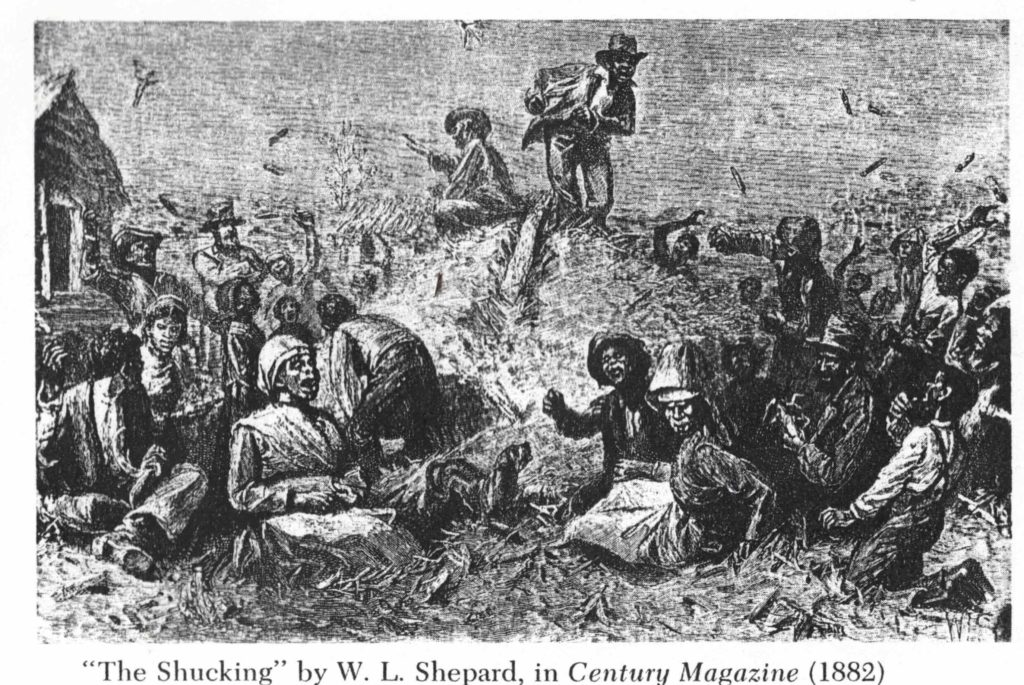
  Under the regime of slavery there was a major autumnal gathering on many plantations that served at least three purposes. The master needed the harvested corn husked. He had the sense to take advantage not only of the people under his own shackles but also of others from the neighborhood. So the shucking became not just another task; it was a party that featured husking speed contests, feasting, and song and dance. The enslaved were able to communicate among themselves, and the masters were able to enjoy African-American music. What sort of music was it? It was a remarkable enough display that 

white observers discussed it a great deal, seeing in it something savage and therefore frightening, but enormously attractive at the same time.[ix]

—a description remarkably similar to White society’s later response to jazz and blues and subsequent genres. What they heard was a blend of order with cacophony, singing that entered and disappeared, competition in volume and improvisation, calling and responding, led by the “captain,” who

seated himself on top of the pile—a large lightwood torch burning in front of him, and while he shucked, improvised words and music to a wild “recitative,” the chorus of which was caught up by the army of shuckers around.[x]

  Captive workers played fiddles and banjoes, triangles and fifes. They also clapped, snapped, and patted on their bodies—a practice that came to be known as “patting juba,” and was one of many that substituted for the banned African drum.[3] A slave-owner wrote in 1851 that a fiddler he “owned” was “always accompanied with Ihurod on the triangle and Sam to ‘pat.”[xi] And in a remarkable pun, 

the phrase “patter de pat, patter de pat” was used to warn fellow slaves of the presence of patrols in the neighborhood.[xii]

[3] The British prohibited the Africans from drumming in Jamaica in 1680,
in South Carolina after the Stono Rebellion of 1739,
and generally in the American colonies from the 1740s.
See Epstein, 1977, 59.

These patrols, or “paterollers” as the enslaved called them, were hunting escaped humans. But the shortening of the word to “pat” seems to have linked the practice of body percussion with a warning of danger, curiously similar to the communication of the famed banned drum. It could well have become one of many hidden meanings, its roots buried in the music.

  And the clapping was no simple matter of getting it on the right beat; there were distinctly different pitches produced by different hand positionings and cuppings. The drum, again. Elaborate slap and clap became hambone, a cousin to juba used in playground games.

playground games

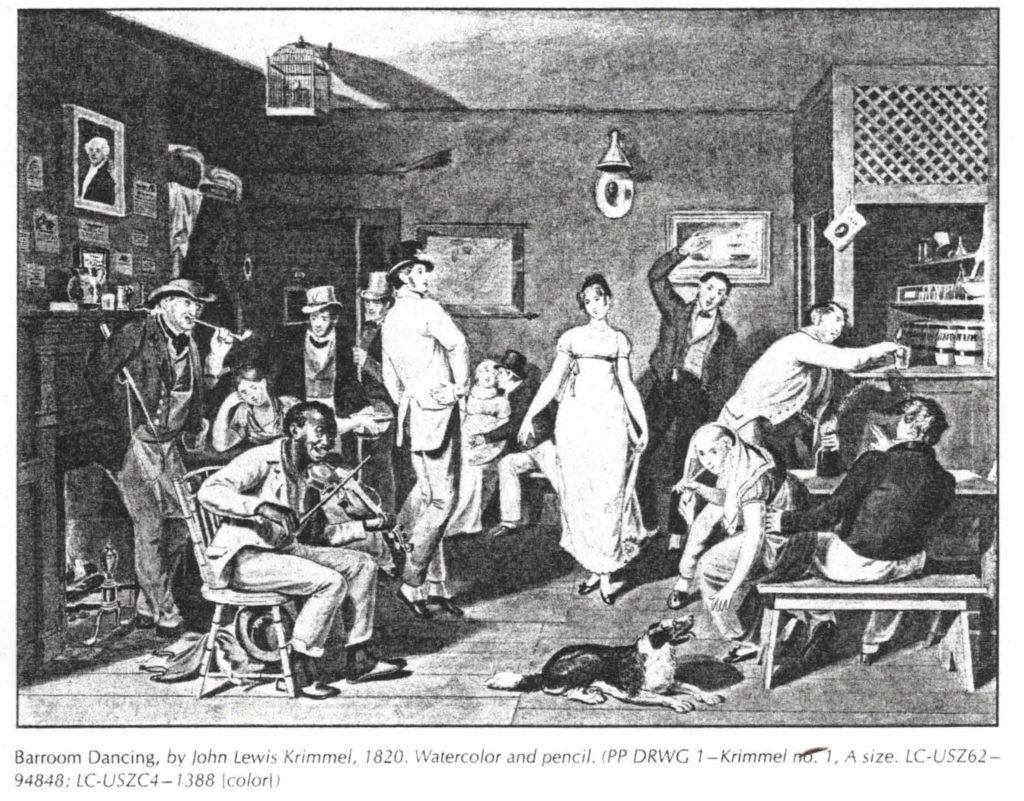
  Perhaps the oddest percussion of all is also the most revealing of African rhythmic sense: the “beating of straws” on a fiddle. The setting of a second rhythm against the primary one, the meter or “beat,” produces syncopation. At the corn frolics, the fiddler had a second person armed with two stout lengths of straw, which are drummed against the fiddle strings between the bow and the fingering hand. One fiddle, two rhythms. W.C. Handy described another version:

A boy would stand behind the fiddler with a pair of knitting needles in his hands. From this position the youngster would reach around the father’s left shoulder and beat on the strings in the manner of a snare drummer.[xiii]

What a curious thing to do. But then, the fiddle probably had more uses than we know—certainly more than the White observers of the day knew. It appears to have been one of several repositories for the power of the banned drum. It continued, arguably, the functions of summoning gods and spirits, transmitting their messages, and returning them whence they came.[xiv] If this seems like a big portfolio for a little fiddle, consider the stringed instruments of India and the respect they command in spiritual music; then reconsider the drum, and music and dance in general, in the West African cultures that gave pride of place to music and dance in their communal spiritual activities. (We could probably find something similar in Europe if we looked back a ways to pre-monotheistic cultures.) These enslaved Africans had African fiddles in their background before encountering the European one. And their truly old-time fiddling in the old country had, as noted above, not been irreligious, not mere entertainment.  

  American missionaries at times tried to stamp out fiddling among the enslaved. What they thought profane, Africans thought sacred. Yet a single plantation in Georgia, holding 500 enslaved persons in the 1840s, had 25 fiddlers among them. And how many dance callers?  Phil Jamison, a professor of Appalachian Studies and Music, professes:

All the earliest references to dance callers were black musicians. And that’s something that you do not find in the European tradition, but developed in this country with these black fiddlers.[xv]

As for the dances, first there were jigs, then the more intricate cotillions. [4] Though the names were taken from the Europeans, the actual dances were some combination of Africa via West Indies, Scottish and Irish, and imitations of dances prevalent in English-derived planter culture. Some dances required a “caller-out,” who we now know from square dancing as the caller. Those rhyming calls are probably descended from the improvised rhymes of the corn-husking contests and fieldwork yells. In this connection we might mention the term breakdown, commonly used to describe the holiday-time plantation dances. They may have been named after the harvesting or “breaking down” of the corn, or after the fact that celebrations usually ended with virtuosic solo displays witnessed by the slapping, clapping, patting group. Regardless, it seems that the Euro-American breakdown, a derivative of the European reel, derives its name from the plantation goings-on.[xvi]

[4] Jig was an Irish term and an Irish dance; as applied to
African Americans in the 18th century it meant some combination of
borrowed, altered, and relatively unrelated Black dances.

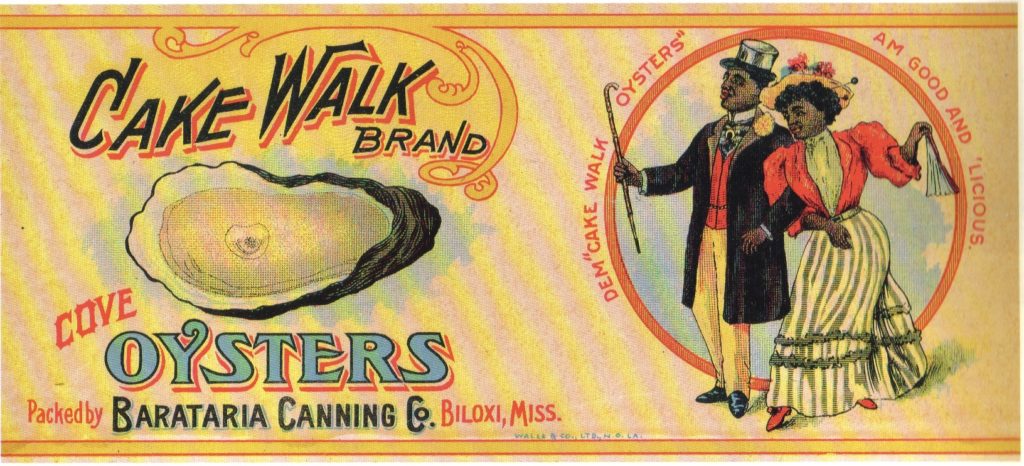
The dancers preferred a dance floor to the bare earth, so they could hear their steps—further evidence of the importance of percussion. One dance that persisted right up to the twentieth century was the cakewalk, also known as the walkabout or strut. Enslaved people developed it as an imitation of their masters’ fancy manners. Master awarded a cake to the best dancers.[5] Masters seem to have missed the mockery of their own style, taking it as a flattering imitation. White minstrels corked up their faces to imitate Blacks imitating Whites—and knew not whom they imitated. Later generations of dancers cakewalked to ragtime, in the final run-up to the explosion of jazz.

[5] Berlin, 104. Hence the expression “takes the cake.”

When not mocking Master, the subjugated workers exhibited a different style of dancing than any practiced by Europeans. The fluidity that we observe in most all African-derived movement is partly a result of the center of gravity: the hips. Movement starts here and radiates out in all directions, moving like a wave and freeing up the torso to undulate in a most un-European manner. Watch people dancing to different kinds of music and you’ll see. Watch the Irish and the Balkan and Texan line dancers, watch the Morris and Contra and Country dancers. Then watch the Congolese and Brazilian and funk dancers. If you’ve a mind and body to, dance to all these musics yourself. Report the results to the class. While we’re waiting, let’s look at three versions of the fabled “Hokey Pokey,” an old British folk dance: a “Western” version, a Caribbean/minstrel version, and a hip-hop kids version from 2005.

“Western” version
“Caribbean” version
Hip-hop version

Another thing you could try is dancing an imitation of an animal. That’s the source of plantation creations like the Pigeon Wing, Buzzard Lope, and Turkey Trot. The latter had a long life after slavery, becoming a popular ragtime dance. Around the same time, the Fox Trot was credited variously to W.C. Handy and others. There were also the Bunny Hug, the Monkey Glide and the Chicken Scratch. Africans during and after plantation slavery often responded to dance calls with animal imitations, quite unlike later and/or Whiter dancers.[xvii]

  The subject of African dancing in America can be studied from different angles. Marshall and Jean Stearns observed, somewhat in reverse:

…the Ibibio of Nigeria performing a shimmy to end all shimmies, the Sherbro of Sierra Leone executing an unreasonably fine facsimile of the Snake Hips, and a group of Hausa girls near Kano moving in a fashion closely resembling the Lindy, or Jitterbug…[xviii]

They further note that the director of the Philadelphia Dance Academy 

“found [among the Africans] close parallels to American dances such as the Shimmy, Charleston, Pecking, Trucking, Hucklebuck, and Snake Hips, among others.”[xix]  

  And in America, Zita Allen contends,

The slaves’ low-to-the-ground, bent-knee stance and fluid, articulate pelvic movements, combined with remarkable isolations, syncopations, and improvisations, would leave their stamp on everything from the “Turkey Trot” and “Fox Trot” of the early 1900s to the “Charleston” and “Black Bottom” of the 1920s, the “Lindy Hop” of the 1930s, the “Jitterbug” or “Swing” that followed in the 1940s, and break dancing, hip-hop, and today’s free style.[xx]

According to Marshall and Jean Stearns, there are six important aspects of the African source style, which was

1) danced on naked earth with bare feet, often flat-footed, favoring gliding, dragging or shuffling steps; 2) frequently performed from a crouch, knees flexed and body bent at the waist like a hunter crouched for the kill, 3) imitates animals in realistic detail, 4) places great importance upon improvisation, allowing freedom of individual expression, 5) centrifugal, exploding outward from the hips, and 6) performed to a propulsive rhythm, which gives it a ‘swinging’ quality.[xxi]

More generally, Robert Farris Thompson describes African dance as characterized by

…dominance of a percussive performance style; a propensity of multiple meter, overlapping call and response; inner pulse or keeping a beat indelibly in mind as a rhythmic common denominator in a welter of different meters; suspended accentuation patterning or offbeat phrasing of melodic and choreographic accents; and songs and dances of social allusion…[xxii]

And while there were new influences in the “new world,” the old ones re-asserted themselves every time more captives arrived from Africa. If they came via the Caribbean they brought other variants of expressivity, conditioned by the different regimes: African culture was more pronounced, less modified, in the sugar zones, where humans were more frequently imported directly from Africa, and masters were sometimes more tolerant of African expression.

By studying the evolution of music and dance in the US since the Civil War, and especially since the Spanish-American one, these descriptions tell us that we have all been dancing a derivative of African style all the while, and all the while not knowing it. In a word, not really knowing who we are. Nor, as it often happens, do we know what we are appropriating, without acknowledgment, for our own use.

  And then there’s the matter of the music that accompanies the job at hand.  Let’s start with corn shucking. The song leader, in this case called the general, takes the workers through their paces:

Gen: Slip shuck corn little while
Cho: Little while, little while.
Gen: Slip shuck corn little while  
Cho: Little while I say.[xxiii]

It wasn’t only work songs that provided this framework for participation, though. An early spiritual shows this:

Dere’s no rain to wet you, 
O’ yes, I want to go home,    
Dere’s no sun to burn you,    
O’ yes, I want to go home   
Dere’s no whips a-crackin’    
O’ yes, I want to go home

Here we hear a link in the chain from West African call and response to its permutations in the blues, jazz, and on down to today. We might compare the corn-songs to the waulking songs, a Scottish tradition. These are sung by a group engaged in pre-shrinking or tightening the weave on a new blanket. At a “milling frolic” I attended in Cape Breton, Nova Scotia, we took turns improvising a wordless vocal chorus: individual improvisation, though no call and response. Such points of similarity between these two cultures will constitute a recurring point of interest in our story—as will the fact that the Scots engaged in an often more physical and extroverted approach to their work and their music than the English. It helps to explain the tendency of convergence between the Celts and the African Americans, a convergence that would rope in the English later on, when they learned to swing.

  Another link to the Celts and English and many other nationalities flashes into view when we examine such corn shucking lyrics as 

Old marster shot a wild goose…
Ju-ran-zie, hio ho.
It wuz seben years fallin’.
Ju-ran-zie, hio ho.[xxiv]

What does it sound like? A sea chantey, says Roger Abrahams, who goes on to note that most of the corn songs also turned up in similar form as sea chanteys. We’ll come back to that. But to return to the call and response aspect, Abrahams emphasizes a difference from the European style of leader-chorus interaction:

…the leader not only gives out the song, but as the rest come in with the chorus he sings over, under, and through their response.[xxv]

In other words, there is a flexibility, a give and take, an interplay more complex than the simple leader-follower format implies. One hears this in certain churches to this day. 

One also hears not-so-hidden meanings employed in the work party songs of old:

Grind de meal, gimme de husk;
Bake de bread, gimme de crus’;
Fry de meat, gimme de skin;
And dat’s de way to bring ‘em in.[xxvi]

All this, theoretically, right in front of the master. Maybe he wasn’t listening, or understanding, or maybe the tone was light enough to be indulged; the kidnapped laborers found a way to voice their discontent in song, and go unpunished. Keep in mind that the captain is not just the best or loudest singer, though he will be that, but also good with words—in other words, a griot.[6] It was, and is, common for Whites to underestimate the doings of African arts in America—in this case, to miss the fact that they were seizing the occasion of group work to comment ironically on their condition and generally to continue their conversation about survival strategies. 

[6] The griot in west Africa is an oral historian, court satirist, praise singer,
musician; the tradition dates back into the mists of centuries.

The griot, an important and respected person, was perceived from the outside as a clown—a  (lack of) perception that allowed the Trojan horse of community commentary to slip through the gates. Consider this report of a corn frolic:

From the dances a transition was made to a mock military parade, a sort of burlesque of our militia trainings, in which the words of command and the evolutions were extremely ludicrous.”[xxvii]

  Back to music: a lively and sometimes ill-mannered debate has thrived over the derivation of African American music. In the early 20th century, Henry Krehbiel made the case for African roots, and Guy B. Johnson countered in 1930 with the claim that most African American musical elements were traceable to Euro-American practices. This debate was heavy with racism and simplification, but in the end it helped to point to the syncretism that results when two cultures with common practices meet. The Scottish practice of “lining out,” in which a preacher or song-leader sings a line and the congregation repeats it, was similar enough to African call and response to have prompted enchained worshippers to adopt the hymns of Isaac Watts and make them their own for centuries. 

  It’s a little hard to tell at this distance precisely what the folk music of the 19th century was like, but as to what it derived from, we can be sure it was a gradually shifting mix of African heritage and influences from the New World. Jeannette Robinson Murphy wrote in 1899 that “the greater part of their music, their methods, their scale, their type of thought, their dancing, their patting of feet, their clapping of hands, their grimaces and pantomime”[xxviii] came directly from Africa. She cites African American authorities of her day—clergy and laity—as backing her contention. More recent research among the Gullah or Geechee people of the Georgia and South Carolina Sea Islands confirms the African roots of many African American practices, including musical ones.

  And even then, in 1899, Murphy described with some amusement the White folks’ attempts to render the Black tunes: 

What is there to show him that he must make his voice exceedingly nasal and undulating; that around every prominent note he must place a variety of small notes, called ‘trimmings,’ and he must sing tones not found in our scale…[xxix]

She proudly recounts a compliment received as she sings with a Black family she visits: “You does shore significant ‘em good; and for a white lady you is got a good deal of de Holy Spirit in you, honey.” All along, it seems, African Americans have had something Whites wanted, beyond their labor.

  The music of the African laborers exhibited a vigor born of its use: survival. It was a form of community-building. It allowed individual expression in a society where Blacks were enslaved en masse; it expressed suffering and longing in a way that made it easy for other suffering and longing people to understand—other people who were, if not enslaved, at least painfully exploited. For this reason it traveled well, and far. 

  Through more than just music, the imprisoned workforce had a pervasive, daily influence on plantation aristocrats, and especially on their children, in a society in which

…the infant son of the planter was commonly suckled by a black mammy, in which gray old black men were his most loved storytellers…in which his usual, often practically his only, companions until he was past the age of puberty were black boys (and girls) of the plantation…nearly the whole body of whites, young and old, had constantly before their eyes the example, had constantly before their ears the accent, of the Negro…[xxx]


[i]Higginson, 41.
[ii]Stuckey, 11.
[iii]Stearns 1956, 12-13
[iv]Stuckey 373, n.203
[v] Epstein 2003 (1977), 7-17, quoted in  Maultsby ,“The African Cultural and Musical Past,” in Burnim and Maultsby.  See also White, 1994.
[vi]Stuckey, ibid., 93.
[vii]loc. cit.
[viii]Stearns 1956, 13.
[ix]Abrahams 180.
[x]Burwell, 131-32.
[xi]Southern, 1983, 178.
[xii]Fry, 85.
[xiii]Handy, W.C., 5.
[xiv]Melville and Frances Herskovitz, 520.
[xv] Rhiannon Giddens Black Roots podcast, https://www.bbc.co.uk/sounds/play/m0017khq , Ep 1, 5/24/22 minute 13:12
[xvi]Abrahams, 102.
[xvii]Stuckey, 370, n.159.
[xviii]Marshall and Jean Stearns, 13.
[xix]loc. cit.
[xx] Allen, Zita, “From Slave Ships to Center Stage,” https://www.thirteen.org/freetodance/behind/behind_slaveships.html
[xxi]Marshall and Jean Stearns, Jazz Dance, cited in Allen.
[xxii]Robert Farris Thompson, Flash of the Spirit, cited in Allen.
[xxiii]Barrow, Jr., David C., A Georgia Corn-Shucking, Century Magazine, XXIV, New York 1882, in Jackson, Bruce, 168.
[xxiv]John Cabell Chenault, Old Cane Springs: A Story of the War Between the States in Madison County, Kentucky, Louisville: The Standard Printing Co., 1937), cited in Abrahams, 115.
[xxv]Abrahams, 119.
[xxvi]E.C. Perrow, Journal of American Folklore 28 (1913), 139, cited in Abrahams, 124.
[xxvii]William Cullen Bryant, Letters of a Traveler, New York:Putnam, 1850, cited in Abrahams, 194.
[xxviii]Jeannette Robinson Murphy, The Survival of African Music in America, Popular Science Monthly, 55, New York, 1899, in Jackson, Bruce, 331.
[xxix]loc. cit.
[xxx]W.J. Cash, The Mind of the South, quoted in Abrahams, 1992, 24-25.

Early Fusion Music

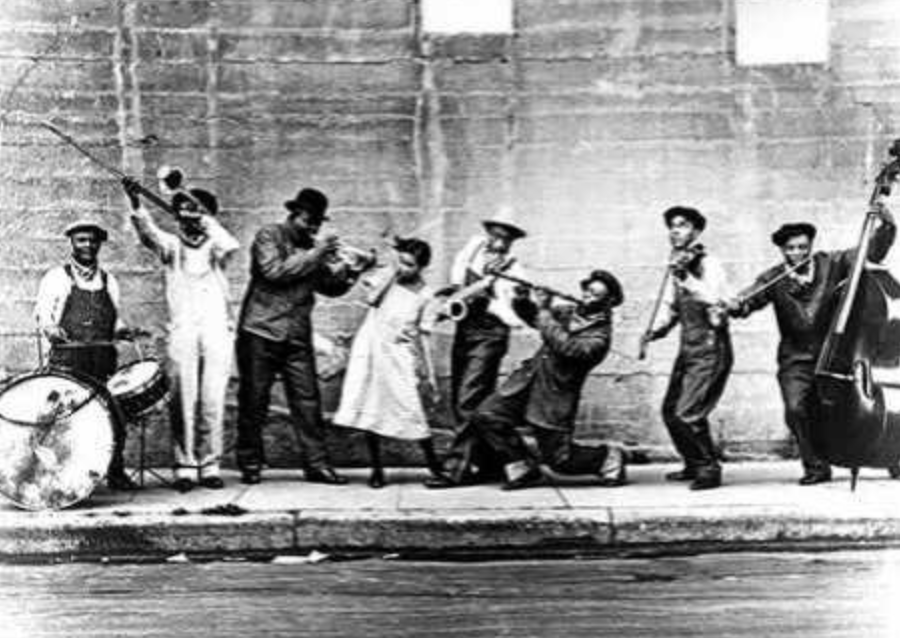
African‑American music, down through the centuries, has always been a product of a series of compromises and blendings between West African styles and West European forms. African polyrhythm, for example, is widely considered the most complex rhythm in the world: a singer, chorus, hand-clappers, bell players, and drummers typically produce seven to ten different rhythms at a time, in a way that makes sense to the musicians and their audience. 

  This African rhythmic universe is more complex than the “western” mind is accustomed to, and has therefore, by some logic, been called “primitive.” And yet, as musicologist Melville Herskovitz wrote in 1941, for a European 

to master a simple South African piece on the marimba which requires the player to follow a 4/4 beat in the left hand, and a 9/4 in the right—with a rhythmic consonance every 36 beats, is well-nigh impossible.[i]

Such “primitivism” has never really sold big here in its original form. It has been transformed into a number of musical practices including syncopation, or off-the beat emphasis, originally called “mistakes” by the Euro-American music authorities. The echoes of polyrhythmic musicality are heard in Afro-Latin rhythms and in the blues, jazz, and everything that came after. One particular rhythm from Ghana, for example, has been traced through the samba and ragtime to the Charleston.[ii]

  West African traditions place even stress on all beats, as opposed to only the “strong beats” (one and three, out of four). This approach was expressed by Africans in America not only as syncopation, but also as added stress on the formerly weak offbeat, which seems to shift the rhythm backwards while it’s moving forwards—hence the term “backbeat”—setting up a rocking motion in the music and the dancing. 

  The result is a blend of African rhythmic feeling with European musical forms. The backbeat is the Black beat: for the most obvious example, listen to an audience clapping to Country music,[1] then to audience response to any form of Black popular music. (It would be even simpler to listen to the clapping in White churches as opposed to Black ones, but we White folks don’t clap so much in our churches.) With the backbeat competing with the downbeat, it’s as if two different rhythms were coexisting—the closest you can come in 4/4 time to the West African concept. Robert Cantwell, in Bluegrass Breakdown, even supposes that 

[T]he strong backbeat which suggests sexual thrusting is only the grossest and most violent of the many subtler kinds of erotic interplay between musician and music occasioned by the musician’s independence of the fundamental rhythm.[iii]

[1] Country music is capitalized, while blues is not,
solely to distinguish this specific music
from the countryside in general.

Which, if true, could help explain the fear and loathing, along with the fascination, that White America has always felt for Black American culture. But I jump ahead. What are these subtler kinds of interplay, erotic or otherwise? A.M. Jones, in Studies in African Music, writes that in the West African musical tradition,

The melody being additive, and the claps being divisive, when put together they result in a combination of rhythms whose inherent stresses are crossed. This is the very essence of African music: this is what the African is after. He wants to enjoy the conflict of rhythms.[iv]

  This was manifestly un-European, but was not to remain un-American for long. If we think of music as being made up of units of time (the bar, with a duration of, for example, four beats), we can understand West African rhythmic sense as grouping the beats irregularly, while the underlying rhythm obtained from the Europeans’ musical forms would be regular, and quite simple. Here again we have the built-in conflict of rhythms. As John Work explains in American Negro Songs and Spirituals, in African-American music

…the rhythms may be divided roughly into two classes—rhythm based on the swinging of the head and body and rhythms based on the patting of hands and feet.[v]

Cantwell explains these two types of movement as

a reciprocal or back-and-forth motion and a continuous rolling, flowing, or driving—that is to say, “rock” and “roll,” whose interdependency reflects the conjunction of pulse and beat in the fundamental rhythm and is the heart of swing.[vi]

While a European musician will commonly play four beats in a measure while another player plays two, the concept of combining three and two confounded the western mind. Jones says of the Africans,

We have to grasp the fact that if from childhood you are brought up to regard beating 3 against 2 as being just as normal as beating in synchrony, then you develop a two-dimensional attitude to rhythm which we in the West do not share…To beat 3 against 2 is to them no different from beating on the first beat of each bar.[vii]

If you doubt the fundamental difference described here, consider the rhythmic complexity of Balkan music, and even more, Indian, and you will have the idea. Or consider the Afro-Brazilian tune set in 12-1/2 beats to the measure, or the African drummers who put an accent every 15 beats for some undoubtedly good reason.[viii]

  The African-Americans’ rhythmic alterations to European-derived forms resulted partly from the banning of the African drum by the English, and later by the slave states of the U.S.[2] The intricacies of drumming were displaced into clapping, stamping, and vocals, and later into the way Blacks handled European instruments.

[2] The drum was perceived to transmit information in a “foreign language” –
some African spoken languages, like Chinese, achieve part of their meaning
through tonal variations. Drumming also gathered slaves in larger numbers than
the masters would like. (Conway 1995, 72, 322)

  Another characteristic of West African music not shared by Europeans was an affinity for a variety of percussive textures; rasping and scraping sounds, for example, are considered musical in this tradition. In the diaspora, this led to the invention of countless percussion instruments, often modeled on African originals. These are to be heard in Brazil, home of more percussion than most of the rest of the world put together; in Caribbean-born salsa and other Afro-Latin genres; and in the vocal as well as instrumental styles of so many varieties of music from the U.S. This elevation of “non-refined” sounds to musical acceptance was and continues to be anathema to many who cultivate a more indoor sensibility. Some people think washboards are for washing. And some folks just can’t warm up to the banjo, often described as essentially a drum with strings.

  We should take into account here something usually not accounted for: the early closeness of European and African working people in America. Many Whites, and some Blacks, were brought across the ocean as indentured servants. They were able to earn their freedom, until the construction of the legal edifice of slavery, which came later. So in the first period, up till the late seventeenth century, there was a much more fluid and collegial relationship between folks from different continents. As one French scholar put it, “From 1620 to 1660 or so people of different shades worked shoulder to shoulder, lived and occasionally revolted in concert.”[ix]

  And undoubtedly sang in concert as well—work songs, at a minimum. Bear in mind that Europeans and Africans did not first meet in America. There was already cultural contact, sometimes directly, sometimes via Arab cultures, and much had been shared before crossing the Atlantic. Another writer informs us that in early Jamestown,

Negro and white servants seemed to be remarkably unconcerned about their visible differences. They toiled together in the fields, fraternized during leisure hours, and, in and out of wedlock, collaborated in siring numerous progeny.[x]   

      All this singing and siring was set to cease as the development of the North American colonies began to look like a profitable enterprise requiring a longer-term indenturing—to wit, slavery. Beginning in the 1660s, legal codes separated White and Black into those who could look forward to freedom and those who could not. This had partly to do with the relative inability of Blacks to run away and hide among the populace, and more to do with the growing trade in enslaved Africans. By 1700, Blacks had lost the right to read, to marry freely, to better their position. Racial harmony among the lower classes abated; indentured servants whitened.


[i]Herskovitz 1941, 20.
[ii]Schuller 1968, p 19-20.
[iii]Cantwell, 215.
[iv]A.M. Jones, 1959, vol 1, 21.  
[v]John Work, American Negro Songs and Spirituals, New York:Bonanza Books, 1940, quoted in Roberts, Black Music of Two Worlds, 164.
[vi]Cantwell, 99.
[vii]Jones, 46, 102.
[viii]Stearns, 270.
[ix]Denis-Constant Martin, 28-29.
[x]Kenneth M. Stampp, The Peculiar Institution, New York:Knopf 1956. Quoted in Rublowsky, 57.                         


In The Beginning…

People traveled from many countries and cultures to what would eventually become the United States. Some came from Europe, where they were persecuted and impoverished, and found themselves making America safe from the Americans—those people Columbus bumped into. Some came from western Africa, and were guaranteed full employment for themselves and their children’s children, as we know. The Africans brought with them a culture quite different from that of Europeans, though much of it was obliterated to ensure control on the plantation. Their languages, dress, and religion were suppressed, their families broken up, their drums prohibited. 

  The African culture went underground, took on disguises, metamorphosed, and resurfaced in an American version. West African music re-emerged as spirituals, “field hollers,” and other new forms that would change the face of music in North America and ultimately around the world. African music adapted to American life, assimilating influences from White America just as Whites, especially in the South, assimilated West African influences into their music. 

  It’s normal for neighbors to absorb something of each other’s culture. In the case of a land newly settled by various uprooted populations, there is exceptional cultural dislocation and mutation. Africans absorbed the widest array of influences of any group in America. Snatched from their homeland, their culture driven underground, they looked to their new surroundings for anything that would sustain them. This was true throughout the Americas; in North America and particularly in New Orleans they blended influences from French, Spanish, German and English colonizers, as well as Native Americans and, of course, Africa.[1]

1] Other overlapping sectors of American society have made
major contributions that have been forgotten, suppressed, or distorted;
one might mention women, workers, and gays, for starters.

  The suppression of African culture made Black innovation inevitable. In music, religion, and so many other areas, African-Americans were forced to invent themselves anew, molding a new culture by combining the remnants of their roots with whatever they found around them. This helps explain why in the succeeding centuries it has usually been African-Americans who jostle us all into each new style of music, among other things. It is because their culture in this country is founded on innovation for survival.[2] European settlers retained more of their cultural birthright, which was modified over time to reflect their new circumstances and influences, including different climates, residence patterns, political structures, and the presence of new neighbors, such as African-Americans.

[2]Parallel examples can be found in the other African colonies
throughout the hemisphere, though they take different forms because
the suppression of their culture was different in form and degree.

  African‑ and European‑Americans in the South interacted on a daily basis over three centuries; yet today we are basically unaware of the ways each culture influenced the other. It’s like trying to separate and identify the strands of the music at other cultural crossroads like the Balkans, Madagascar, or for that matter most of the western hemisphere, where European, African, and indigenous cultures collided and mixed in so many variations. Most people can hear the blues in rock and roll from the mid‑twentieth century, though I’m not so sure that remains true as we get further from those years. But what about, for example, the influence of slavery era field hollers on country music, via the hollers’ descendant, the blues? Who hears that? 

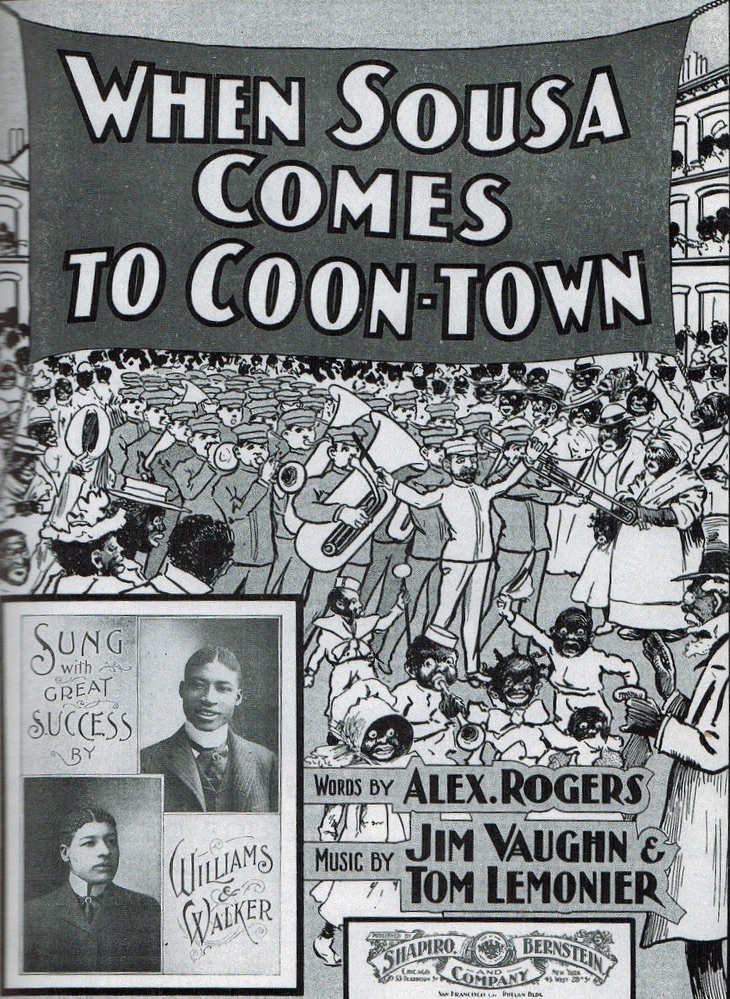
  Stephen Foster, John Philip Sousa and the White minstrels in blackface used the music of Blacks as their main source. Foster wrote about the Swannee River but never saw it. Michael Bolton, like the Righteous Brothers before him, while clearly white of skin tone, has some other color in his musical tone. But how “White” was the work of Bing Crosby, Hank Williams, or Judy Garland? How “Black” was the music of Louis Armstrong, Duke Ellington, Michael Jackson, or Prince? Did White America apprentice itself culturally to Black America?[i] Was the interaction between the cultures a musical theft, a commercial rip-off, a mutual borrowing, a sharing—or was it all of these and more? And what is it today?

  If at any point it begins to grate on the reader that I repeatedly point out the race of individuals mentioned, I can relate. But I would quote jazz historian Gunther Schuller who, in his book, The Swing Era, explained such writing as a

way of documenting what is in fact a reality—one which black musicians know only too well, for they live with it day in and day out—while the average American suppresses and ignores it…every manifestation of [Blacks’] creativity—from minstrel music (mid-19th century), ragtime (turn of the century), jazz (first half of the 20th century) to rock and roll (the 1950s through the 1980s)—has been taken from them and commercialized by whites.[ii]

NOTES

[i]Conway 1995, 85.
[ii]Schuller 1989, 200

Introduction: The Inaudible Beat

There’s an experiment I used to do when I was a high school teacher. I would ask one of my musically inclined charges whether she knew where rock and roll came from. I particularly liked one response I got, from a student who looked at me as if I were a side dish she hadn’t ordered. It came, she explained confidently if not patiently, from a juke box.[1]

[1] A loudspeaker apparatus in the corner of a
bar or malt shop, stocked with 45 rpm records.
Kind of like  a DJ without the DJ. Or kind of like Spotify.

Not long after that enlightening interchange, in pursuit of my night job as an alleged (never convicted) satirist/songster, I was hard at work on—or more likely idly toying with—a parody version of “Has Anybody Seen My Gal?” as a comment on our unfolding invasion of Panama. You guessed it, “Has Anybody Seen My Canal?” I hoped it would be at least minimally thought-provoking, as viral hadn’t been invented yet.

But a question had been eating at me about the sources of the songs I was in the habit of plundering for my own political purposes: where had they been plundered from in the first place?  I had already learned that many songs I picked up from 1960s rock bands had been picked up by them from 1930s blues singers. What about the rest of the songs I was personally heisting? I began to badger fellow musicians and music teachers who might help me with knowledge about such things. I started with one area that had been mystifying me: the relationship between Broadway musicals and jazz. A few responses:

Chocolate Dandies, Broadway show, 1924

“Jazz musicians play show tunes.” 
“Jazz musicians are classically trained.” 
“There isn’t any relationship.”
“There are a lot of things you could analyze, but doesn’t that take the fun out of things?” 

  These answers set me to thinking. As a musician who grew up on music from all over the world, I always thought of myself as both a musically and socially aware kind of guy, conscious of racial and cultural conflicts, sensitive to injustice. I knew about the blues origins of rock and roll; I knew there used to be some jazzy Broadway tunes, before Oklahoma! Now I was beginning to learn how much I didn’t know, and coming to realize that many other people didn’t know even more than I didn’t know. 

  And my questions, which had percolated for years, weren’t only about music: Why are so many White (and other) youths always imitating Black styles in speech, music, dress, etc.—as I myself had done and continue to do, without even noticing it? Why is last week’s slang out of date, and why do I have to go to an inner city high school to catch up? In this nation of “minorities,” what is the “mainstream” popular culture? Is there one? 

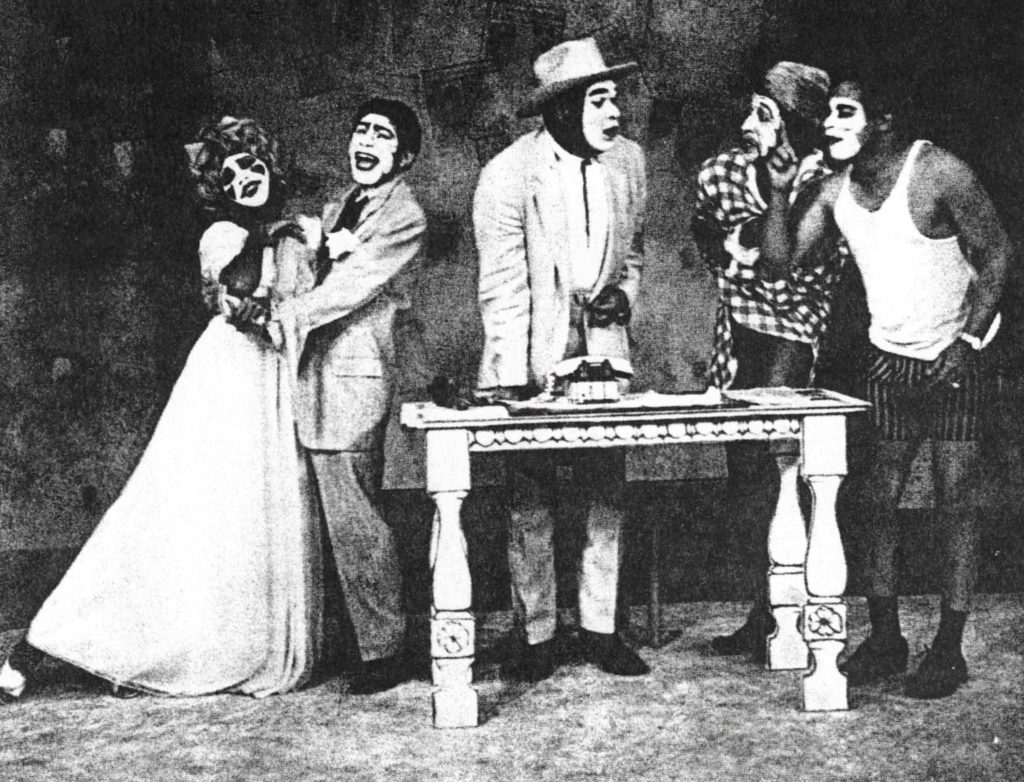
Black minstrels in whiteface

  When a barbershop quartet singer told me that barbershop quartets were originally a Black phenom, I had to sit down and catch my breath. Not because I felt any jealous attachment to my “White heritage,” but because even my most paranoid inner voices hadn’t prepared me for this level of historical befuddlement. Now I was forced to take another listen to some other “White” musical styles as well. I was beginning to hear things I hadn’t heard before, and was reminded of Ralph Ellison’s “Invisible Man,” unacknowledged by society. Was there an Inaudible Beat as well? 

  This is how I began to read between the musical lines to find some of the hidden relationships among the strands of American musical culture. When, where, how and why did they first weave together? Starting with an exploration of the roots of Broadway show tunes, I was led backwards into Vaudeville and further back to the horrid yet fascinating minstrel shows of the 1840s, then on to the African American barbershops of Florida in the 19th century, through Ragtime to New Orleans and various permutations of jazz, then to Swing and Rock ‘n’ Roll, and later back to the music of the Texas cattle trails of the 1870s. After this, I was tired. But I was also energized: I had found patterns of intercultural interaction that had been hiding in plain sight, but covered by layers of societal misconception and denial.

  They say that music tells you who you are. That sounds like something worth knowing; but it only tells us that if we know what to listen for. Maybe, I speculated, a closer look and listen could help sort out the truths hidden behind the tapestry of sound surrounding us. 

An Aid To Listening

  When one musical genre interacts with another, the product is a new variation, with changes from the previous, suddenly un-hip generation. The beat has evolved, either subtly or brazenly; the use of melody and harmony has morphed, the quality of the tone altered. There are changes in choice of instruments. And of course, hair styles.

  Much of this story has been told before, but here I try to knit together the persistent processes that recur through many generations of musical evolution. Along the way, I’ll suggest some sources you can use to flesh out my efforts at explaining these evolutionary steps. 

  I’ll also suggest an exercise for you, one you can do right there inside your mind. Because we carry inside our heads the sounds of various singers and instruments we’ve heard before, we can understand something of the relationships between musical cousins and nephews and nieces by substituting, in our mind’s ear, one for the other. If you want to hear the influence that swing jazz had on western swing, you could find a Bob Wills and His Texas Playboys song that features a clarinet playing along with the fiddles. But even without the record, you can play—once you’ve heard it twice—”Yellow Rose of Texas” in your mind and add in your own version of Benny Goodman playing along. To understand the relationship of rhythm and blues to rock and roll, you can listen to the early to mid-Rolling Stones and superimpose Muddy Waters’ voice over it. You can sing like Muddy inside your head, because nobody else can hear it. It’s safe.[2]

[2] To give the Stones their due, Buddy Guy asserted “the Rolling Stones only agreed to appear on the popular show Shindig! if [Howlin’] Wolf came on the show with them.” Patrick Doyle, “King Bee,” Rolling Stone 11-19-15 p. 47. Likewise, the Rascals, one of the only White bands popular with Black audiences, refused to perform without a Black band on the bill.

  Of course it’s easier to leave it to the experts, and I’ll try to steer you to some folks who pop up now and then with new/old syntheses of various roots-related sounds, sometimes mixed with the very post-post-modern styles of today’s clubs.

  Let us now begin this exploration somewhere near the start. But when do stories start? Depends who’s telling it, doesn’t it? Let’s have a look. 


Contents

FOREWORD

This book’s been a long time in the factory, and it shows: some of my references that were once timely, if not quite hip, are now old and moldy. But then, they’re history, so they’re saved here, for better and worse. 

I started the project in 1993, searched out a lot of people and sources, and here we are. I’ve decided to publish it here, on line, with mixed media inserted, so as to make it easier to comprehend what the hell I might even be talking about. Speaking of comprehending, whenever musical jargon pops up, I try to explain it. But not everything here can be understood by everyone, including me. Some people will understand it better than I wrote it. So be it. If your eyes glaze, move on, or ask someone for a better explanation, and then send it to me.

A NOTE ABOUT NOTES

There are two types of notes here: footnotes and endnotes. The footnotes have been set right after the paragraph where the reference occurs. That makes them elbow notes, I guess. The endnotes appear at the end – of each chapter. The first set is substantive, or at least (allegedly) informative. The second set records the sources, for the scholars among us.

A NOTE ABOUT BLACK AND WHITE

In most cases I capitalize both Black and White, out of respect for all cultures and peoples and because that is now the accepted practice, except for AP Style, which will catch up.

In quotations, I have left in place the lower-case when it occurs, just as I have left in the n-words, along with photos and videos of blackface: it seems important to look our history in the eye.

A NOTE ABOUT VIDEOS

When you click on a video to play it, a banner ad is likely to pop up. Pop it smack in the “x” to close it. Unless you need to be told what you need to buy.

A NOTE ABOUT YOU

If you find something wrong or questionable herein, or just want to converse about it, feel free to contact me at david3 at lippnet dot us . I’m able to make changes as long as the tome sits here, so fire away.

Thanks so very much to: Jerry Parsons at the Library of Congress for interest and helpful direction, Judith Gold for research assistance; Peter Sokolow for a virtuosic interview about Broadway and jazz;  Peter Lippman for enthusiastic and combative editing; Dom Flemons for cowboy lessons, Robert Cantrell and Eric Lott for guidance on minstrelsy, and Glenn Hinson for steering me to the importance of Gospel music. And for essential feedback: Richard Wolinsky, Cecilia Conway, George Lipsitz, Robin D.G. Kelley, Archie Green, David Roediger, Ted Vincent, Eric Lott, and Ken Bilby. And for invaluable digi-tech facilitation, Margarete Koenen.

COMMENTARIES

Bleaching Our Roots: Race and Culture in American Popular Music is a fascinating multi-media read with important film clips of performers who represent the history. Bleaching Our Roots is a welcome addition to the history of American popular music that will an important resource for courses on American music.
—William Ferris, author, film-maker, founder and director of the Center for Southern Folklore in Mississippi and Chair of the National Endowment for the Humanities; co-editor of the Encyclopedia of Southern Culture.

It kicks off with a bang. The information is really strong, really useful. I appreciated the  dedication to covering the connections with the Latin heritage, and the Swing era. I really liked the interactivity of the substitutions. Thorough research. 
Michelle Shocked

Really like the spirit, openness, language. All to the good. All direct.   
-Charles Keil, author, Music Grooves, Urban Blues

Engagingly written. I learned lots. Some listeners to US popular music know of its tragic long roots in the appropriation of Black songs by white performers in blackface disguise. More know something of the African American roots of rock and roll. But few will be prepared for the contributions of this ambitious and remarkable study, which considers the mixing of cultures, and the role of Black creativity, in everything from bluegrass to barbershop quartets, from crooning to country, from Elvis to Doris Day.”
   —David Roediger, author, How Race Survived Us History

An extremely successful, popularly written, prodigiously researched, very smart and very funny work of music, cultural, and social criticism.  I learned a great deal from it.  Equally sensitive to the intricacies of racial-cultural interaction and the exploitative racial results of American music’s commercial marketing…it is rare to find both of these stressed (as both must be) in a single work. The tenacity of investigation of America’s “mulatto” music (as critic Albert Murray calls American culture generally) is heartening, and it leads to fresh insights (country-inflected Black singers and Black-inflected country singers, say) and fresh areas.  To my ears you don’t miss a beat in recounting the complexities of stylistic formation in a whole variety of musics, nor do you muffle at all the at once mind-bogglingly intermingled and socially segregated strains of American song. This, along with the work’s accessibility, is a real achievement, and ought to help find it the audience it deserves.  A meticulous, morally astringent, and compelling narrative. 
— Eric Lott, author, Love and Theft: Blackface Minstrelsy and the   American Working Class